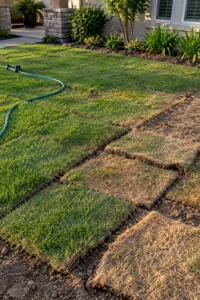
How to keep mulch from washing away depends on slowing runoff, choosing interlocking or heavy material, and containing the bed with edging or a contour trench. Apply organic mulch 2-3 inches deep, keep it away from trunks, and use netting, stone, terraces, or rooted plants when the slope or water volume exceeds mulch’s limits.
Key Facts and Quick Answer
- Shredded hardwood and pine straw resist movement because their fibers interlock into a rough surface.
- Apply most organic mulch 2-3 inches deep after loosening compacted soil and correcting concentrated water flow.
- A 3:1 slope, approximately 18 degrees, is a practical upper limit for relying on ordinary loose organic mulch alone.
- A 3-4-inch contour trench and edging positioned about 2 inches above the mulch can catch displaced material.
- River rock does not float, but it can migrate downslope, heat soil, complicate weeding, and create drainage hazards.
- Heavy rain cannot be solved by mulch alone when runoff comes from a roof, downspout, driveway, or compacted upper slope.
Why Does Mulch Wash Away?
Mulch washes away when moving water generates enough shear force to overcome the friction, interlocking texture, and weight holding the material against the soil. Wind, gravity, saturated soil, and concentrated runoff increase that force, while shredded fibers, rough terrain, roots, and retaining edges reduce movement.
Rainfall itself is often only part of the problem. A garden bed may receive water from a roof downspout, an impermeable patio, a sloped lawn, or a driveway. A narrow flow path can carry mulch much farther than evenly distributed rainfall across the same area.
Mulch protects soil by intercepting raindrops, reducing splash erosion, and slowing surface water. It cannot absorb an unlimited volume of water. Once the soil beneath becomes saturated, water moves across the surface and can float light chips, push pine straw into piles, or carve channels through the bed.
| Cause of movement | Typical field sign | Best first correction |
|---|---|---|
| Sheet runoff | Thin mulch layer reaches the lower edge | Add a low edge and spread flow across the contour |
| Concentrated flow | Bare channel or fan-shaped deposit | Redirect the source before replacing mulch |
| Wind | Dry fibers collect beside fences or pavement | Use heavier mulch or a temporary fiber mat |
| Compacted soil | Water beads and runs instead of soaking in | Loosen the surface and improve infiltration |
| Steep slope | Repeated loss after moderate storms | Terrace, use erosion netting, or establish rooted plants |
Expert insight: Replacing washed mulch without tracing the water source usually produces the same failure after the next storm. The pattern of displaced material is diagnostic: a broad thin trail suggests sheet flow, while a narrow deep trail points to concentrated drainage.
What Mulch Stays Put Best?
The most stable loose organic mulches are shredded hardwood and pine straw because long, irregular fibers overlap and resist sliding. Dense cedar, cypress, and coarse bark perform reasonably well, while smooth nuggets and lightweight chips move more easily because they have fewer contact points and can float.
No material is ideal in every bed. Rock resists floating but transfers heat and may roll on a steep grade. Pine straw is effective on slopes but decomposes faster than wood. A choice should match water volume, slope, plants, access, and the required maintenance interval.
- Shredded hardwood: Good general choice for moderate slopes and mixed ornamental beds.
- Pine straw: Useful where a fibrous mat is desirable, especially around acid-tolerant plants.
- Coarse bark: Durable and attractive, but large pieces can roll when water becomes concentrated.
- Cedar or cypress: Dense wood that resists floating better than very light chips.
- River rock or crushed stone: Permanent against buoyancy, but not immune to downhill rolling.
- Straw or coir erosion blankets: Temporary surface protection for seeded banks and exposed soil.
- Living ground covers: Long-term stabilization through roots, once plants become established.
| Mulch type | Movement resistance | Typical life | Typical material cost | Main limitation |
|---|---|---|---|---|
| Shredded hardwood | High on moderate slopes | 1-2 years | $30-$50 per cubic yard | Decomposes and needs replenishment |
| Pine straw | High after settling | About 1 year | $5-$12 per bale | Fades and breaks down relatively quickly |
| Coarse wood chips | Medium to low | 2-3 years | $25-$60 per cubic yard | Floats when water is concentrated |
| River rock or gravel | Very high against floating | 10+ years | $50-$120 per cubic yard | Rolls, heats soil, and complicates planting |
| Straw or coir mat | High when pinned | 6-24 months | $0.50-$2.50 per square foot | Requires anchors and eventual replacement |
| Rooted ground cover | Increasingly high | Long-term | $4-$20 per plant | Needs 1-2 growing seasons to fill |
The listed prices are typical United States retail or bulk ranges, not universal quotes. Delivery, regional material supply, rock size, and installation can change the total substantially.
Are Wood Chips or Nuggets Good on a Slope?
Wood chips and rounded nuggets are poor choices where water can become concentrated because smooth pieces have limited interlocking contact. Chips can work on a nearly level bed with a defined border, but shredded fibers are safer on a grade.
Small rounded nuggets behave like floating objects during intense rain. They may remain in place through several ordinary showers and then disappear during one storm that saturates the bed. Coarse chips also bridge over voids, allowing water to pass beneath and lift them from the soil.
How Deep Should Mulch Be?
Most landscape beds need 2-3 inches of settled organic mulch, measured after spreading rather than immediately after unloading. Depth below 2 inches exposes soil and provides little splash protection; depth above 3-4 inches can reduce oxygen exchange, retain excessive moisture, and bury shallow plant crowns.
Depth does not compensate for bad drainage. A 6-inch layer may still wash away if a downspout discharges above the bed. Extra thickness also increases the amount of material available to move, making the lower edge harder to maintain.
Use these application rules:
- Remove weeds and large debris without burying living stems.
- Loosen the upper 2-4 inches of compacted soil where plant roots allow it.
- Correct downspouts, rills, and concentrated drainage before adding mulch.
- Spread 2-3 inches across the bed, allowing slight extra depth where settling is expected.
- Keep mulch 3-6 inches away from tree trunks and woody shrub stems.
- Leave plant crowns and ground-cover foliage uncovered.
- Water lightly after installation if the mulch is dry and wind-prone.
- Recheck the bed after the first substantial rainfall.
Around trees, mulch should form a broad, shallow ring rather than a cone. The International Society of Arboriculture and university extension guidance commonly warn against “volcano” mulch because constant moisture against bark encourages decay, pests, and abnormal root growth.
How Can Edging and Trenches Stop Mulch Loss?
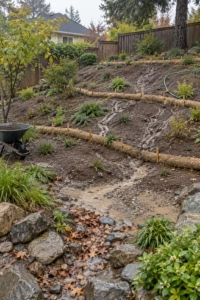
Edging and contour trenches stop mulch by interrupting downhill travel at the bed boundary. A 3-4-inch V-shaped trench along the lower perimeter catches loose fibers, while stone, brick, timber, or durable plastic edging provides a visible retaining lip about 2 inches above the settled mulch surface.
The barrier must follow the contour rather than point directly downhill. A straight channel aimed down a slope concentrates water and can turn the edge into an erosion chute. Shape the lower boundary as a broad, level or gently curved line that spreads overflow.
Building a Contour Trench
Mark the lowest edge of the bed and excavate a shallow V or rounded trench 3-4 inches deep. Place excavated soil on the uphill side only if it remains stable, then compact the trench sides lightly and fill the bed above it with mulch.
Do not block a natural drainage route without providing a safe outlet. During a storm, inspect whether water pools behind the edge. If it does, reduce the barrier height, add a level spreader, or redirect water to a stable vegetated or rocked area.
Choosing an Edge Material
| Edge option | Exposed height | Typical installed cost | Suitable use |
|---|---|---|---|
| Steel or heavy-duty plastic | 1-2 inches | $2-$8 per linear foot | Curved beds and light runoff |
| Brick or paver | 2-4 inches | $5-$20 per linear foot | Formal beds and moderate flow |
| Natural stone | 3-8 inches | $10-$35 per linear foot | Visible retaining boundary |
| Timber landscape edging | 3-6 inches | $6-$18 per linear foot | Straight beds with stable soil |
| Coir log or straw wattles | 4-12 inches | $3-$12 per linear foot | Temporary slope and drainage control |
Costs are typical United States project ranges and exclude unusual excavation, hauling, and drainage construction. A barrier is not a substitute for a failed retaining wall. If soil, stones, or edge material are visibly sliding, obtain local drainage or structural advice before rebuilding the bed.
What Should You Do on a Steep Slope?
Steep slopes need a system that anchors soil and divides water, not loose mulch alone. For grades steeper than about 3:1, use pinned jute or coir netting, straw blankets, contour wattles, terraces, rock designed for the site, or deep-rooted native plants.
Slope ratio describes horizontal run compared with vertical rise. A 3:1 grade rises 1 foot over 3 horizontal feet and equals approximately 18 degrees. A 2:1 slope is steeper, while a 4:1 slope is gentler.
| Slope condition | Recommended treatment | Establishment or installation period |
|---|---|---|
| Nearly level to 5:1 | Shredded mulch plus edging | 2-4 hours per 500 square feet |
| 5:1 to 3:1 | Fibrous mulch, contour edge, drainage correction | Inspect after each major storm |
| 3:1 to 2:1 | Coir or jute blanket, pins, and rooted plants | 1-2 growing seasons for plant cover |
| Steeper than 2:1 | Terraces, engineered stabilization, or specialist design | Project-specific |
| Channelized runoff | Drainage correction before mulching | Usually one installation project |
Place erosion blankets directly against prepared soil, overlap adjoining sections according to the manufacturer’s instructions, and pin the upper edge, lower edge, and seams. Loose mulch can cover the blanket, but it should not replace the pins.
Native grasses, sedges, creeping ground covers, and shrubs stabilize soil through roots after establishment. Select species for local rainfall, sun, soil drainage, and winter temperatures. Pachysandra, creeping thyme, and similar plants are not universal solutions: some spread poorly in shade, drought, clay, or intense foot traffic.
When Should You Use Rock Instead of Organic Mulch?
Rock is preferable where floating material repeatedly leaves the bed, where long-term coverage matters, or where irrigation and rainfall would quickly decompose organic material. Rock is a poor choice beside heat-sensitive plants, on unstable steep grades, or where future planting and weeding will be frequent.
Choose angular crushed stone when interlocking is more important than appearance. Rounded river rock rolls more readily, especially on slopes. Use landscape fabric only when it matches the planting plan, because fabric can complicate future planting, collect soil on top, and allow weeds to root in deposited sediment.
Rock does not stop all erosion. Water can move fine soil between stones, undercut the lower edge, or carry individual stones downslope. A rock bed still needs a stable base, defined boundary, and safe discharge path.
Can a Liquid Mulch Binder Help?
A liquid mulch binder can knit the upper mulch layer together and reduce wind and light surface movement, but it cannot stop concentrated runoff or stabilize a failing slope. Polymer tackifiers are most useful on moderate grades, newly seeded areas, and beds where the mulch is already correctly placed.
Follow the product label for dilution, coverage, plant safety, and weather limits. Typical concentrate pricing is $25-$40 per gallon, with roughly 500-1,000 square feet of coverage depending on the product and application rate. Many products need 24-48 hours without substantial rain to cure.
Apply only after correcting drainage and removing loose debris. Spray evenly across the surface without creating a hard, impermeable crust. Avoid ponds, streams, storm drains, edible crops, and open soil unless the label specifically permits those uses.
Expert insight: Tackifier is a surface treatment, not an erosion-control structure. When a binder fails, the usual cause is water moving beneath the mulch layer, excessive application before rain, or a runoff source larger than the bed can safely disperse.
What Is the Best Installation Sequence?
The most reliable installation sequence diagnoses water first, improves infiltration second, contains the bed third, and adds mulch last. Installing material before those steps often hides the problem temporarily while increasing cleanup after the next storm.
- Trace the water source. Watch the bed during rain or use a hose carefully. Check roofs, downspouts, pavement, sprinklers, and upper slopes.
- Separate sheet flow from channel flow. Sheet flow spreads broadly; channel flow follows a narrow path and needs diversion or energy reduction.
- Remove unstable mulch. Rake usable material uphill and remove sediment, trash, and clogged drainage paths.
- Loosen compacted soil. Improve infiltration where roots and utilities permit, but do not damage established tree roots.
- Install the boundary. Add a contour trench, edging, stones, wattles, or another suitable retaining feature.
- Stabilize steep sections. Pin netting or blankets before adding surface mulch.
- Spread the correct material. Apply 2-3 inches of settled mulch and maintain trunk clearance.
- Test drainage. Use a controlled hose flow and confirm that water spreads without ponding or cutting channels.
- Inspect after rain. Reposition displaced fibers, clear outlets, and repair small failures before they enlarge.
For a 500-square-foot bed, spreading and edging typically requires 2-4 hours for one experienced person, excluding drainage construction. At 3 inches deep, the bed needs approximately 4.6 cubic yards of loose volume before settling and compaction, so measure carefully and confirm supplier delivery quantities.
How Much Does a Wash-Resistant Mulch Fix Cost?
A basic DIY repair often costs $75-$300 for mulch, hand tools, pins, and modest edging. Drainage work, stone delivery, terraces, or professional labor can raise the project cost to several hundred or several thousand dollars.
| Project component | Typical quantity or rate | Typical cost |
|---|---|---|
| Organic mulch | 2-3 inches deep | $30-$50 per cubic yard |
| Bagged organic mulch | 2-cubic-foot bag | $3-$7 per bag |
| River rock or gravel | Bulk material | $50-$120 per cubic yard |
| Liquid tackifier | 500-1,000 square feet per gallon | $25-$40 per gallon |
| Coir or jute blanket | 500-1,000 square feet | $250-$2,500 |
| Basic landscape edging | Per linear foot | $2-$20 |
These are planning ranges, not bids. Delivery often costs more than the material for small jobs. If a downspout, driveway, or neighboring property supplies the water, budget for drainage correction rather than repeatedly buying replacement mulch.
Common Failure Modes and Corrections
Mulch Is Piled Against a Tree
A mulch volcano keeps bark damp and can create adventitious roots near the trunk. Pull mulch back until the trunk flare is visible, then maintain a 3-6-inch clear ring.
The Bed Has No Lower Boundary
Mulch placed flush with a lawn or sidewalk has no stopping point. Add a shallow contour trench or low edge, while keeping an outlet for excess water.
The Soil Is Hard-Packed
Compacted soil sheds water and sends runoff across the mulch. Aerate or loosen accessible soil, add organic matter where appropriate, and avoid working wet clay because it can smear into a less permeable layer.
The Downspout Ends Above the Bed
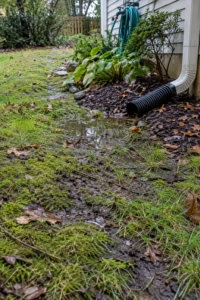
A downspout can deliver far more water than normal rainfall over the same footprint. Extend it to a stable discharge area, install an approved rain garden or infiltration feature, or use a properly designed drainage system.
Too Much Mulch Is Applied
Deep mulch can remain wet, smell sour, and bury plant crowns. Remove excess gradually, restore a 2-3-inch layer, and keep woody stems exposed.
The Lower Edge Becomes a Dam
An edge that traps water without an outlet can increase erosion behind the barrier. Create a level overflow route protected with vegetation, angular stone, or an engineered drainage feature.
How Do You Repair Mulch After a Storm?
Repair storm damage after the soil surface has dried enough to work without smearing, but before exposed soil develops rills or weeds. Rake displaced mulch uphill, fill small channels with stable soil, redirect the water source, and replace only the lost amount.
Do not bury storm-deposited sediment blindly. Sediment may cover plant crowns, contain lawn herbicide residues, or block drains. Remove contaminated or sharply contrasting material, and inspect nearby paths and storm grates for clogged outlets.
If the storm exposed roots, undermined edging, or created channels deeper than several inches, treat the event as an erosion problem. Mulch replacement alone will not restore grade or protect the next storm.
Frequently Asked Questions About How to Keep Mulch From Washing Away
Will landscape fabric keep mulch from washing away?
Landscape fabric may reduce soil mixing beneath mulch, but it does not reliably anchor loose material during concentrated runoff. A contour edge, drainage correction, erosion blanket, or rooted planting usually addresses movement more directly. Fabric can also make future planting and weed removal more difficult.
Should mulch be wet before a storm?
Moist mulch usually settles and interlocks better than extremely dry, loose fibers, but watering cannot overcome a drainage problem. Lightly wetting a new layer may reduce wind movement; do not saturate the bed before heavy rain or create runoff with a hose.
How do I stop mulch from washing onto a sidewalk?
Install a low, continuous edge along the sidewalk and shape the bed so water flows parallel to the boundary rather than directly toward it. A 3-4-inch contour trench behind the edge can catch fibers, while a stable overflow route prevents water from pooling against pavement.
Is pine straw better than bark mulch for erosion?
Pine straw often performs well on moderate slopes because long needles knit into a fibrous mat. Shredded hardwood bark can provide comparable or greater resistance where heavier organic material is preferred. Local availability, decomposition rate, soil acidity, and wind exposure should determine the final choice.
Can I use straw to hold mulch in place?
Straw can provide temporary surface protection, especially when combined with biodegradable netting and pins on newly seeded slopes. Loose straw alone is vulnerable to wind and water, and hay may contain weed seeds. Use certified erosion-control straw or coir products when vegetation establishment matters.
When should I call a drainage professional?
Call a qualified drainage or landscape professional when water comes from a neighboring property, undermines a foundation or retaining wall, crosses a driveway, creates deep channels, or repeatedly defeats ordinary grading and edging. Structural slopes and buried drainage systems require site-specific design, permits, and utility checks.
Conclusion
To keep mulch from washing away, correct the water source, loosen compacted soil, use interlocking material, maintain a 2-3-inch layer, and install a contour edge or trench. Shredded hardwood and pine straw suit moderate slopes; netting, rock, terraces, or rooted plants suit stronger runoff. Mulch is a soil cover, not a replacement for drainage control.