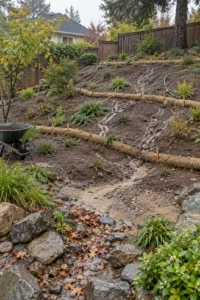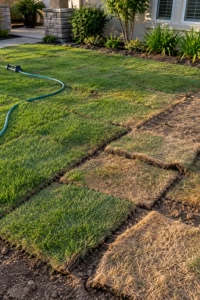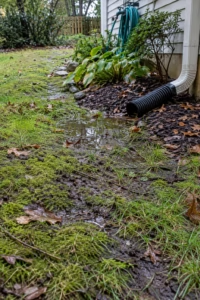
A soggy lawn that never dries out is a drainage failure in which water enters the soil faster than it can infiltrate, evaporate, or leave the property. The reliable fix is to identify whether runoff, compaction, a perched water table, or groundwater is responsible, then match grading, drainage, soil improvement, or planting to that cause.
Key Facts / Quick Answer
A lawn that remains wet during dry weather usually has a high water table, perched water, or a compacted subsurface layer.
A 1%-2% grade equals a fall of 30-60 cm over 30 m and allows surface water to move by gravity.
Core aeration helps compacted topsoil, but it cannot correct groundwater or an impermeable clay layer.
A French drain commonly costs about $85-$250 per linear metre installed, depending on access and discharge complexity.
Never send collected water toward a neighbour’s property, building foundation, septic field, or public road without checking local rules.
The most dependable systems combine downspout control, a lawful outlet, and soil or planting changes suited to the site.
Why Does a Lawn Stay Wet After the Rain Stops?
A lawn stays wet when its water inputs exceed its drainage capacity. Rainfall may be the visible input, but roof runoff, uphill properties, leaking irrigation, seasonal groundwater, and underground compacted layers often determine how long the surface remains saturated.
Healthy soil contains both water-filled and air-filled pores. When water occupies nearly all pore space, oxygen movement slows, roots lose access to air, and turf becomes thin, yellow, shallow-rooted, or vulnerable to fungal disease. Foot traffic then presses wet soil into a denser layer, making the next puddle last longer.
In practice, the duration matters more than the size of one puddle. A shallow pool after a cloudburst can be normal if it disappears within 24 hours. Persistent wetness for several days, or wet soil during a dry week, requires a profile investigation rather than more fertilizer or seed.
What Is a Perched Water Table?
A perched water table is a temporary saturated layer above a dense barrier such as clay, compacted fill, hardpan, or shallow bedrock. Water moves through loose topsoil, reaches that barrier, and spreads sideways near the root zone instead of continuing downward.
Dig a test hole about 30 cm deep beside, rather than in, the worst turf. A sharp change from crumbly soil to grey, dense, smeared material indicates a possible restrictive layer. Rust-coloured streaks, grey soil, and a rotten smell also suggest prolonged saturation.
A high regional water table behaves differently. If the hole refills from below during rain-free weather, a shallow French drain may only move groundwater from one place to another. The system needs a lower legal outlet, a designed sump, or a landscape conversion that tolerates wet conditions.
How Can You Diagnose the Water Source?
The fastest diagnosis compares wetness timing, elevation, soil layers, and inflow routes. Do not choose a drain from the puddle alone because two lawns with identical surface symptoms may need opposite solutions.
Use this sequence before excavating:
- Map the wet area. Mark puddle boundaries after rain and again 24 hours later. Note whether the water follows a slope, property line, foundation, or downspout.
- Check elevations. A builder’s level, laser level, or long straightedge with a spirit level can reveal whether water has an outlet.
- Inspect roof drainage. Disconnect one downspout temporarily and observe whether the lawn improves after the next storm. Never leave the downspout discharging beside the foundation.
- Dig profile holes. Inspect soil at 15 cm, 30 cm, and 60 cm. Record texture, roots, gravel, bedrock, compaction, and water depth.
- Run an infiltration test. Dig a 30 cm hole, saturate it once, refill it, and measure the drop during the second test. Less than about 2.5 cm per hour indicates slow infiltration, although a high water table can produce the same result.
- Test irrigation. A leaking valve, broken underground line, or poorly timed sprinkler can maintain wetness without obvious surface flow.
- Check local constraints. Contact the relevant utility-locating service before digging and ask the municipality about stormwater, grading, discharge, and permit requirements.
Diagnostic Clues and Likely Causes
| Observation | Likely mechanism | First check | Typical remedy |
|---|---|---|---|
| Puddle forms beside a downspout | Concentrated roof runoff | Downspout outlet | Solid pipe to lawful outlet |
| Wet strip crosses the yard downhill | Surface runoff | Elevation survey | Swale or regrading |
| Wetness remains in dry weather | Groundwater or perched water | Profile hole | French drain, pump, or wet planting |
| Water appears after foot traffic | Compacted topsoil | Soil compaction test | Core aeration and controlled access |
| Hole fills from below | High water table | Rain-free observation | Engineered discharge or rain garden |
| Water stops at a uniform depth | Hardpan or clay lens | Soil-profile inspection | Interceptor drain or soil reconstruction |
Expert insight: A puddle is often the endpoint, not the source. Trace water uphill to roofs, driveways, neighbouring grades, and retaining walls before disturbing the lawn.
Which Drainage Method Fits the Problem?
The correct drainage method depends on where water travels and whether the property has a safe place to release it. Surface systems address water above ground; subsurface systems intercept water below ground; soil treatments address restricted pores near the surface.
- Surface swales: shallow graded channels for sheet runoff.
- Catch basins: grated inlets that collect concentrated surface flow.
- French drains: perforated pipes that intercept subsurface water.
- Solid drain lines: sealed pipes that transport water without leaking into soil.
- Core aeration: temporary openings through compacted turf soil.
- Rain gardens: planted basins that store and infiltrate runoff.
- Dry wells: underground storage structures that release water into suitable subsoil.
- Wet-area planting: a landscape alternative where drainage is impractical or undesirable.
When Is a French Drain Appropriate?
A French drain is appropriate when water moves through or along the soil and a lower outlet is available. The typical installation uses a perforated pipe in a gravel trench, with washed aggregate and geotextile separation to reduce sediment entry.
For residential lawn drainage, a trench commonly sits 30-60 cm deep, although the required depth depends on utilities, roots, soil, frost, and the target water layer. The pipe needs continuous fall toward its outlet. A typical design uses about 1%-2% grade where the site permits, but the designer must maintain that fall across every change in elevation.
Use perforated pipe only where collection is needed. Use solid pipe from a catch basin or downspout to the discharge point. Mixing the two without a plan can release water in the wrong location or prevent the system from collecting efficiently.
A French drain cannot create an outlet where none exists. It also performs poorly when the trench is lower than a permanently high water table and has nowhere to discharge.
When Should You Build a Swale or Catch Basin?
A swale is usually the least disruptive solution for runoff that flows across the lawn during storms. A shallow channel with stable turf, rock, or erosion-control vegetation moves water toward a lower approved point without burying a pipe across the entire yard.
A catch basin fits a defined low spot or a concentrated flow path. The grated box connects to solid pipe and should remain accessible for cleaning. Place the inlet where water naturally gathers, not where a slight reshaping of the grade could eliminate the low point more cheaply.
A swale needs stable side slopes and an outlet that will not erode. Avoid creating a steep trench that becomes a hazard, traps leaves, or carries sediment into a storm drain.
Can Aeration and Soil Amendments Solve It?
Core aeration can solve mild surface compaction when the underlying soil drains adequately. A hollow-tine machine removes plugs, allowing air, water, and roots to enter the upper soil temporarily; repeated traffic can close the holes again within one growing season.
Aerate only when the turf is moist enough for penetration but not wet enough to smear. In cool-season grass, early autumn is often suitable; warm-season turf generally responds during active summer growth. Local grass species and soil conditions determine the exact timing.
Topdressing with a thin layer of mature compost can improve biological activity and aggregation. Do not bury clay under a deep layer of sand. Fine clay mixed with insufficient coarse material can form a dense cement-like layer, while excessive compost can hold additional water.
Expert insight: Aeration is a root-zone treatment, not a groundwater treatment. If a profile hole contains standing water below the aeration depth, repeated machine passes will not dry the lawn.
Are Rain Gardens or Dry Wells Better Without an Outlet?
Rain gardens and dry wells suit properties that can store water and infiltrate it safely without sending flow downslope. A rain garden is visible, planted, and easier to inspect; a dry well preserves lawn area but depends heavily on soil permeability and maintenance.
Keep infiltration systems away from foundations, septic systems, wells, and unstable slopes. Exact separation distances vary by jurisdiction and soil type, so local stormwater guidance takes precedence. A dry well in saturated clay has little useful storage because the surrounding soil cannot accept water.
Every basin needs overflow planning. A rain garden that fills beyond its design depth should direct excess water toward a safe route, not toward a basement or neighbouring lot.
What Does Each Solution Cost and How Long Does It Take?
Typical residential drainage costs vary with excavation access, soil, imported stone, restoration, permits, and outlet construction. The figures below are planning ranges rather than quotations.
| Solution | Typical cost | Installation time | Best use |
|---|---|---|---|
| Core aeration | $75-$250 per visit | 1-3 hours | Surface compaction |
| Compost topdressing | $0.50-$2.50 per square foot | 1-2 days | Root-zone improvement |
| Turf swale | $1,000-$5,000 | 1-3 days | Sheet runoff |
| Catch basin and solid pipe | $800-$3,500 | 1-2 days | Concentrated pooling |
| French drain | $85-$250 per linear metre installed | 1-3 days | Subsurface water |
| Dry well | $1,000-$4,000 | 1-2 days | Temporary storage |
| Rain garden | $1,500-$6,000 | 2-5 days | Runoff with planting |
DIY material costs for a simple French drain may fall near $15-$35 per linear metre, excluding equipment rental, soil disposal, turf replacement, and difficult excavation. A professionally installed system commonly costs $85-$250 per linear metre because labour, access, stone, restoration, and discharge work dominate the budget.
A properly designed and maintained French drain may function for 20-30 years. Its actual life depends on sediment, root intrusion, pipe deformation, fabric selection, inspection access, and whether the outlet remains open.
French Drain, Swale, or Aeration?
| Criterion | French drain | Swale | Aeration |
|---|---|---|---|
| Water location | Below surface | Above surface | Upper 5-15 cm |
| Typical disruption | High | Moderate | Low |
| Needs a fall or outlet | Yes | Yes | No |
| Handles groundwater | Sometimes | No | No |
| Handles roof runoff | Only with connected solid pipe | Yes | No |
| Expected effect | Days to weeks after installation | Immediate during storms | Temporary improvement |
| Main failure | Clogged trench or blocked outlet | Erosion or poor grade | Recompaction |
Select a French drain when a subsurface layer is the problem. Select a swale when visible runoff crosses the property. Select aeration when the soil is compacted but not saturated from below.
How Do You Install a Basic Drainage System?
A durable installation begins with the outlet, not the trench. Confirm where water will terminate before calculating alignment, depth, stone volume, or equipment needs.
- Confirm the discharge point. Use a public storm connection, drainage ditch, approved outlet, or on-site infiltration area allowed by local rules.
- Call for utility locating. Mark electricity, gas, communications, water, and irrigation lines before digging.
- Measure the grade. Verify that the proposed trench falls continuously toward the outlet.
- Separate collection from transport. Install perforated pipe in the wet zone and solid pipe after the collection point.
- Excavate to design depth and width. Remove unstable soil and keep trench walls safe; deep excavation may require professional shoring.
- Install non-woven geotextile. Wrap the trench or use a manufacturer-approved configuration that prevents surrounding soil from entering the stone.
- Place clean aggregate. Washed 2 cm stone or similarly specified drainage aggregate leaves voids for water movement. Fine, dirty gravel clogs faster.
- Set the perforated pipe. Keep the perforations and pipe orientation consistent with the product design, then verify grade before covering.
- Complete the outlet. Protect the discharge from erosion and install an accessible cleanout where practical.
- Restore and observe. Replace soil and turf, then inspect the system during several storms rather than judging it after one rainfall.
Rigid PVC Schedule 40 offers strong crush resistance, but properly specified flexible pipe can work in low-load areas when installed to manufacturer instructions. The pipe label alone does not determine performance; trench support, aggregate cleanliness, fabric, grade, and maintenance matter more.
What Mistakes Make a Wet Lawn Worse?
The most damaging errors are hidden slope defects, unplanned discharge, and treating symptoms without locating the water source. A drain can move water efficiently and still create flooding, erosion, or legal problems at its outlet.
Avoid these failures:
- Skipping fabric or using dirty stone: Soil migrates into voids and can clog the trench within a few seasons.
- Using perforated pipe for the full route: Water may leak out before reaching the intended outlet.
- Discharging beside the foundation: The system can increase basement dampness and hydrostatic pressure.
- Draining onto a neighbour’s property: Many jurisdictions prohibit this, even when the neighbour’s land is lower.
- Ignoring the outlet: Leaves, ice, sediment, or a submerged outlet can stop the entire network.
- Digging without utility clearance: Gas, electrical, and fibre damage can cause injury, service loss, and major repair costs.
- Overbuilding a dry well in clay: The pit fills and remains saturated instead of infiltrating.
- Adding sand to wet clay without a soil plan: The resulting mixture may restrict rather than improve movement.
- Planting thirsty trees beside foundations: Roots and moisture changes can affect structures and underground services.
Expert insight: The outlet is the system’s capacity limit. A 100 mm pipe, large trench, and expensive catch basin cannot discharge more water than the receiving soil, ditch, or storm system can accept.
What If the Lawn Is Wet All Year?
Year-round wetness requires a different strategy from storm-only pooling. Persistent saturation can indicate a high water table, spring, leaking utility, uphill groundwater, a failed septic component, or a property grade that traps water.
Observe the site during at least one rain-free period. If the wet area expands or the hole refills from below, install an observation point or seek a drainage professional before placing a shallow drain. A pump system may be required where gravity cannot reach a legal outlet.
If the area is naturally wet and no safe outlet exists, convert part of the lawn into a rain garden or wet meadow. Choose native sedges, rushes, moisture-tolerant grasses, and regionally suitable shrubs rather than relying on a single water-loving tree. Willow and river birch can consume substantial water, but their mature roots and size make them unsuitable near foundations, septic fields, and buried utilities.
Replacing turf does not remove water. It reduces mowing damage and accepts the site’s hydrology while providing habitat and stabilizing soil.
What Happens in Winter or Spring?
Spring thaw can keep soil saturated because frozen ground blocks infiltration while snowmelt adds water. Avoid driving equipment over the lawn during this period; traffic on wet or thawing soil creates compaction that can persist for years.
Winter drainage also exposes weak outlets. Ice can block shallow pipes, while salt-laden runoff from driveways may damage turf and aquatic environments. Inspect outlets before autumn, clear debris from catch basins, and maintain overflow routes before snow arrives.
How Should You Maintain the System?
Maintenance preserves the hydraulic capacity that installation provides. Inspect surface inlets, outlets, cleanouts, and visible erosion at least twice yearly and after unusually intense storms.
| Maintenance task | Frequency | Failure sign | Corrective action |
|---|---|---|---|
| Clear catch-basin grate | Monthly during leaf season | Water bypasses inlet | Remove leaves and sediment |
| Inspect outlet | Spring and autumn | No discharge during rain | Clear blockage or repair pipe |
| Check downspouts | Twice yearly | Foundation-side pooling | Extend or reconnect solid line |
| Monitor lawn grade | Annually | New low spots | Add soil and reseed |
| Aerate compacted turf | Every 1-2 years as needed | Thin roots and hard surface | Core aerate during active growth |
| Inspect rain garden | After major storms | Erosion or standing water | Stabilize inlet and overflow |
Keep grass height appropriate for its species, avoid mowing saturated ground, and limit heavy traffic while soil remains plastic. A drainage system may remove excess water, but it cannot prevent new compaction caused by repeated vehicle or foot traffic.
Frequently Asked Questions About How to Fix a Soggy Lawn That Never Dries Out
Will adding topsoil dry a wet lawn?
Adding topsoil can raise a shallow depression, but it will not solve a high water table or impermeable layer. A deep cap may bury turf, alter runoff toward a building, and create another perched water table. Correct the source, establish the final grade, and use compatible soil in measured lifts.
Can grass grow in constantly wet soil?
Some turf grasses tolerate brief saturation, but most common lawn species decline when roots lack oxygen for extended periods. Moisture-tolerant sedges, rushes, and native wet-meadow plants are better where water is naturally persistent. Choose species for local climate, sunlight, soil, and mature maintenance requirements.
How long should a puddle take to disappear?
A reasonable residential lawn may retain shallow water for several hours after ordinary rain, while heavy storms can extend that period. Persistent puddling beyond roughly 24-48 hours, repeated pooling in the same place, or wetness during dry weather indicates a drainage or soil-profile problem.
Is a dry well safe for a clay lawn?
A dry well is safe only when surrounding soil can accept stored water and the installation meets local separation and overflow requirements. Dense clay, shallow bedrock, or a high water table can make a dry well ineffective. Perform infiltration testing and plan an overflow route before construction.
Should downspouts connect to a French drain?
Downspouts should usually connect to solid, non-perforated pipe until water reaches an approved infiltration or collection location. Connecting a downspout directly to a perforated trench can saturate the lawn beside the trench and overload a system intended for groundwater interception.
When should a drainage professional inspect the property?
Arrange professional assessment when water reaches a foundation, the site has no gravity outlet, excavation exceeds safe shallow depths, a septic field is involved, or wetness persists during dry weather. A survey, soil-profile inspection, and outlet design can prevent an expensive system from being installed in the wrong location.
Conclusion
To fix a soggy lawn that never dries out, first determine whether water comes from runoff, compaction, a perched water table, or groundwater. Redirect downspouts with solid pipe, use a swale for surface flow, install a properly graded French drain for subsurface water, and reserve aeration for compacted root-zone soil. Where no legal outlet exists, a designed rain garden or wet-area planting may be safer than forcing drainage. Test the soil, verify grades, protect utilities, and design the discharge before digging.