Why is my lawn turning brown after mowing? The usual cause is mechanical stress from cutting too short, removing more than one-third of the leaf, or mowing with a dull blade. Heat, drought, compacted soil, disease, and traffic can intensify the damage. The timing and pattern of the discoloration usually identify the cause.
Key Facts / Quick Answer
A tan haze within 24-48 hours usually indicates shredded leaf tips from a dull blade or excessive mowing.
Brown areas on ridges, slopes, and high spots indicate scalping caused by uneven ground or a low mower deck.
Remove no more than one-third of the grass height per cut. For a 3-inch lawn, mow when it reaches about 4.5 inches.
Water deeply only when the soil is dry several inches below the surface. Frequent shallow watering encourages weak roots.
Grass that remains green at the crown can recover in 1-3 weeks under suitable moisture and temperature.
Dead crowns, spreading lesions, or browning unrelated to mower paths suggest drought, disease, insects, or soil problems.
Why Is My Lawn Turning Brown After Mowing?
A lawn turns brown after mowing because cutting removes photosynthetic tissue faster than the plant can replace it, or because a blunt blade tears the leaf instead of cutting it cleanly. The most likely causes are scalping, mowing more than one-third of the blade, and mowing heat-stressed grass.
The first diagnostic question is timing. Browning that appears the next day across the cut surface points toward mowing injury. Browning that existed before mowing, expands independently of mower paths, or appears at the soil line deserves a different diagnosis.
In practice, inspect a handful of blades rather than judging the entire lawn from a distance. Cleanly cut tips look flat and sharp. Damaged tips look tan, split, and fibrous, often creating a pale cast over otherwise living turf.
What the Browning Pattern Reveals
Pattern is often more useful than color. Mowing injury follows the deck, wheels, height changes, or direction of travel, while drought and disease usually follow soil, shade, drainage, or plant-host patterns.
| Visible pattern | Most likely cause | Confirmation test | Typical response |
|---|---|---|---|
| Uniform tan haze | Dull blade or excessive cut | Inspect 10-20 blade tips | Sharpen blade, raise deck |
| Brown ridges and high spots | Uneven-ground scalping | Compare elevation and cut height | Raise deck, mow across contours |
| Parallel wheel lines | Heat, drought, or traffic stress | Check soil moisture at wheel marks | Irrigate deeply, reduce traffic |
| Circular or expanding patches | Disease, insects, or soil issue | Inspect crowns, roots, and lesion edges | Diagnose before treating |
| Brown stems after long grass cut | Severe scalping | Measure remaining green tissue | Mow gradually during recovery |
How Mowing Physically Injures Turf
Mowing injury has two primary mechanisms: removing too much green leaf and tearing the remaining leaf tissue. Both reduce photosynthesis, but they leave different visual clues.
Scalping Exposes Stems and Crowns
Scalping occurs when the mower removes most of the green leaf and exposes pale stems, thatch, or crowns. Warm-season grasses such as Bermuda grass and zoysiagrass tolerate short mowing better than tall fescue, but even those species can be scalped on uneven ground or after excessive growth.
A mower deck set at 2 inches can cut safely on smooth ground yet scalp a ridge where the wheels drop into a shallow depression. The blade follows the deck, not the average lawn height. This explains why high spots brown first.
Scalped turf may look dead while the crowns remain alive. Crown tissue near the soil surface is the recovery point, so do not reseed immediately unless the crown is dry, loose, or absent.
Dull Blades Shred Leaf Tips
A sharp blade slices grass leaves; a dull blade bends, bruises, and tears them. The damaged ends lose water rapidly and turn tan, producing a bleached appearance even when the roots and crowns remain healthy.
The United States Department of Agriculture identifies clean mowing as part of good turf management, while extension programs from universities including Purdue and Michigan State recommend regular blade maintenance and removal of no more than one-third of the leaf at a time. Those recommendations address plant stress rather than a guaranteed browning threshold.
A useful field test is to examine clippings. Ragged, stringy clippings and frayed standing leaves indicate a blade problem. Sharpening usually costs about $15-$30 per blade, while replacement commonly costs $25-$60 for residential equipment.
Mowing Height, Frequency, and Grass Type
Correct height depends on species, season, shade, and lawn use. A fixed setting is not universally safe because cool-season and warm-season turf maintain different growth habits.
| Turfgrass | Typical mowing height | Maximum removal per cut | Common browning risk |
|---|---|---|---|
| Kentucky bluegrass | 2.5-3.5 inches | 0.8-1.2 inches | Scalping during heat |
| Tall fescue | 3-4 inches | 1-1.3 inches | Crown damage when cut short |
| Perennial ryegrass | 2-3 inches | 0.7-1 inch | Drought stress after short cuts |
| Bermuda grass | 0.5-1.5 inches | 0.2-0.5 inch | Shading and scalping on ridges |
| Zoysiagrass | 1-2.5 inches | 0.3-0.8 inch | Slow recovery after severe cuts |
| St. Augustinegrass | 2.5-4 inches | 0.8-1.3 inches | Heat and wheel-track stress |
The one-third rule means the mower should remove no more than 33% of the current leaf height. If tall fescue is intended to remain 3.5 inches and has reached 5 inches, one cut should remove at most 1.5 inches, but a safer approach is two cuts several days apart if the lawn is heat-stressed.
Why Long Grass Turns Brown After One Cut
Long grass often contains a green upper canopy and pale lower stems. A hard cut removes the canopy in one pass, exposing tissue that never developed strong light tolerance. The lawn can appear tan immediately even though the root system remains viable.
The mistake most people make is lowering the deck once and trying to restore the desired height in a single session. Reduce height gradually, leaving at least 3-4 days between cuts when growth and weather permit.
When Should You Mow?
Mow when the grass is dry, upright, and growing actively. Early morning dew increases clumping and can spread some pathogens; the hottest afternoon period increases water loss and wheel damage.
A practical schedule is based on height rather than a calendar. During rapid spring growth, mowing may be needed every 4-7 days. During drought or dormancy, mowing may be unnecessary for 1-3 weeks, depending on species and local restrictions.
Drought, Heat, Disease, and Soil Problems
Not every lawn that browns after mowing was damaged by the mower. Mowing can reveal an existing problem by removing the green tissue that was masking drought, shallow roots, or disease.
| Alternative cause | Distinguishing sign | Soil or plant check | Typical action |
|---|---|---|---|
| Drought stress | Footprints remain visible | Probe 3-4 inches deep | Deep irrigation if permitted |
| Heat stress | Browning on exposed sunny areas | Compare shade and sun | Raise height, reduce traffic |
| Compacted soil | Thin growth and puddling | Screwdriver penetrates poorly | Aerate during suitable season |
| Fungal disease | Lesions, rings, or mycelium | Inspect leaves at dawn | Obtain local diagnosis |
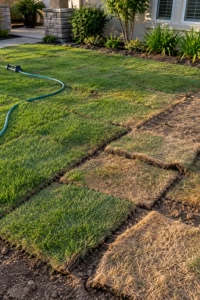
| White grubs or insects | Turf lifts with damaged roots | Check several sod sections | Use confirmed treatment only |
| Fertilizer burn | Irregular or spreader-shaped stripes | Inspect salt-like residue | Irrigate thoroughly if appropriate |
How to Separate Mowing Injury From Fungus
Mowing injury creates a relatively even cut-height pattern and appears quickly. Fungal disease typically produces lesions, circular patches, irregular edges, or progressive spread that does not correspond precisely to mower travel.
Do not apply fungicide solely because turf is brown after mowing. Fungicides work on particular diseases, not on scalping, drought, dull blades, or compacted soil. Misidentified treatments add cost and can disrupt useful soil organisms without restoring the leaf tissue.
Soil Moisture Matters More Than a Surface Appearance
A brown surface does not reveal the moisture status of the root zone. Push a screwdriver or soil probe 3-4 inches into several locations, including a green area and a brown area. Hard entry, dry soil, and shallow roots indicate a soil-water problem rather than an isolated blade fault.
Irrigation should wet the active root zone and then allow the surface to dry moderately. Watering lightly every day often produces shallow roots and does not correct compacted or hydrophobic soil.
What to Do Within the First 48 Hours
The first response should reduce further stress, not add fertilizer or repeated mowing. Use this order:
- Stop mowing until the turf is dry and the cause is identified.
- Inspect the blade for a rounded edge, bends, cracks, and grass packed beneath the deck.
- Measure the current grass height and calculate the one-third limit.
- Check soil moisture at 3-4 inches in both brown and green areas.
- Look at crowns and roots in two or three small samples.
- Irrigate deeply only if the root zone is dry and local rules allow watering.
- Remove heavy clumps that block light, but do not rake aggressively through injured turf.
- Resume mowing with a sharp blade and a higher deck once the grass resumes growth.
Do not fertilize severely heat-stressed turf as an emergency treatment. High soluble nitrogen can increase leaf demand for water and worsen injury, particularly when roots cannot supply moisture.
Recovery Time Depends on Crown Survival
Living crowns and adequate moisture allow mild mowing injury to improve in about 7-21 days. Severe scalping may require 3-6 weeks during active growth, while cool weather, dormancy, or slow-growing zoysiagrass can extend recovery.
A simple crown test helps. If the crown is firm, connected to roots, and shows pale green tissue after several days, recovery is possible. If the crown is dry, hollow, detached, or rotten, reseeding or resodding may be necessary.
| Damage level | Crown condition | Expected recovery | Recommended response |
|---|---|---|---|
| Mild tip shredding | Green and firm | 7-14 days | Sharpen blade, maintain moisture |
| Moderate scalping | Pale but alive | 2-4 weeks | Raise deck, avoid traffic |
| Severe scalping | Sparse living crowns | 3-6 weeks | Water carefully, overseed if needed |
| Crown death | Dry or absent | 4-10 weeks | Prepare soil and reseed or sod |
| Disease or insect loss | Root damage present | Variable | Confirm diagnosis first |
Mower Setup and Cost Decisions
A serviceable mower should have a sharp, balanced blade, correctly inflated tires, and a level deck. Unequal tire pressure changes effective cutting height and can create stripes or scalped edges even when the deck setting appears correct.
Blade sharpening is typically needed every 20-25 engine hours, which may equal twice per mowing season for a frequently used residential mower. Heavy sand, soil contact, sticks, and rough terrain shorten that interval.
| Repair or recovery option | Typical cost | Time to result | Best use |
|---|---|---|---|
| DIY blade sharpening | $0-$15 | 20-40 minutes | Minor dullness and basic tools |
| Professional sharpening | $15-$30 | Same day to 1 week | Balanced, clean edge |
| Replacement blade | $25-$60 | Immediate after installation | Cracked or badly bent blade |
| Supplemental irrigation | $10-$80 | 1-3 weeks | Dry root zone and living crowns |
| Seed repair | $25-$150 | 4-10 weeks | Small dead areas in suitable season |
| Professional reseeding or sod | $150-$500+ | 3-12 weeks | Large or severe crown loss |
A new blade is safer than sharpening a blade with cracks, deep notches, severe corrosion, or an uncertain balance. Disconnect the spark plug wire on gas mowers, remove the battery on electric equipment when appropriate, and follow the manufacturer’s removal instructions.
When Reseeding Is Better Than Waiting
Reseed when living crowns are absent across an area, soil remains bare after suitable watering, and the season supports germination for the selected species. Match the seed to the existing turf, sunlight, soil drainage, and regional climate.
Sod provides faster visual coverage but costs more and still needs careful watering. Seed costs less and develops roots in place, but establishment commonly takes 4-10 weeks and fails if the surface dries repeatedly.
Prevention for the Next Mowing
Prevention combines height management, sharp equipment, and stress timing. No single setting compensates for mowing drought-dormant turf during extreme heat.
- Set the deck using a ruler at the mower’s lowest wheel position.
- Sharpen or replace the blade when tips become ragged.
- Follow the one-third rule rather than a weekly schedule.
- Raise the deck by 0.5-1 inch during heat or drought stress.
- Mow across slopes only when safe, and avoid turning sharply on dry turf.
- Vary mowing direction to reduce repeated wheel compression.
- Keep tires inflated to the manufacturer’s specification.
- Remove no more than the mower can discharge without clumping.
- Test irrigation coverage with catch cups or shallow containers.
- Aerate compacted soil during the species-appropriate growing season.
An expert rule of thumb is to raise mowing height before a predictable heat wave, not after the lawn has already browned. Taller leaves provide more photosynthetic area and shade the soil, although excessive height can create lodging, thatch, and poor air movement.
Another counterintuitive point is that leaving clippings does not normally cause browning. Clippings return nutrients when they are short enough to fall between leaf blades. Thick piles, wet mats, or clippings from a diseased area should be removed.
Frequently Asked Questions About Why Is My Lawn Turning Brown After Mowing?
Will brown grass turn green again?
Brown leaf tips will not turn green again because dead tissue cannot regenerate. Living crowns can produce new green leaves, commonly within 1-3 weeks after mild mowing injury, provided the species is actively growing and the root zone has adequate moisture.
Should I water brown grass after mowing?
Water brown grass after mowing only when the root zone is dry several inches below the surface. Deeply wet the soil without creating runoff, then wait until the surface begins to dry. Watering saturated soil can reduce oxygen around roots and worsen disease or compaction.
Can mowing too short kill a lawn?
Mowing too short can kill a lawn when the cut removes crown-protecting tissue, overheats shallow roots, or occurs during drought. Tall fescue and St. Augustinegrass are especially vulnerable to short cutting, while Bermuda grass tolerates lower heights when managed gradually and grown actively.
How can I tell whether my mower blade is sharp enough?
A sharp mower blade leaves a smooth cut across several inspected leaves. A dull blade leaves split, white, or stringy tips and may create a tan haze within 24-48 hours. Remove, sharpen, or replace the blade if damage is widespread across the mowing path.
Is it safe to mow a lawn that is already drought-stressed?
Avoid mowing severely drought-stressed or dormant turf unless local safety or property requirements demand it. If mowing is necessary, raise the deck, use a sharp blade, reduce turns, and mow when the grass is dry and temperatures are lower.
When should I call a lawn professional?
Call a lawn professional when brown patches spread despite correct mowing, roots are damaged, irrigation coverage is uneven, or disease and insects are possible. Request a diagnosis based on plant and soil inspection rather than an automatic fertilizer or fungicide application.
Conclusion
A lawn that turns brown after mowing usually experienced scalping, excessive leaf removal, or blade shredding, especially when discoloration appears within 24-48 hours and follows the mower’s path. Raise the deck, apply the one-third rule, inspect the blade, and check root-zone moisture before buying seed or chemicals. If the pattern ignores mowing paths, investigate drought, compaction, disease, and insects. These steps answer why is my lawn turning brown after mowing while protecting living crowns and limiting unnecessary recovery costs.