A leafy corner beside your favorite chair. A simple bamboo trellis covered in climbing beans. A plain fence that finally feels like part of the garden.
You do not have to redesign your entire backyard to bring bamboo into it. Start with one place that needs something: more privacy, a little height, a softer backdrop, or a reason to spend more time outside.
These bamboo garden ideas include both living plants and projects made with cut, dried canes. Some suit a roomy backyard, while others need only a patio corner or a planting bed.
Before planting, check whether your bamboo is clumping or running. Running bamboo can spread through underground stems called rhizomes and become difficult to control. Clumping bamboo grows differently, but still needs room to expand. Check local planting restrictions, and do not assume that a pot or raised bed permanently contains running bamboo.
1. Grow a Living Bamboo Privacy Screen
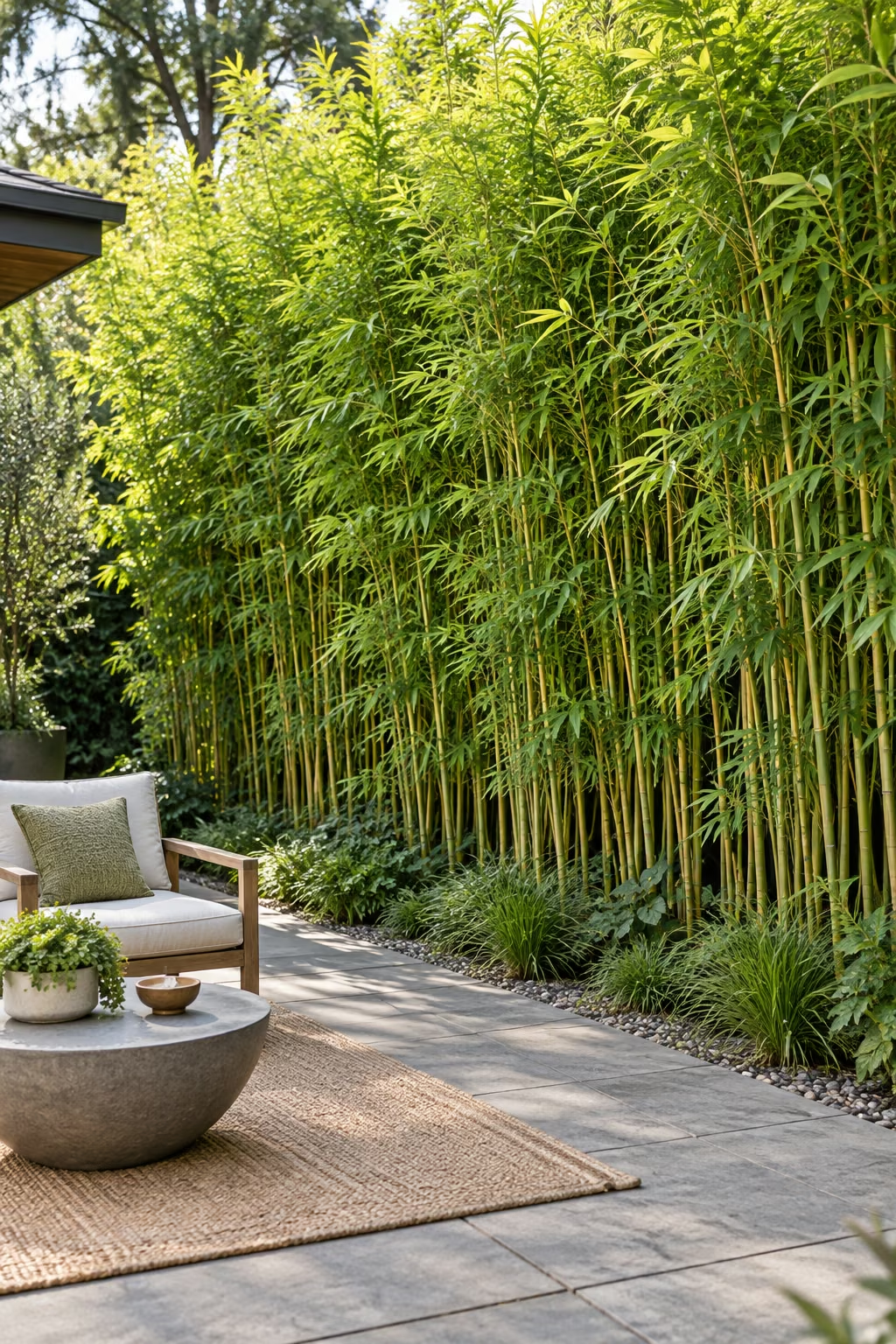
Start with the view you would most like to soften. Perhaps your patio faces a neighboring seating area, or one side of the backyard feels too exposed.
A row of suitable clumping bamboo can become a leafy boundary without giving the garden the appearance of a solid wall. Choose a named variety, rather than a plant labeled simply “bamboo,” so you can check its growing habit and eventual size. Running varieties need a much more demanding containment plan.
Before buying, mark out the mature planting width on the ground. Leave space to reach the plants for maintenance instead of squeezing them tightly between a fence and a walkway.
2. Line a Patio with Bamboo Trough Planters
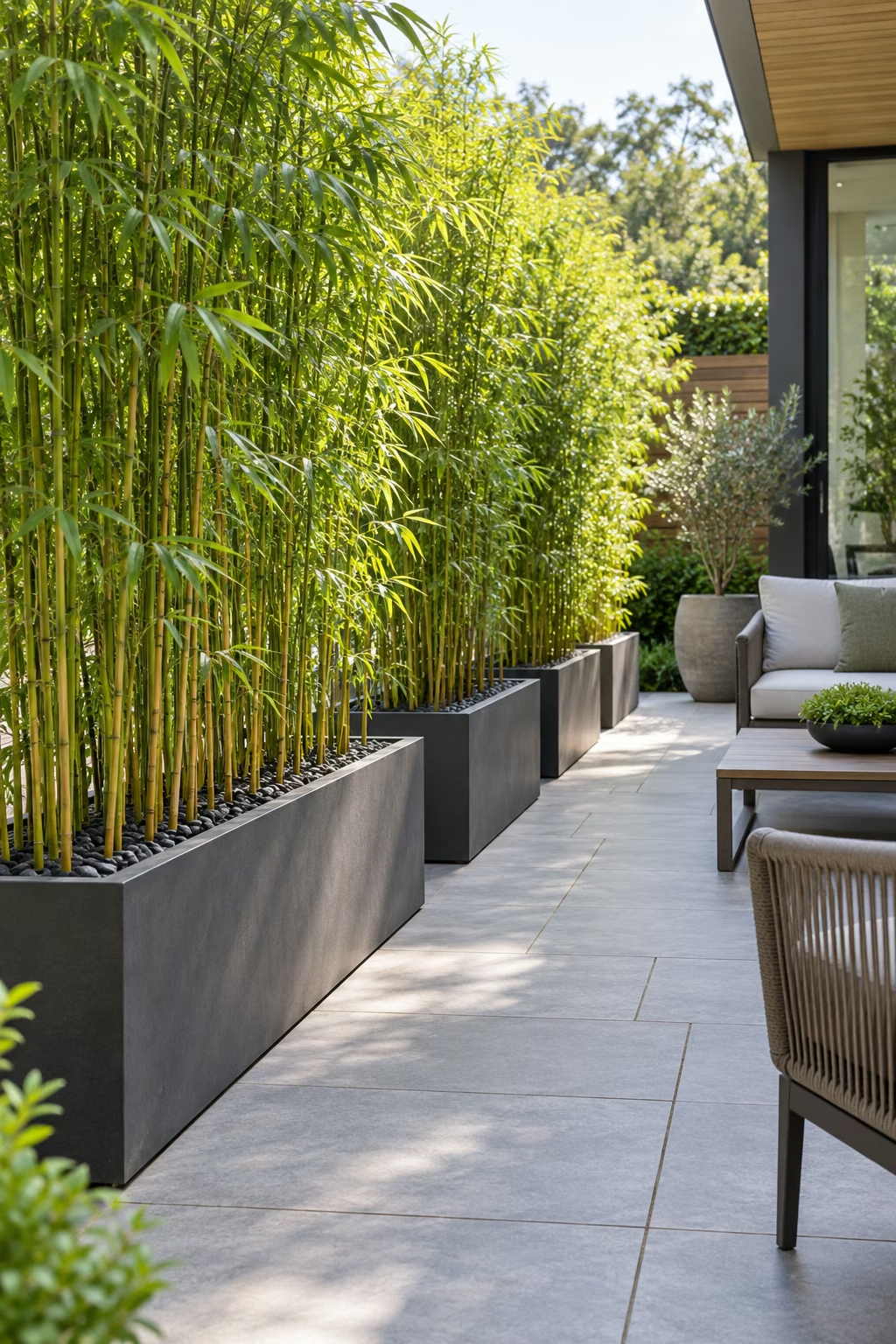
For a patio with no planting beds, try a row of generous rectangular planters along one edge. Keep their color consistent for a tidy look, then let the bamboo supply the softer shapes above.
The important word here is generous. Bamboo needs a container that accommodates its roots, with drainage holes and a suitable potting mix. It will also need watering, feeding, and eventual repotting or division as it becomes crowded.
Set the planters where you can reach them easily. A beautiful screen is much more enjoyable when watering it does not involve climbing behind outdoor furniture.
3. Make a Sheltered Balcony Corner Feel Green
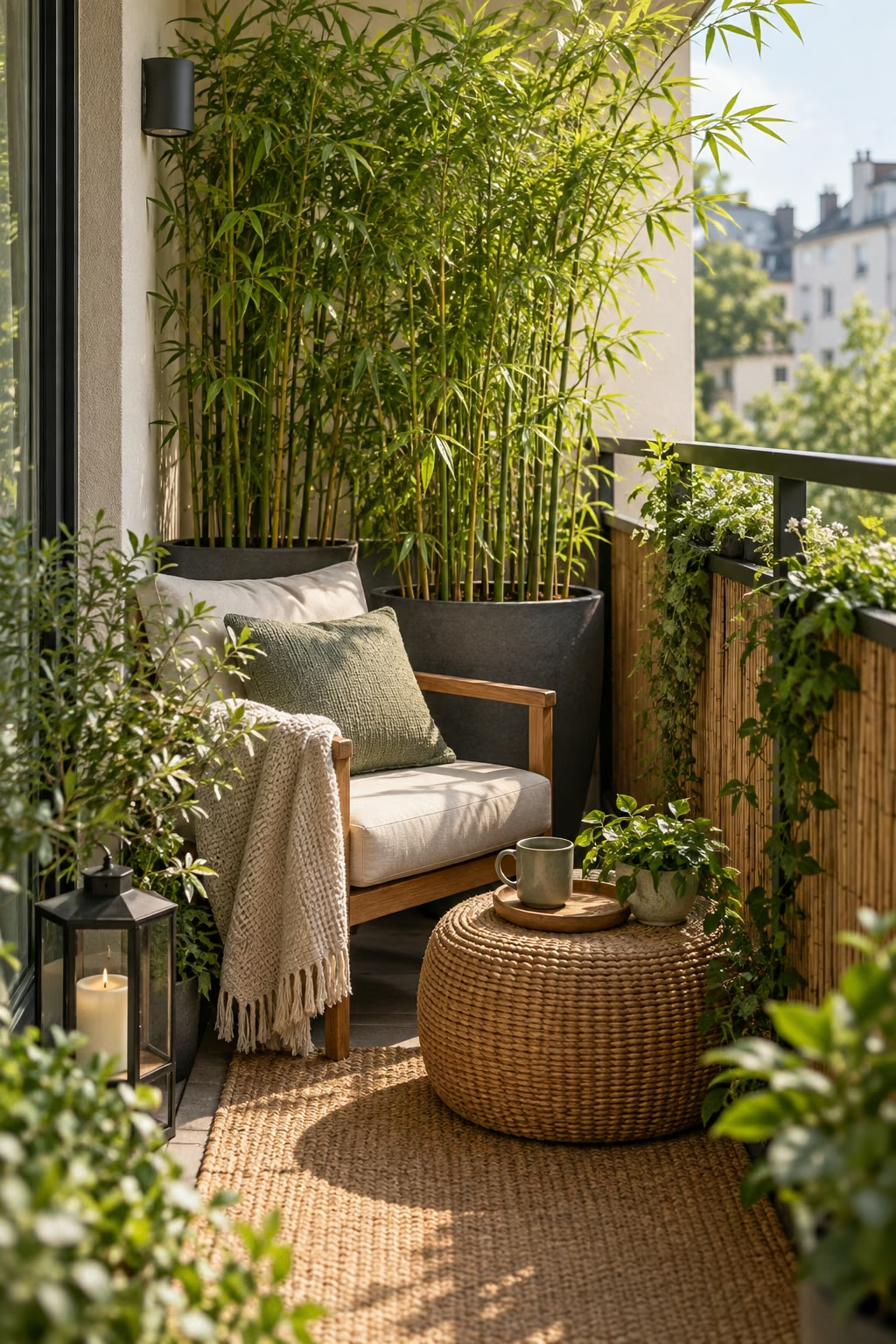
Rather than surrounding a small balcony with plants, give one sheltered corner to bamboo. Add a comfortable chair and a little table, leaving the rest of the floor open.
Check the balcony’s weight limits before choosing a large container. Wind exposure matters, too, and an overhead balcony may prevent rain from reaching your plants even during wet weather. The RHS identifies all three as important considerations for balcony gardening.
Choose the plant and container together. The goal is a leafy corner that fits your balcony, not a tall plant that constantly leans into the doorway or seating area.
4. Frame an Entrance with Matching Bamboo Pots
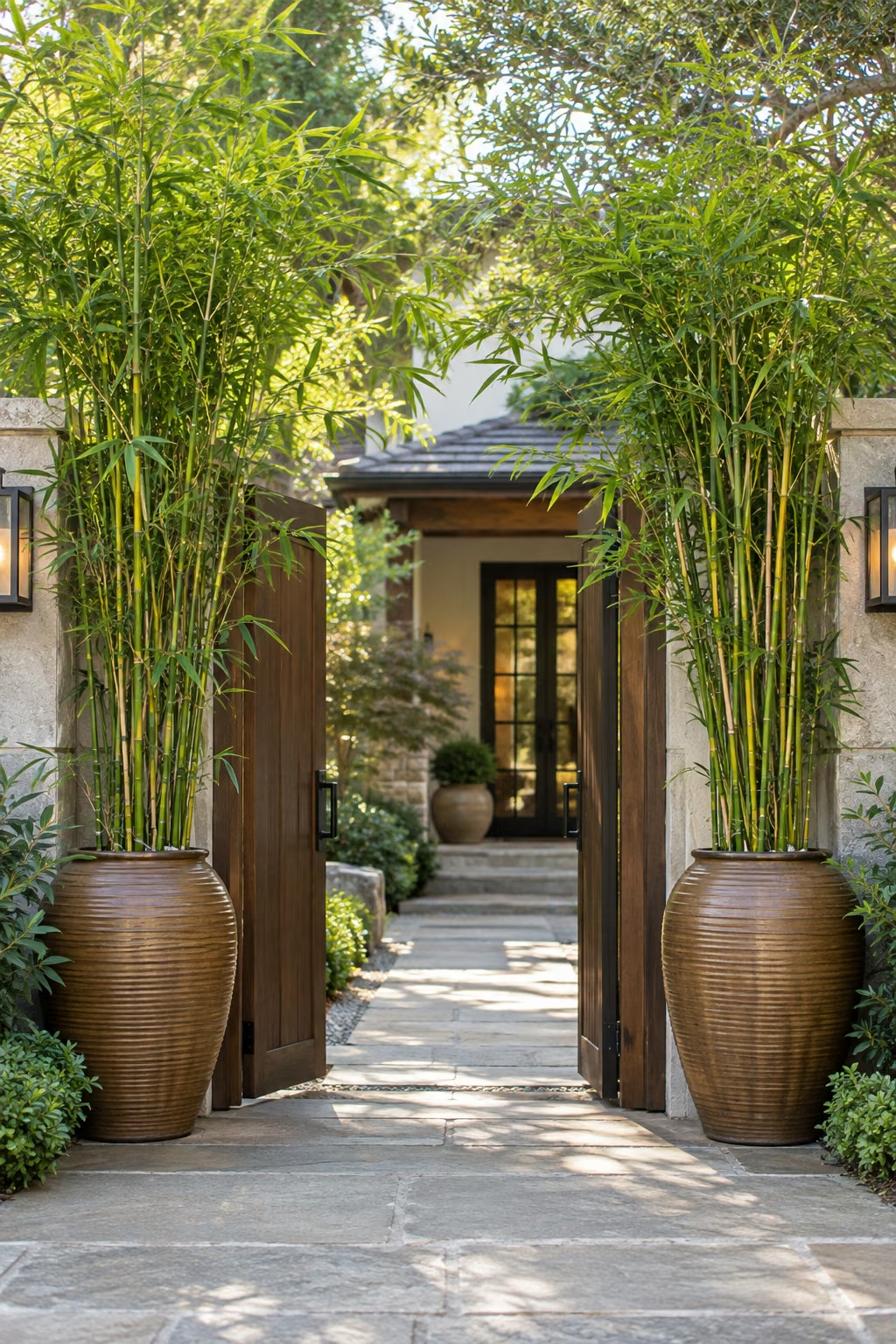
Place a matching pair of bamboo planters on either side of a garden entrance, patio door, or wide set of steps.
For a simple arrangement, use the same bamboo variety in both containers and keep the pots identical. Dark planters would give the entrance a more modern look; warm-toned pots would suit a softer, natural palette.
Position them far enough apart that the doorway remains comfortable to use. Check the plant’s mature shape as well as its height: varieties such as Fargesia rufa develop an arching habit rather than staying narrowly upright.
Keep the surrounding decorations minimal so the pair feels welcoming rather than crowded.
5. Create a Bamboo Reading Nook
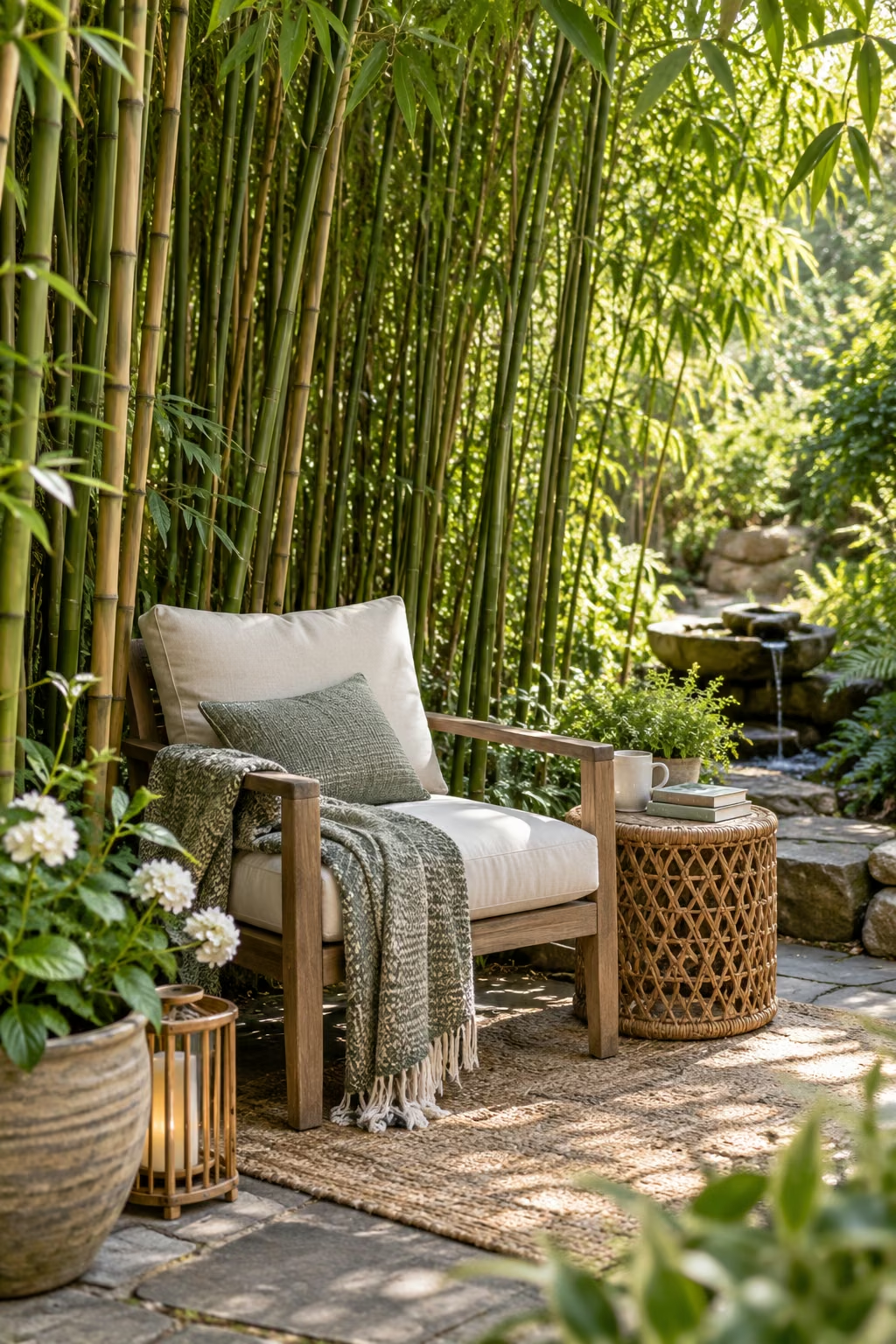
Choose a quiet corner and arrange bamboo behind a bench or comfortable outdoor chair. Leave the front open so you can look across the garden.
You do not need a complete enclosure. A leafy backdrop on one side, a small table, and somewhere to rest your feet may be enough.
Place the furniture first, then decide where the plants should go. Sit down and check the view from that position. This helps you avoid placing the best part of the planting somewhere you cannot actually see while using the nook.
Finish with one cushion or throw in a color you genuinely enjoy, rather than filling the space with accessories.
6. Design a Simple Japanese-Inspired Gravel Corner
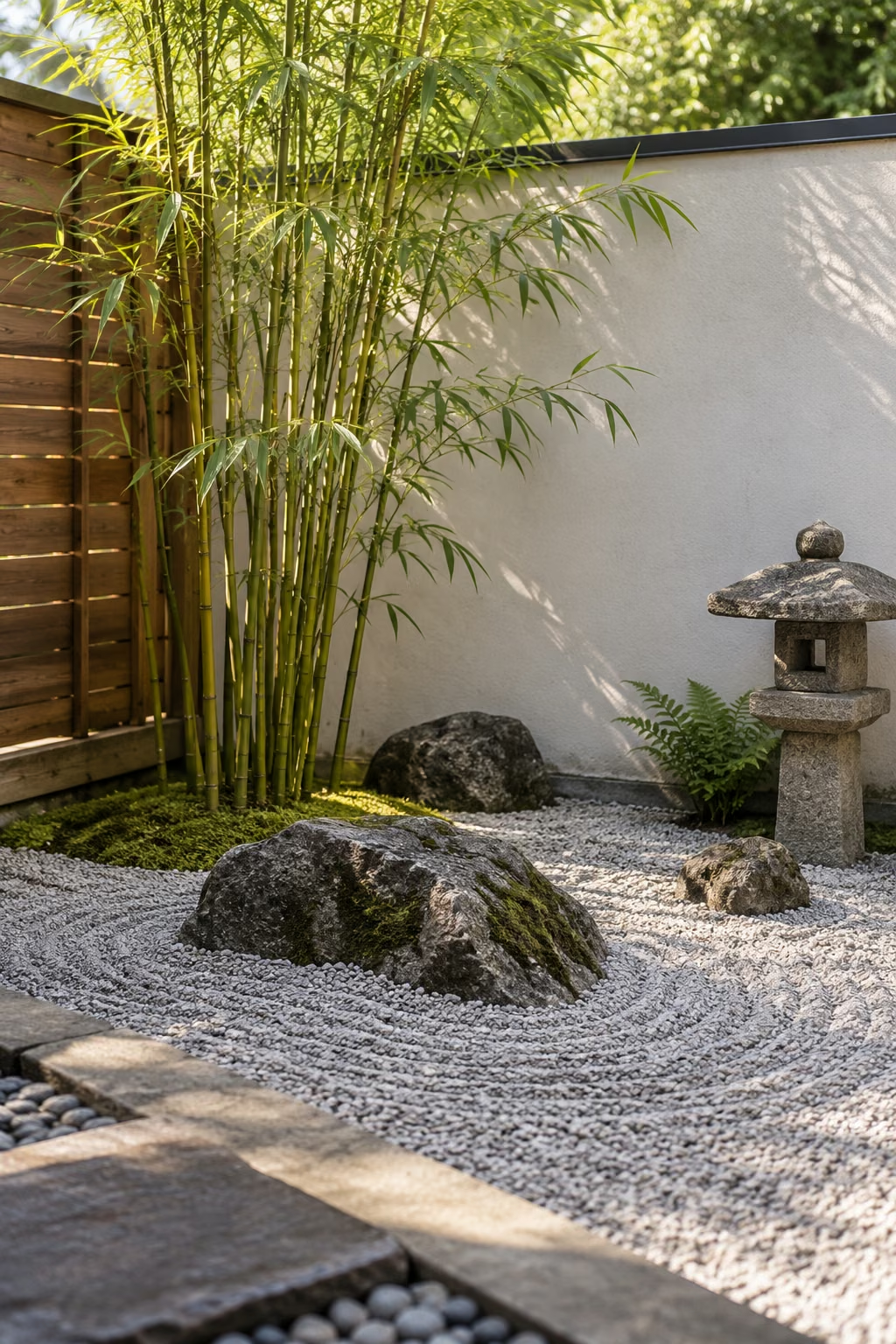
Try a restrained combination of bamboo, gravel, and a few well-placed stones. Give each element enough space to stand out.
For a small version, place one bamboo container toward the back of the composition, add a stepping stone in front, and keep the remaining surface uncluttered. A low bench could sit beside it rather than in the middle.
Bamboo is used in Japanese-style planting as well as contemporary gardens, so there is no need to add lots of themed ornaments to establish the look.
Keep the planting soil separate from the gravel walking surface. Think of this as a small garden composition, not simply a patch of stones around a plant.
7. Layer Bamboo with Ferns in a Shady Corner
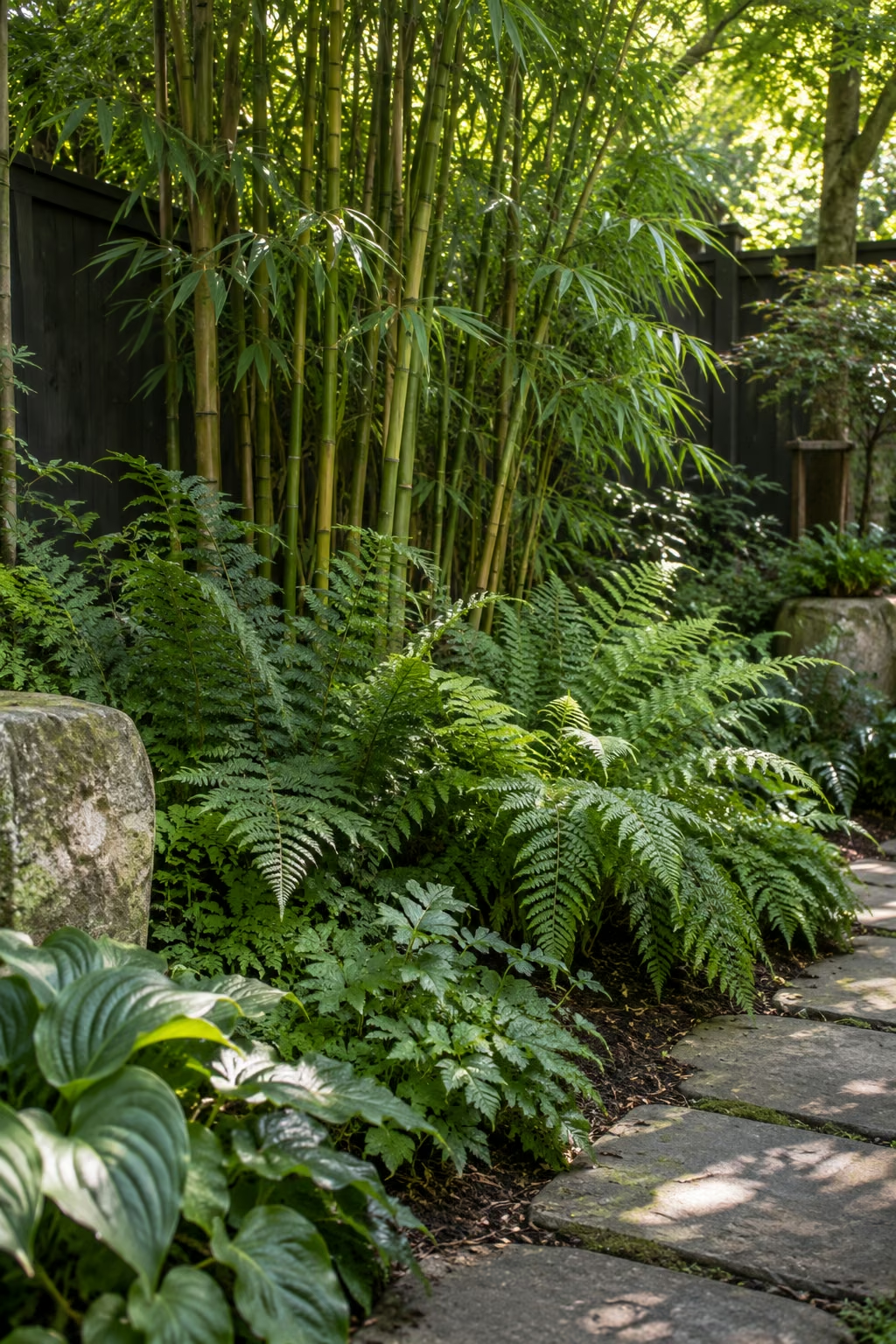
For a softer planting scheme, combine upright bamboo with lower fern foliage. Place the bamboo toward the back and arrange the ferns in loose groups in front.
Choose plants that suit the same conditions rather than assuming every bamboo and fern will grow happily together. Fargesia nitida, for example, prefers partial shade and protection from strong afternoon sun.
Leave enough room around the bamboo’s base for its mature clump. In a very small space, keep the plants in separate containers so you can adjust their positions without disturbing their roots.
A mostly green palette works well here. The contrast comes from leaf shapes rather than lots of different flower colors.
8. Combine Bamboo with Large-Leaf Plants
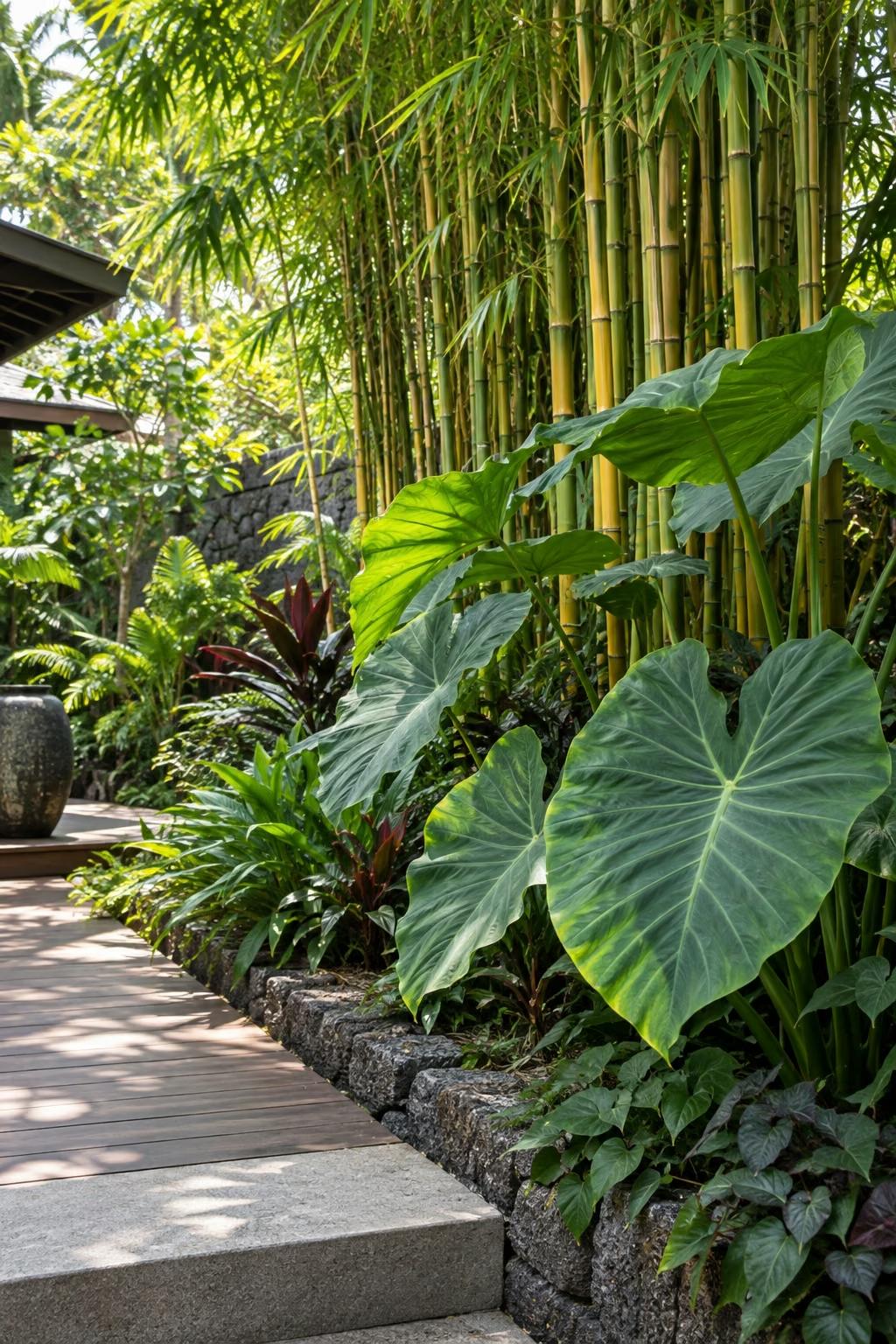
Build a tropical-style corner by placing fine bamboo foliage behind plants with broader leaves.
For the layout, think in three layers: tall bamboo at the back, one or two substantial leafy plants in the middle, and a lower planting along the front. Resist the temptation to fill every gap immediately.
Match the bamboo to your climate. Bambusa multiplex is a clumping option for warmer regions, but it should not be treated as interchangeable with cold-hardy mountain bamboos. NC State lists it for USDA Zones 8a through 11b.
Choose the companion plants locally, too. A convincing tropical look does not require plants that struggle through every winter.
9. Make Colorful Bamboo Canes the Main Attraction
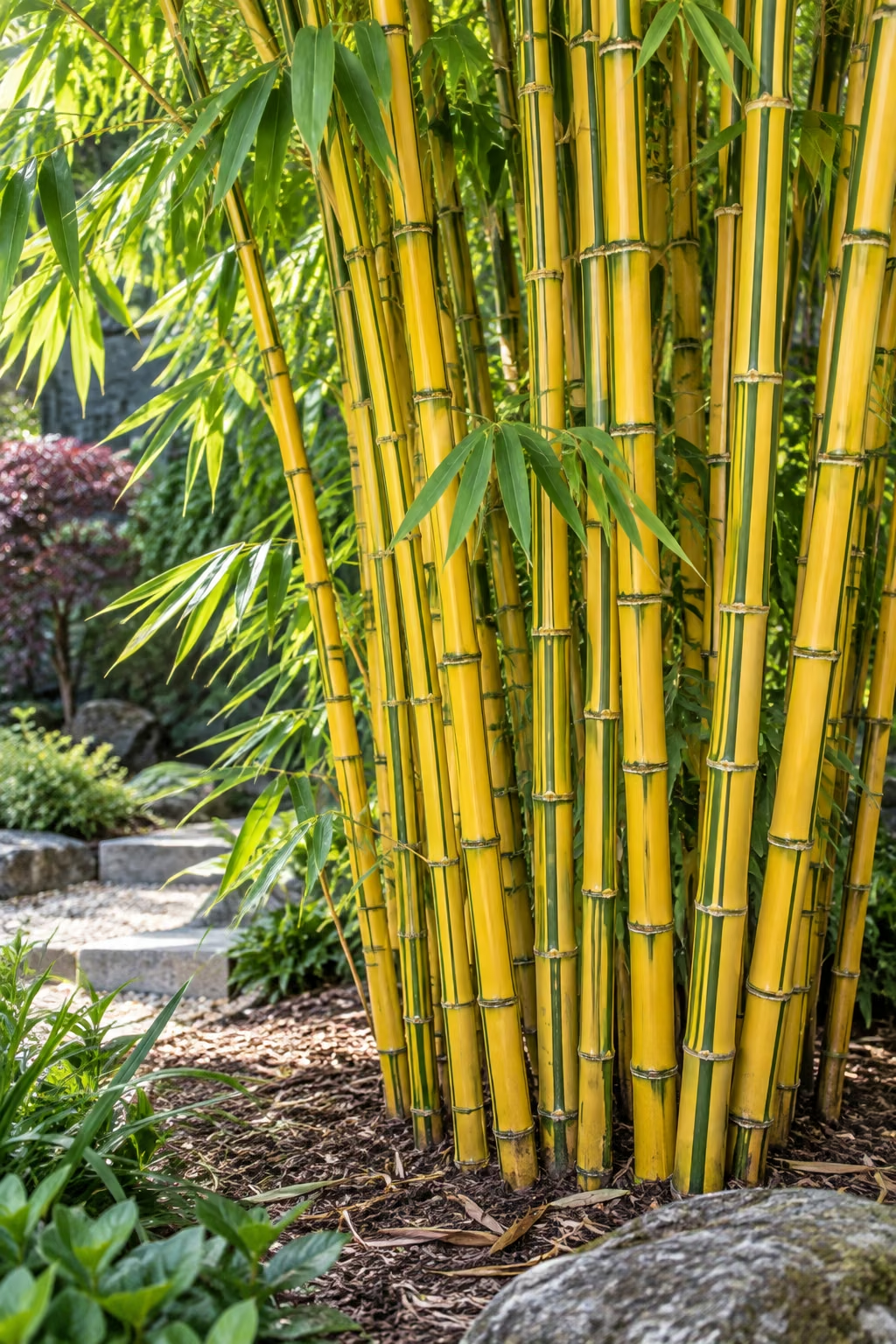
Bamboo foliage does not have to do all the decorating. Some varieties have distinctive stems that deserve a place where you can see them up close.
In a suitable climate, Bambusa multiplex ‘Alphonse Karr’ offers yellow canes with green stripes. Its appearance makes it an interesting candidate for a specimen planting rather than only a background screen.
Position it beside a simple wall or an uncluttered seating area. Avoid placing lots of tall plants directly in front of the canes.
When choosing a colorful variety, check its identity carefully. “Golden bamboo” and “black bamboo” can refer to plants with very different growth habits and containment needs.
10. Use One Large Bamboo Pot as a Focal Point
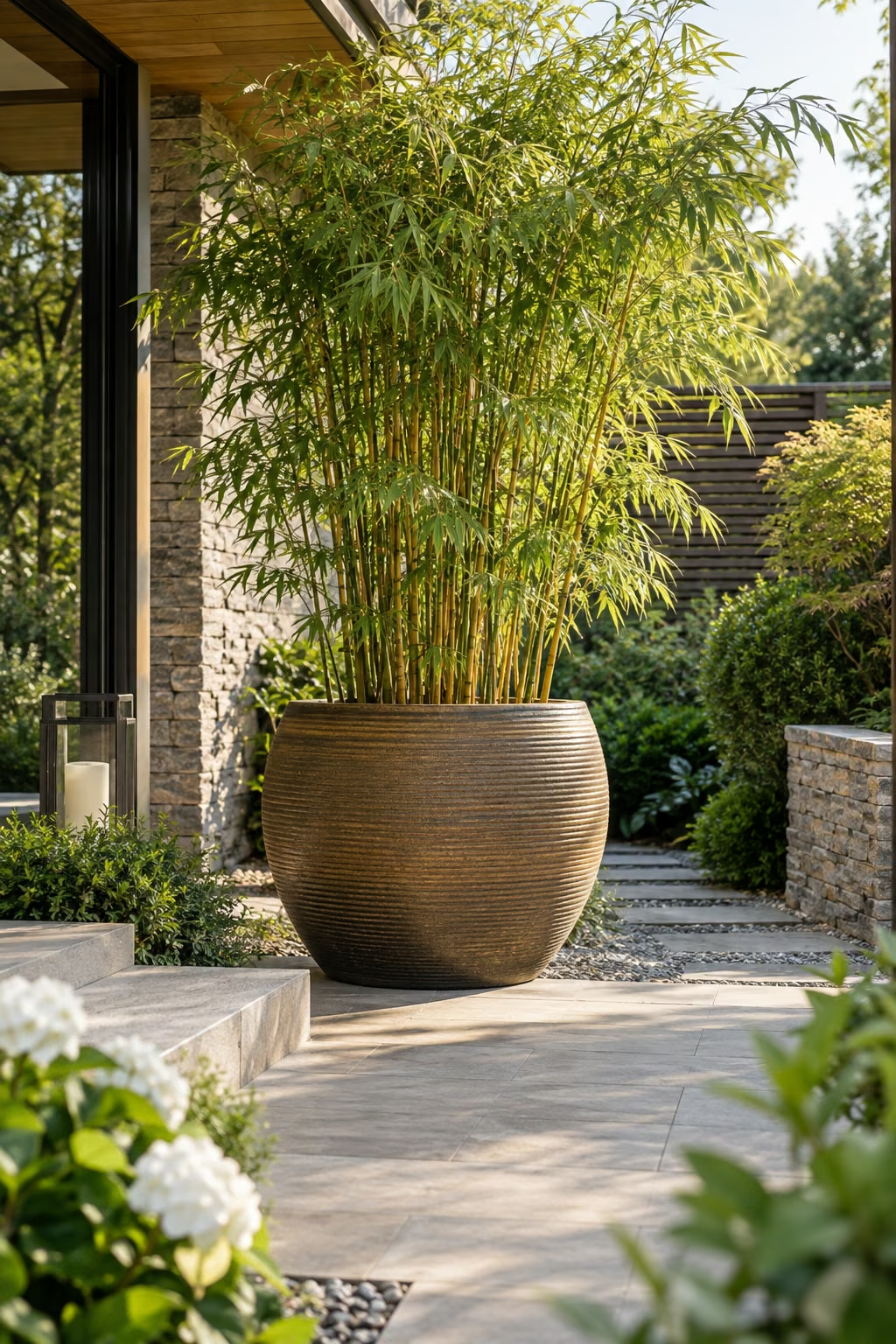
One substantial plant can be enough.
Try placing a large bamboo pot at the far end of a patio, beside a garden bench, or where two paths meet. Keep the immediate surroundings simple so the plant has a clear role in the space.
An arching, clumping variety such as Fargesia rufa is worth considering where its climate and light requirements are met. The RHS lists it for containers and architectural planting.
Choose the final position before filling the pot. Also plan how you will access the root ball later; container-grown bamboo is a long-term maintenance commitment, not a permanently finished arrangement.
11. Soften a Garden Path with Bamboo
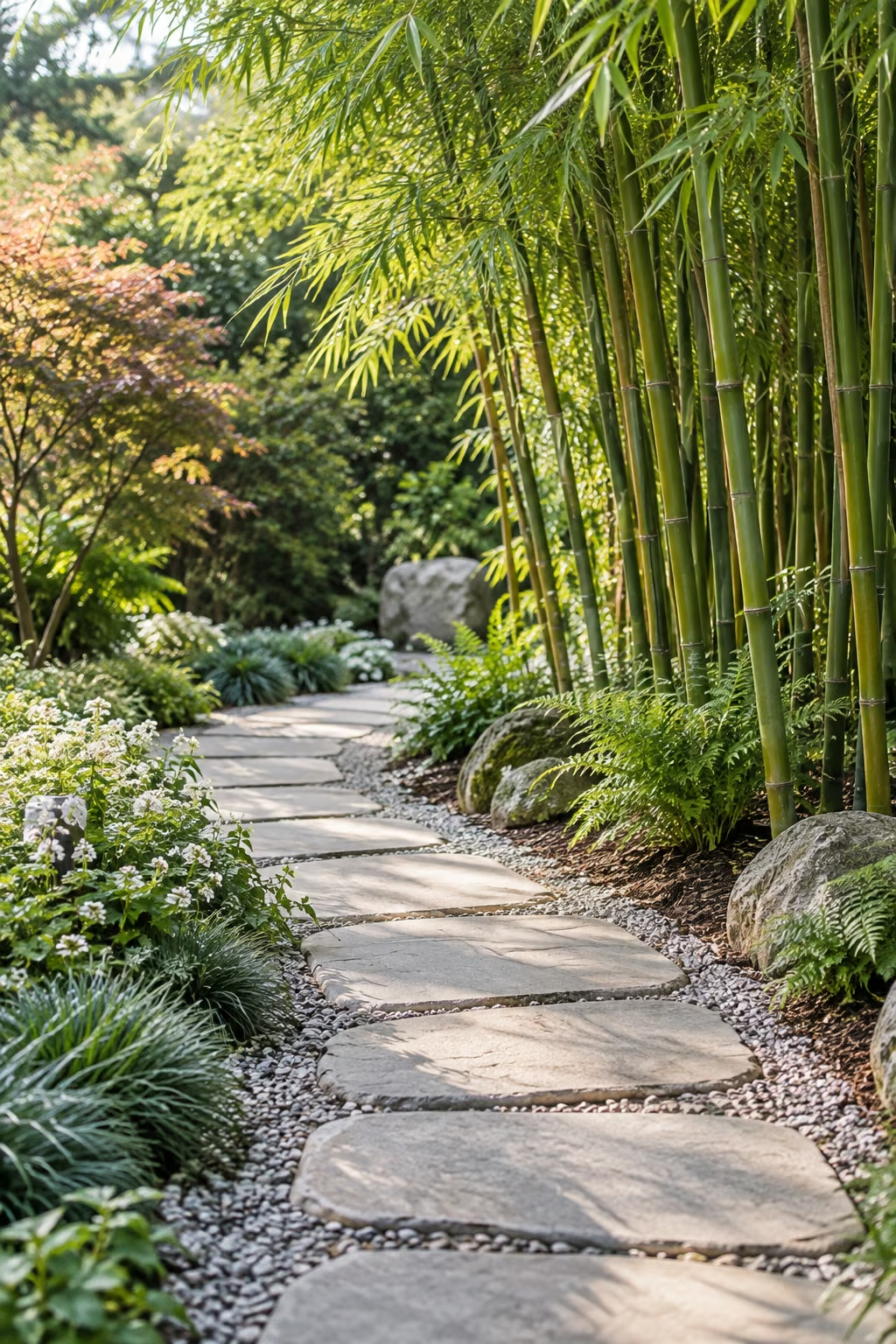
Plant bamboo beside a path to create a leafy edge, but keep the route itself open.
A planting on only one side is often enough for this design. On the opposite side, use lower plants, gravel, or a simple border so the path does not feel enclosed from both directions.
Allow for the mature canopy, not just the width of the young plant’s root ball. Arching bamboo can occupy more space above ground than its base suggests.
Before planting, walk the route while carrying a watering can or pushing a wheelbarrow. That is a useful test of whether you have left enough practical space.
12. Add Bamboo to a Mixed Garden Border
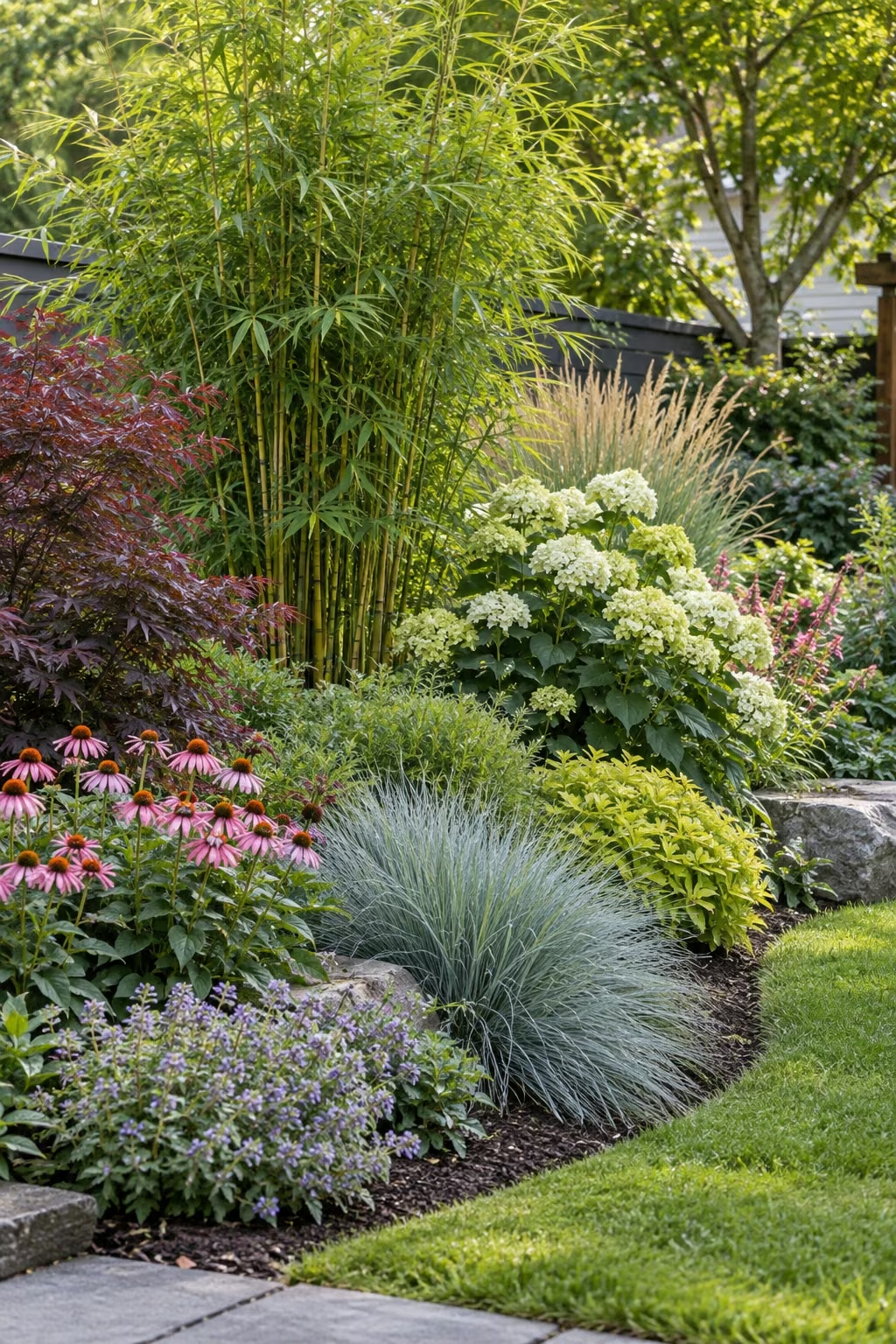
Bamboo does not need an entire bed to itself. Give it one clear position within a larger planting scheme.
Try a clump toward the back of the border, with rounded shrubs nearby and lower flowering plants along the front. Repeat a flower color elsewhere in the bed to connect the different sections.
Choose neighboring plants for compatible light and moisture requirements, and allow for the bamboo’s eventual width. Avoid planting small favorites right against a young clump simply because the space looks empty today.
This is a good direction when you like bamboo but do not want the whole garden to revolve around it.
13. Create a Bamboo Backdrop Behind a Pond
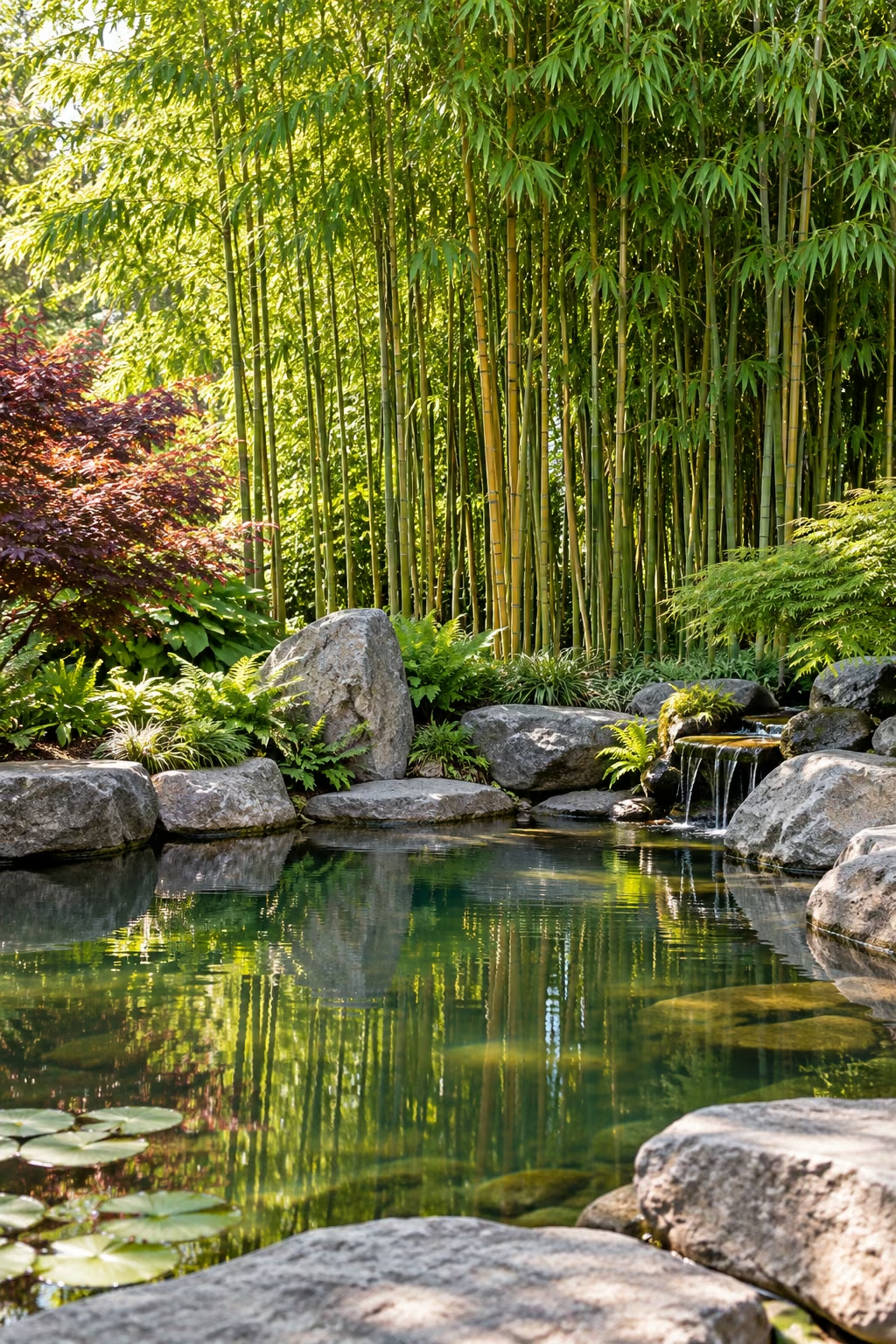
Place bamboo behind a pond so the planting becomes part of the view across the water.
Keep one section of the pond edge open for access and viewing. A single planting group can make a more deliberate composition than surrounding the entire pond with tall foliage.
Bamboo belongs in suitable soil beside the water, not automatically in the water itself. For example, NC State includes pond settings among the landscape uses for Fargesia nitida, while also specifying moist soil with good drainage.
A separate container offers another layout option, provided you can maintain it and keep its drainage and roots away from vulnerable pond components.
14. Reveal the Canes in an Existing Bamboo Clump
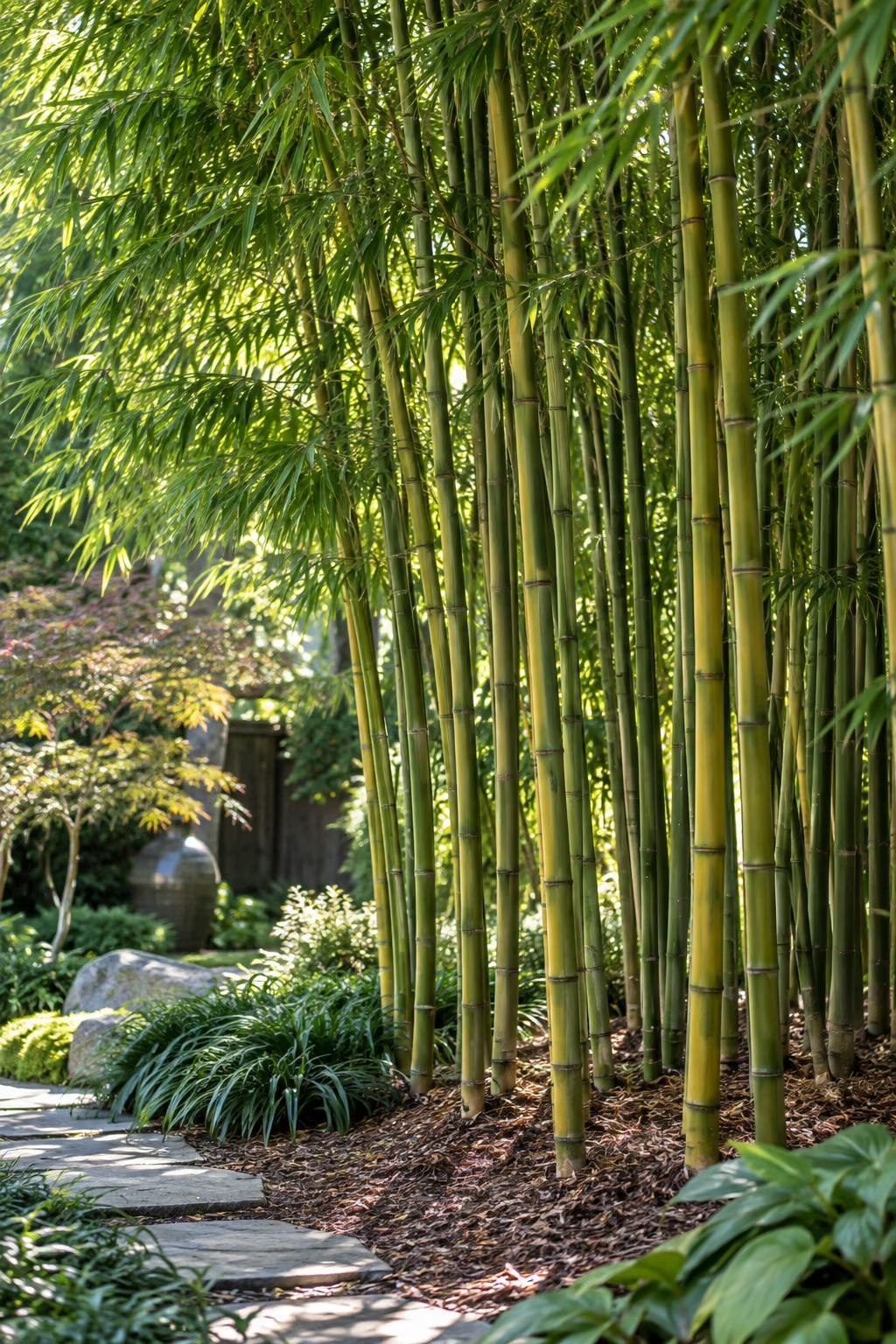
An established planting may need editing rather than more plants.
Where a clump has become congested, remove dead, damaged, and weak canes, then selectively thin it. You can also remove some lower foliage to reveal the stems. The RHS recommends this approach for showing off attractive canes and bringing light and air into dense clumps.
Work gradually and step back frequently. Keep enough foliage to retain the plant’s natural character.
Once the stems are visible, simplify the area around them. A clean bed edge and an unobstructed view from a nearby seat may make the planting feel entirely different.
15. Add Subtle Lighting Beside Bamboo
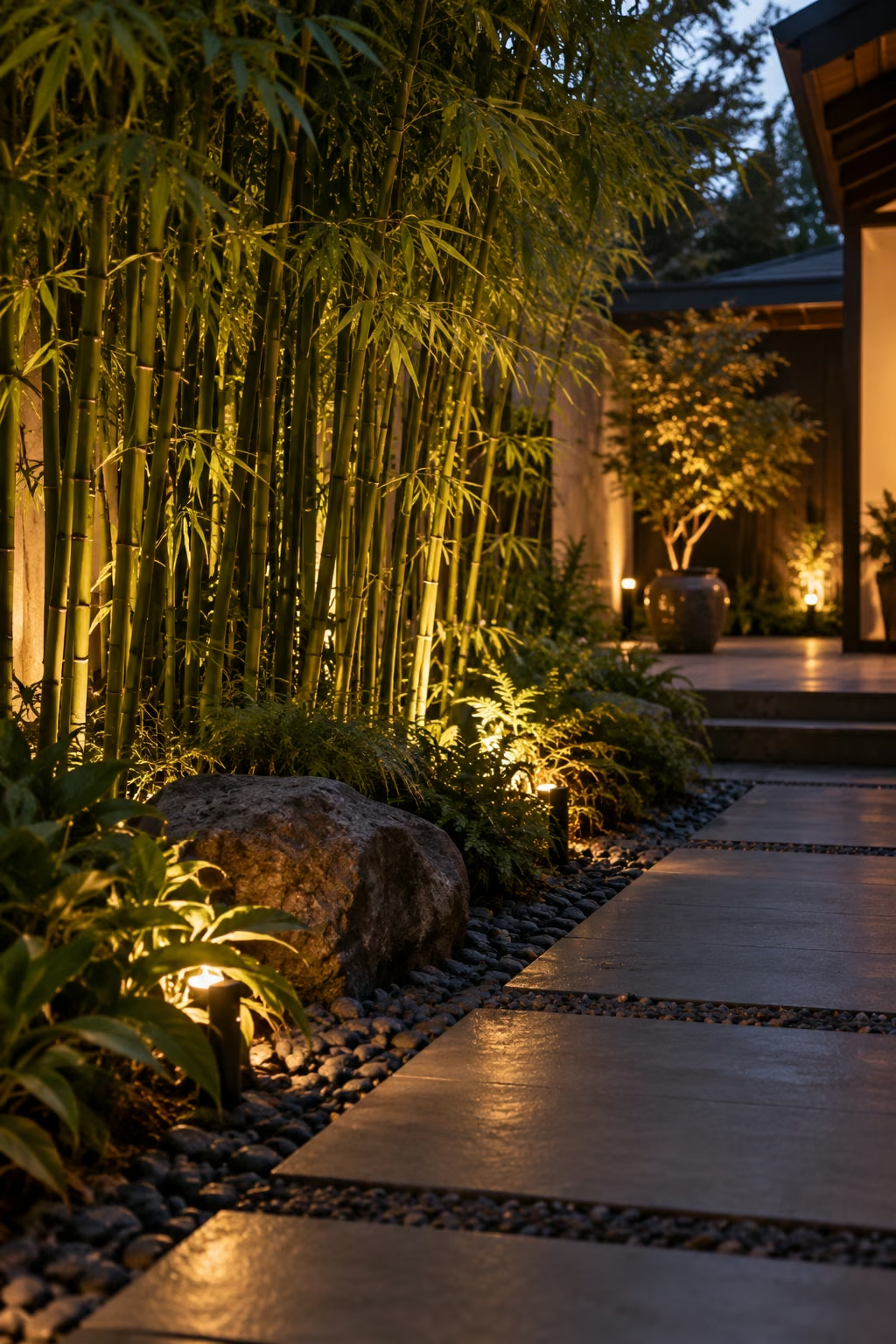
Give a bamboo planting a place in your evening garden with a small amount of carefully directed light.
Try a shielded fixture on a nearby wall, aimed downward toward the lower stems and adjacent path. Keep the source out of your direct line of sight when you sit down.
Use warm-colored light, the lowest useful brightness, and a timer so it is not on all night. These choices follow DarkSky’s principles for responsible outdoor lighting.
The idea is a gentle evening accent, not a brightly illuminated wall of foliage. Leave some parts of the garden dark.
16. Hide Garden Bins Behind a Bamboo Panel
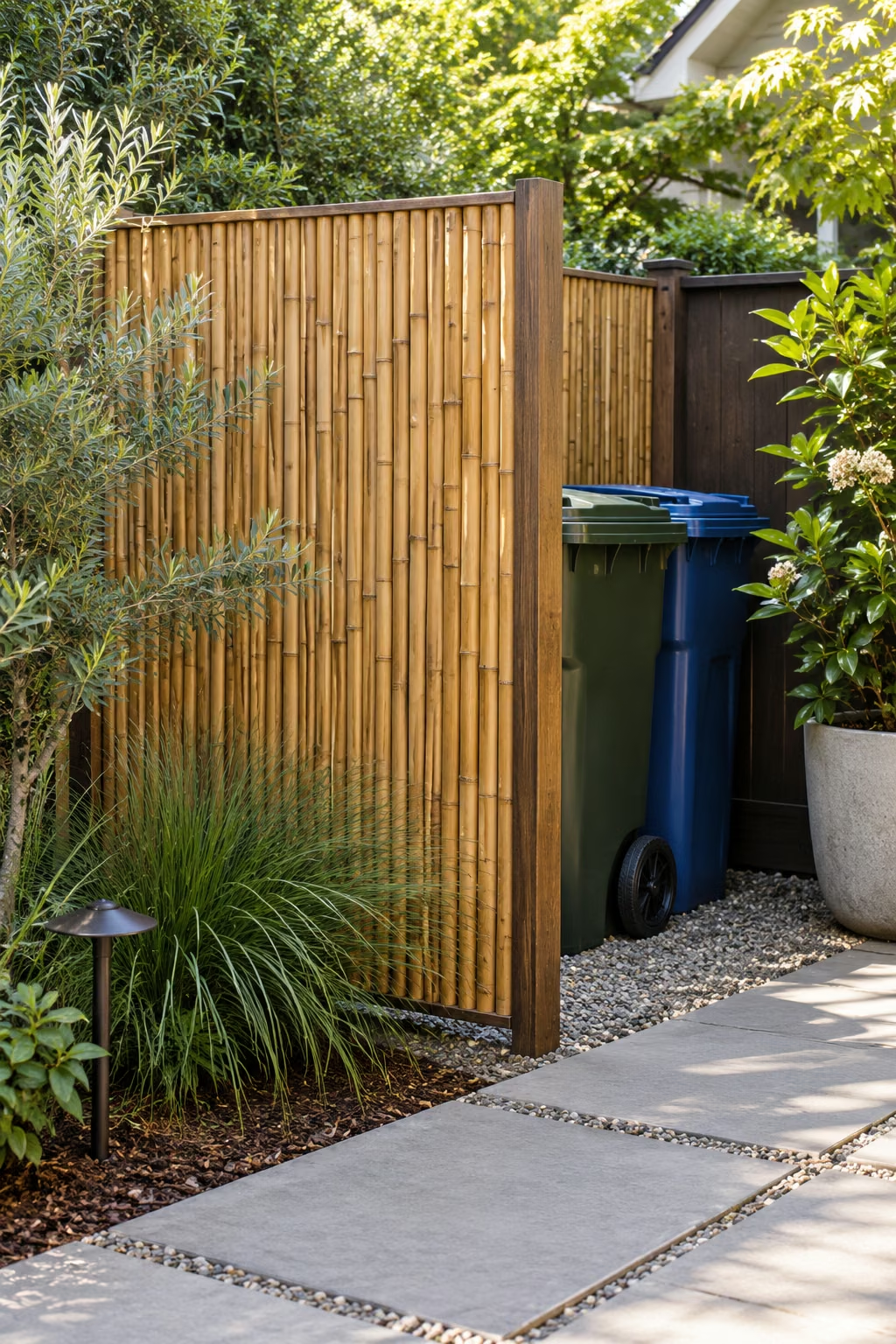
Sometimes the most useful garden improvement is simply changing what you see from the patio.
Place a bamboo-clad panel between your seating area and the bins. Leave an opening wide enough to wheel them out comfortably, with room to lift the lids.
Plan the layout around bin day, not just around the prettiest viewing angle. A fixed panel beside an open access route may be more convenient than a tight enclosure with an awkward gate.
Use cut bamboo as the facing on a properly supported frame. This gives you the look without adding living plants to a narrow service area. Rolled bamboo is an established option for covering a supporting fence structure.
17. Refresh a Plain Fence with Rolled Bamboo
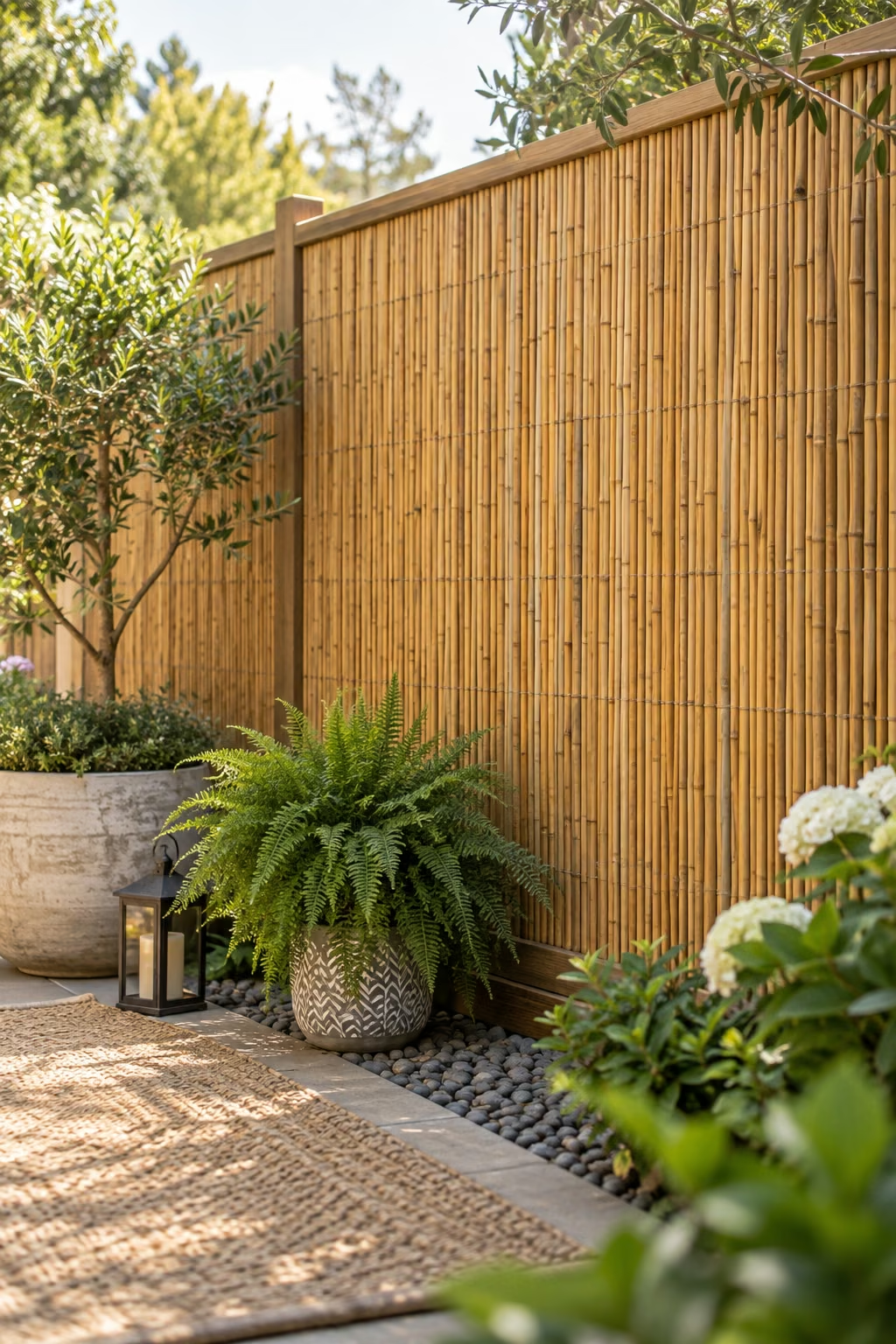
A sound but unattractive fence can become the backdrop for a much nicer seating area.
Attach rolled bamboo fencing to the existing support, following the supplier’s installation instructions. For chain-link installations, Forever Bamboo recommends keeping the roll above the ground and securing it regularly along the supporting fence.
Before covering anything, check that the original fence and posts are in good condition. The bamboo should not be used to disguise a structure that needs repair.
Finish the space with a few pots rather than another continuous screen of plants. Let some of the bamboo surface remain visible between them.
18. Divide an Outdoor Space with a Framed Bamboo Screen
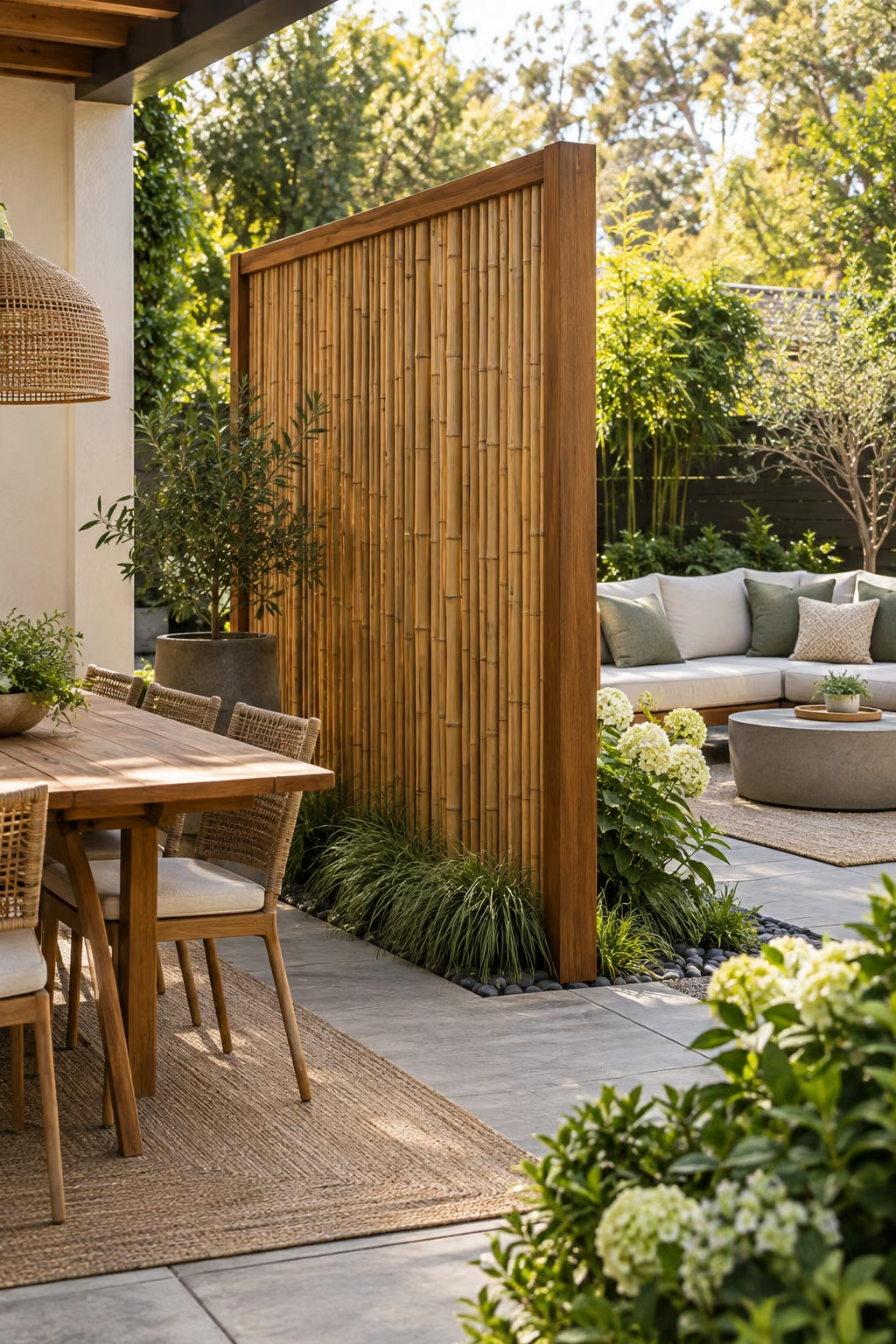
Use a framed bamboo panel to separate two garden activities without building a full wall.
For example, place one between an outdoor dining table and a potting area. Leave a generous opening beside it so the spaces still feel connected.
You could choose closely spaced canes for more visual separation or an open pattern that allows glimpses through. Bamboo fence panels and their traditional construction techniques are part of the practical teaching offered by Portland Japanese Garden.
Have the frame and anchoring designed for the site. A tall outdoor panel needs proper support, particularly where it will catch wind.
19. Give a Garden Gate a Bamboo Finish
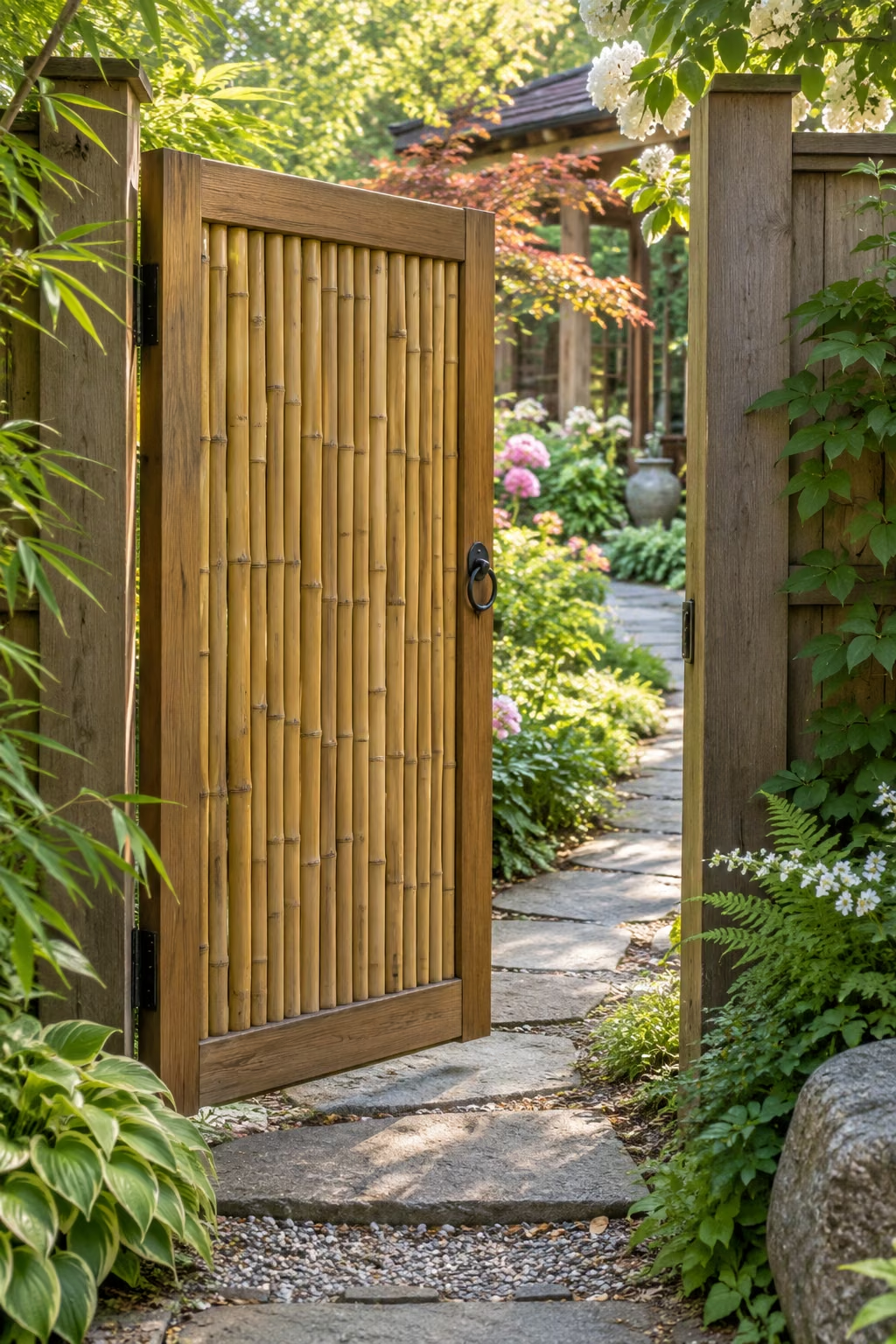
A bamboo-faced gate can make the entrance to a side garden or vegetable plot feel more intentional.
Use a sturdy gate frame and treat the bamboo as the decorative infill. Keep the arrangement simple: evenly spaced vertical canes, a defined outer frame, and hardware that suits the overall look.
For inspiration, look at actual bamboo fence craftsmanship rather than copying a complicated shape from an unverified image. Traditional practitioners use different arrangements of bamboo to create boundaries and control views.
Make sure the finished gate opens fully without scraping the path or catching nearby plants. Everyday convenience matters more than an elaborate pattern.
20. Mark a Planting Bed with a Low Bamboo Fence
A low, open bamboo fence can define a special planting area without hiding it.
Try it along the edge of a gravel corner or beside a garden path. Use a restrained arrangement of rails and upright pieces, with the planting visible beyond.
This idea borrows from the use of bamboo fencing in Japanese garden design, where the fence itself is a crafted garden element. Traditional materials and knot-tying techniques are central to the fence-building workshops at Portland Japanese Garden.
Keep the scale modest. This is a visual boundary, not a substitute for a safety barrier, retaining wall, or secure pet fence.
21. Add Bamboo Shade to an Existing Pergola
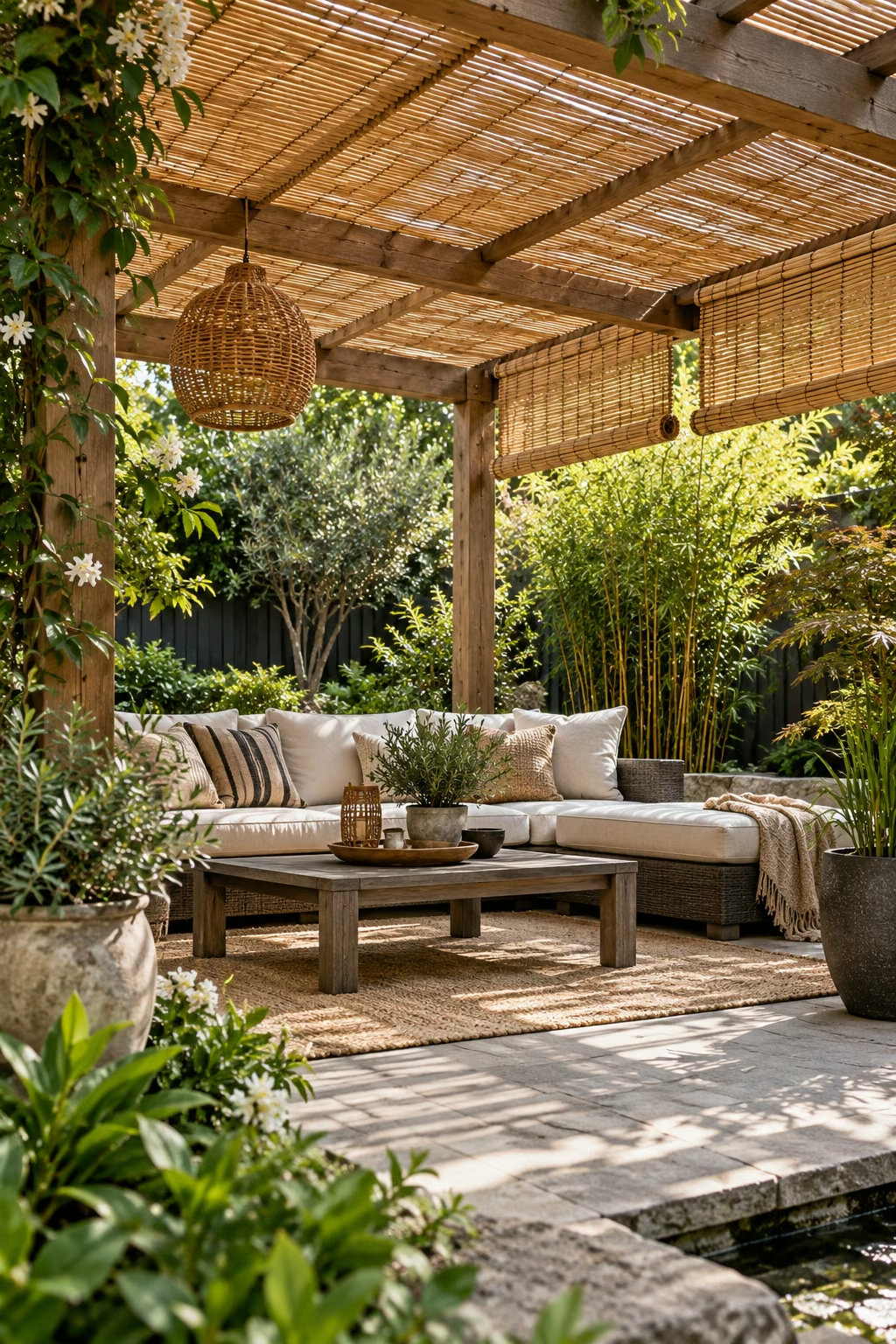
Try bamboo rolls or closely spaced canes over a suitable existing pergola to introduce a patterned layer of shade.
The overhead texture can become the main feature of a simple dining area. Keep the furniture uncomplicated, perhaps with plain cushions and a few pots around the edges.
Rolled bamboo is sold specifically for pergola shade applications, but the supporting structure and fastening method still need to suit your site.
Have those details checked before installation. Treat the bamboo as a shade layer, not a waterproof roof, and leave access for inspection and replacement when necessary.
22. Build a Bamboo Tripod for Climbing Beans
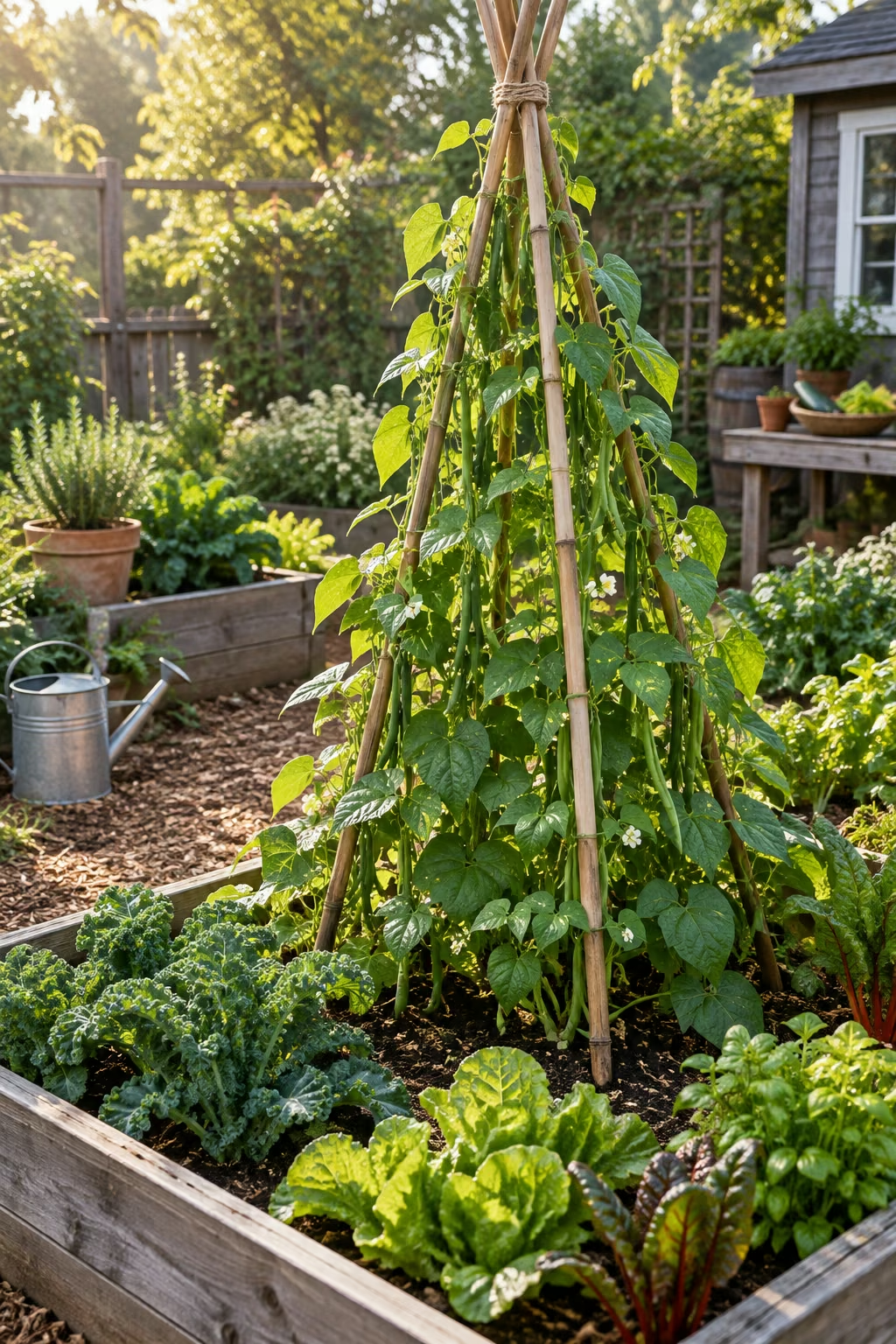
Bring bamboo into the vegetable garden with a simple cone-shaped support.
Arrange several strong canes around a planting area and tie them securely near the top. The RHS recommends this type of bamboo support for climbing runner beans, including in suitable large containers.
Place the structure before planting so you do not have to push poles through established roots later.
A single tripod can sit within a vegetable bed, or you could repeat the same shape in two or three beds. Choose a height that allows comfortable harvesting, and make sure the base is stable before the plants begin covering it.
23. Make an A-Frame Trellis for Cucumbers
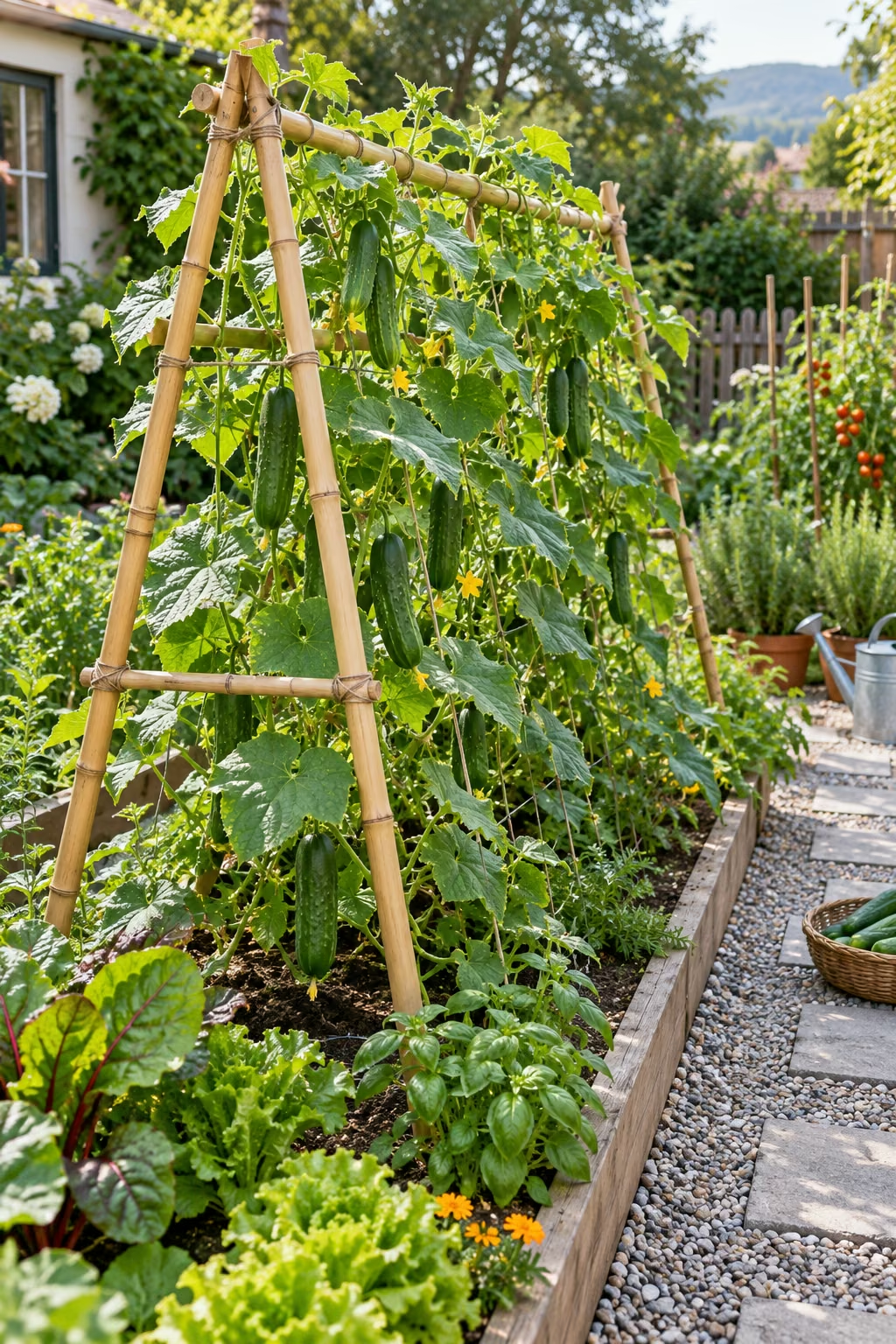
An A-frame gives climbing cucumbers a defined place to grow rather than allowing them to spread across the whole bed.
Build two firmly supported sides that meet along a top rail, then add suitable crosspieces or securely attached climbing support. Choose canes and joints strong enough for the mature plants and their fruit.
The RHS recommends bamboo structures for outdoor cucumbers and notes that vertical growing saves ground space. Young stems may need tying in to get them started.
Leave access along both sides of the frame. A productive trellis should still be easy to inspect, water, and harvest.
24. Create a Bamboo Lattice for Flowering Climbers
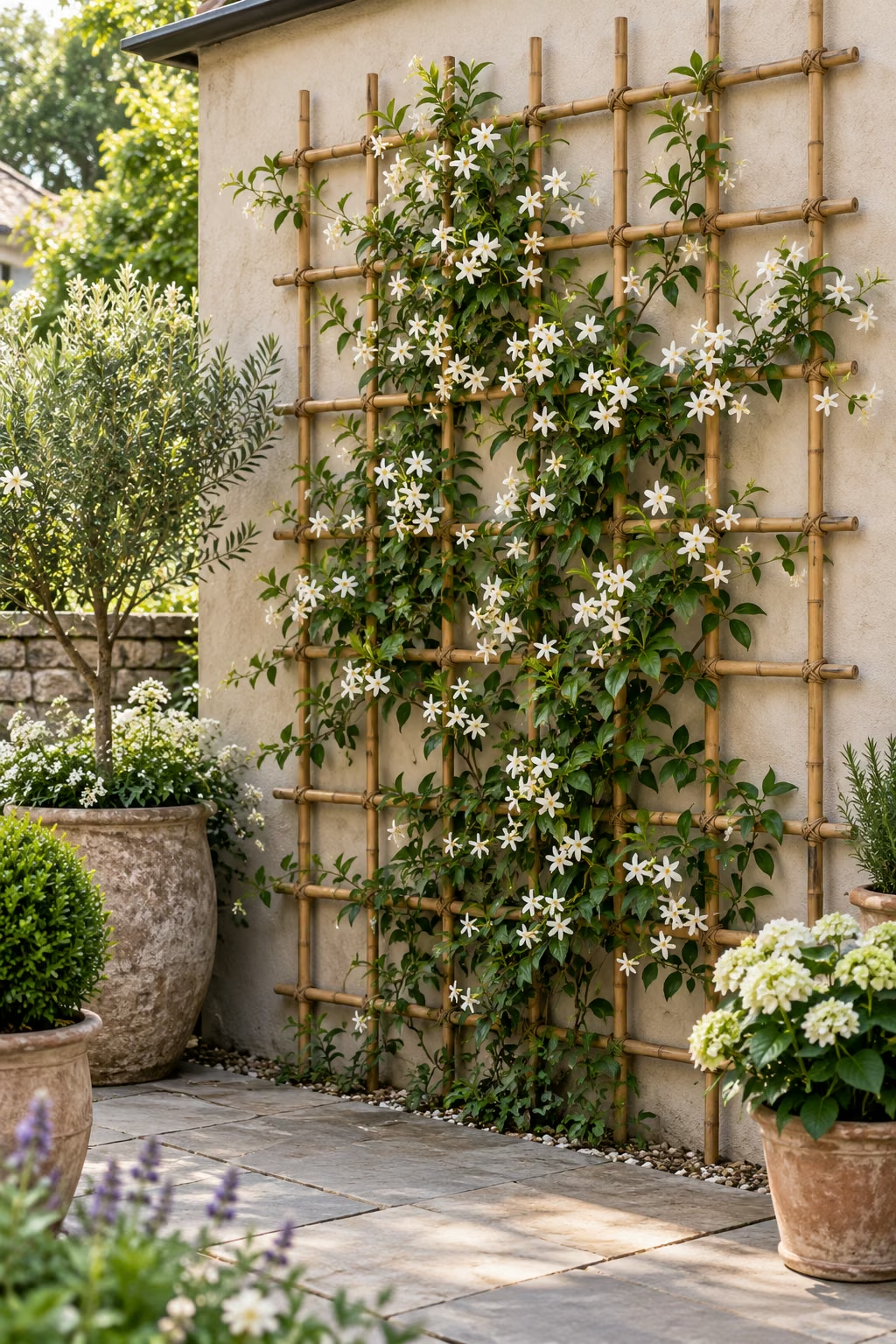
Turn a blank wall or fence into a growing space with a rectangular bamboo lattice.
Lay the design out on the ground first. Use thicker pieces around the outside and lighter canes across the center, then lash the intersections securely. Fine Gardening’s firsthand bamboo-trellis project uses this measured, flat-layout approach.
Choose a climber whose mature growth suits the support rather than placing a very heavy woody vine on a lightweight frame.
Keep the pattern uncomplicated. A straightforward grid leaves room for the flowers to become the main attraction, while the bamboo remains visible during the quieter parts of the growing season.
25. Put a Fan-Shaped Bamboo Trellis in a Flower Pot
For a smaller project, add a bamboo fan trellis to a generously sized container.
The narrow bottom fits within the pot, while the wider top gives the climber room to spread. Place it behind the plant, leaving the front of the container easy to water.
Bamboo fan and grid trellises are established options for potted climbers, especially smaller clematis and suitable annual climbing plants. Match the support to the plant’s eventual size and weight.
Repeat the same trellis shape in two containers beside a patio wall, or use just one to bring height to a group of lower pots.
26. Frame a Garden Path with a Bamboo Arch
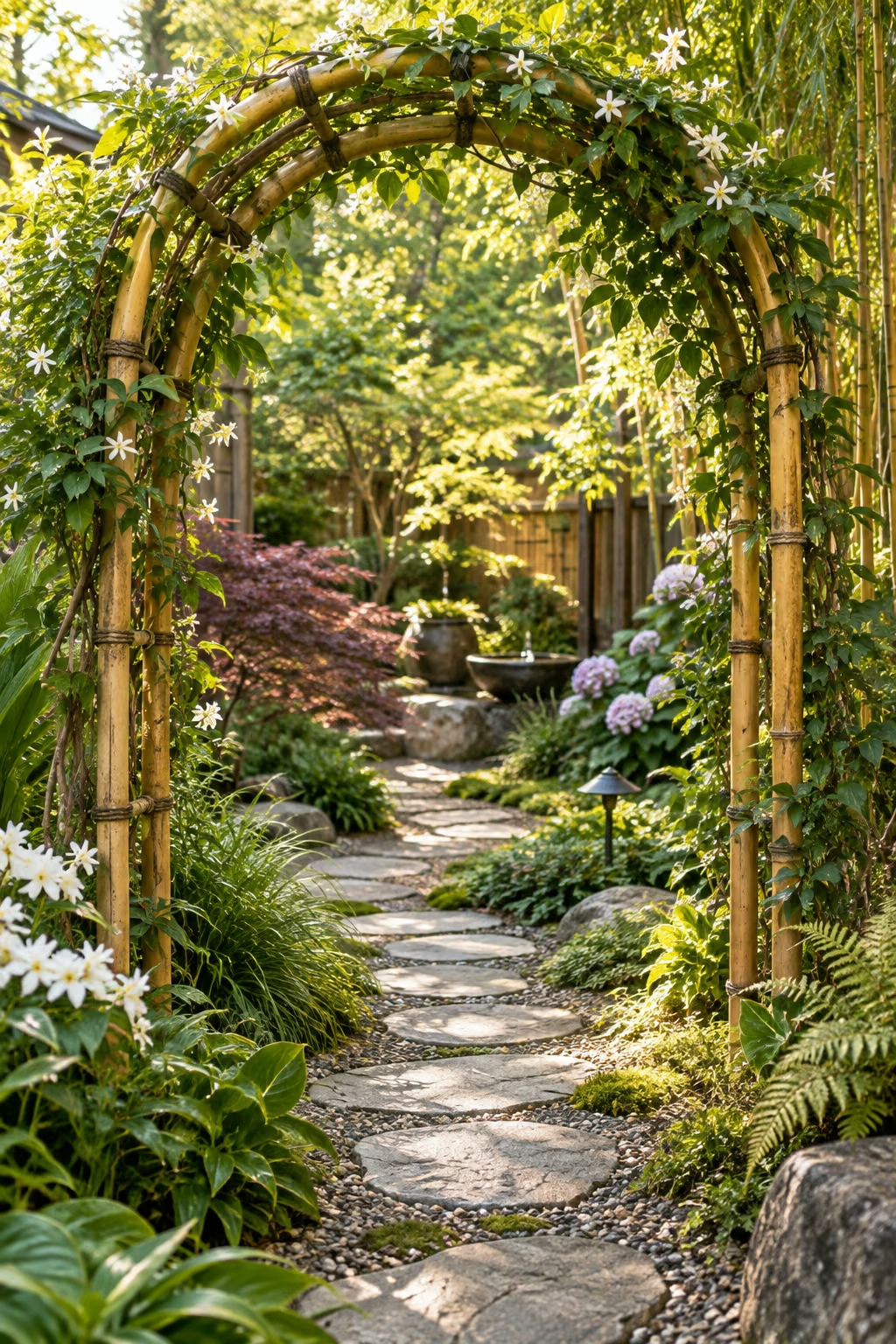
Give the entrance to a vegetable garden or planting area a clear beginning with a bamboo arch or simple overhead frame.
Keep the opening wide enough for people and garden equipment. Plan for the space the plants will occupy once they cover the structure, not just the width of the bare frame.
The RHS includes arches over pathways among the possible supports for climbing runner beans.
Use a proven construction design with suitable anchoring, rather than bending dry poles into a shape they cannot safely hold. For a straightforward look, choose upright sides and a simple horizontal top.
27. Support Tall Flowers with Bamboo Canes
Bamboo can be useful without becoming the main visual feature.
Place canes around flowers that need support, then connect them with soft ties or twine as appropriate. Install the support early so the plants grow around it rather than trying to rescue everything after it has flopped.
The RHS recommends matching the support to the plant’s size, anchoring it securely, and avoiding ties that grip stems too tightly. A figure-eight tie can help prevent rubbing between a stem and its cane.
This is a practical way to keep a flower border upright while allowing the blooms, rather than the supports, to draw attention.
28. Make a Small Bamboo Water Feature
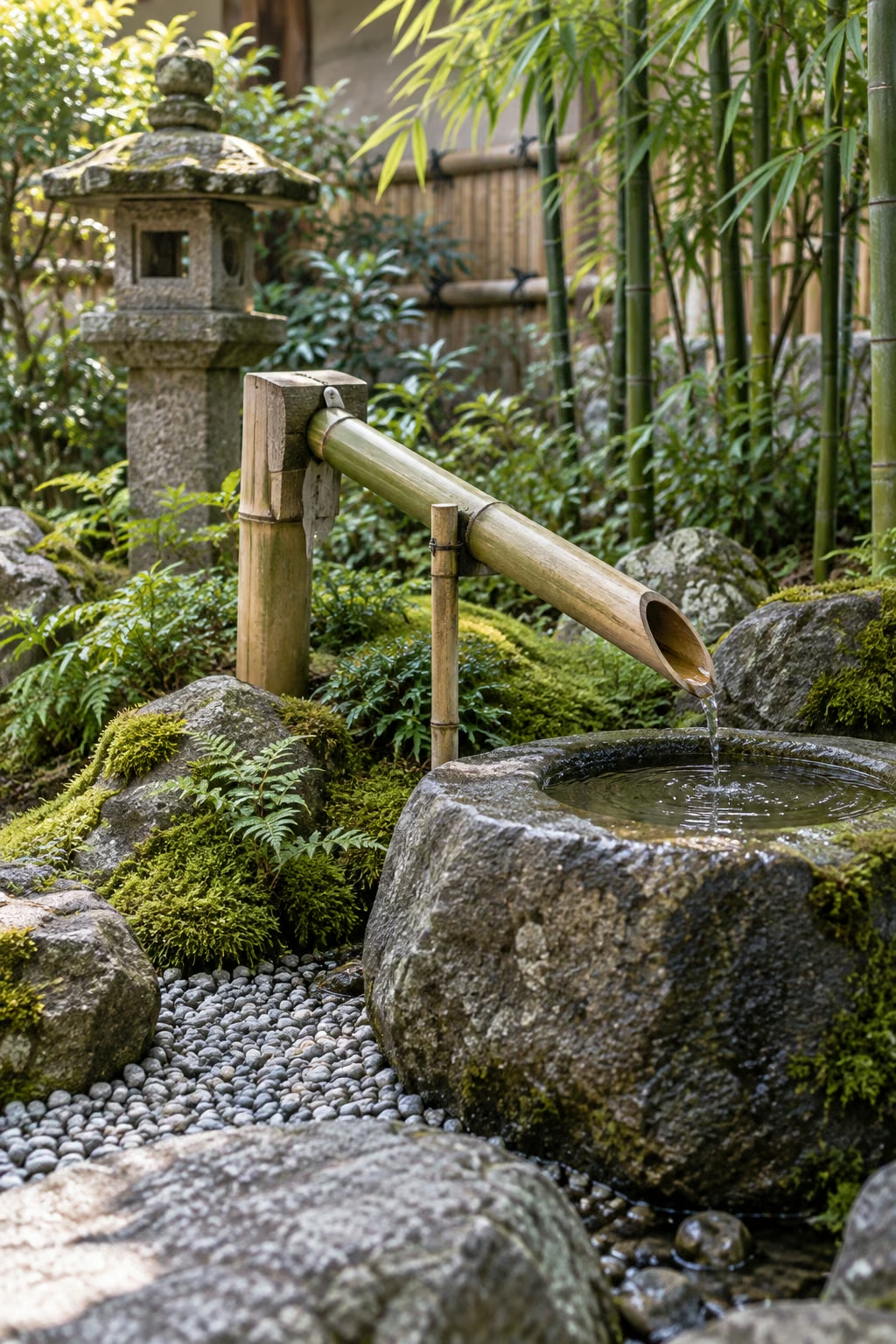
A bamboo spout over a watertight bowl can create a compact water feature beside a seating area.
Choose a bowl that suits the garden’s materials, then use a compatible fountain kit with a pump and tubing. Place everything on a level surface and keep the pump accessible for maintenance.
Bamboo Accents’ setup guidance specifies a fully submerged pump, secure tubing, and regular attention to the water level so the pump does not run dry.
Keep the surrounding arrangement simple. A few stones and a nearby plant are enough. Follow the equipment’s outdoor electrical instructions, and plan for safe access around the water.
29. Give a Plain Planter a Bamboo Cover
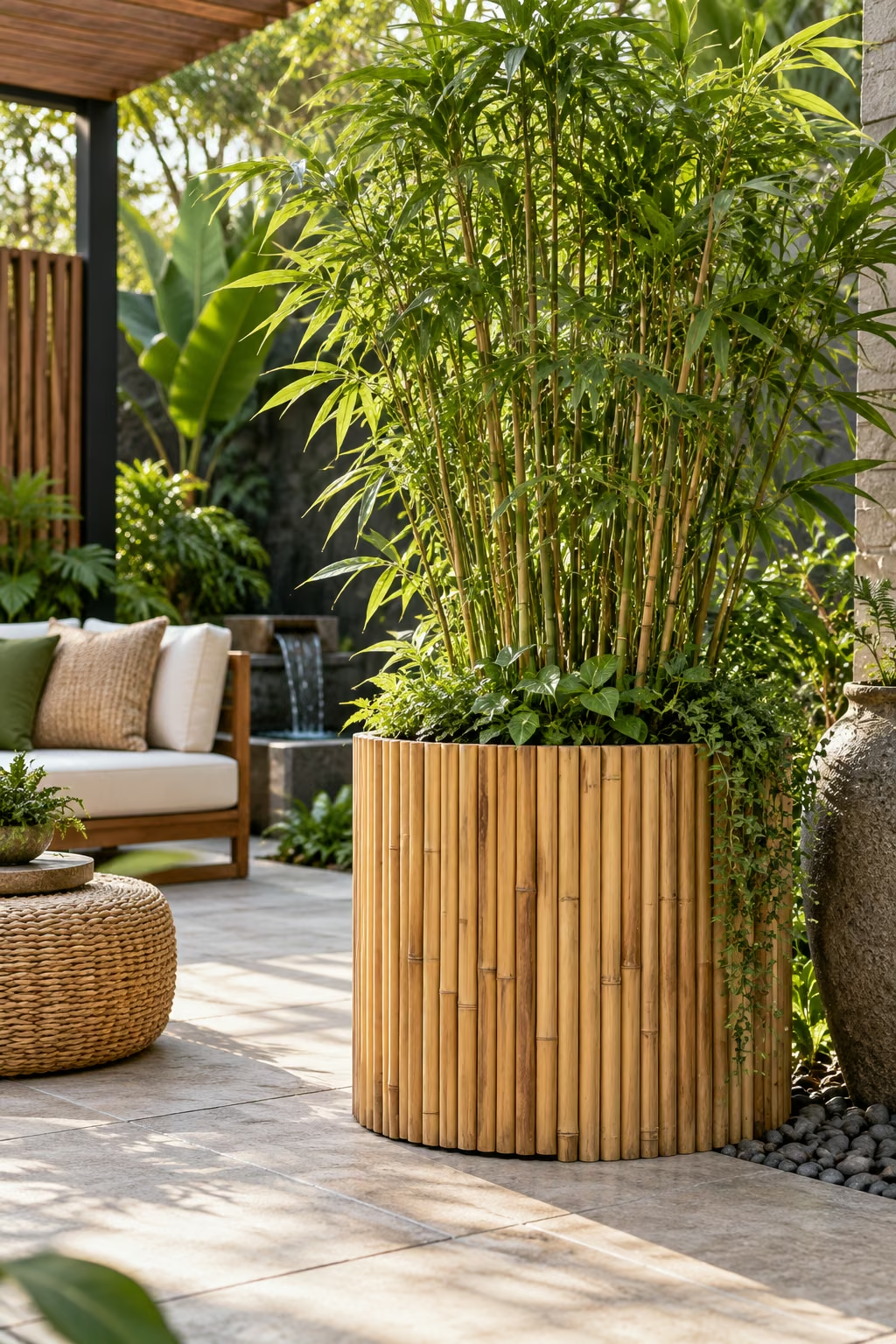
Keep the container you already have and change how it looks.
A bamboo outer cover can bring a natural finish to a plain planter without asking the bamboo itself to hold wet soil. Ready-made bamboo planter covers provide an existing example of this approach.
For a custom version, use a removable outer sleeve around a proper planting container. Leave drainage openings unobstructed and enough access to lift the inner pot when needed.
Try repeating the same finish on two or three containers. They do not need to contain identical plants; the matching covers can provide the connection between them.
30. Finish a Small Flower Bed with Bamboo Edging
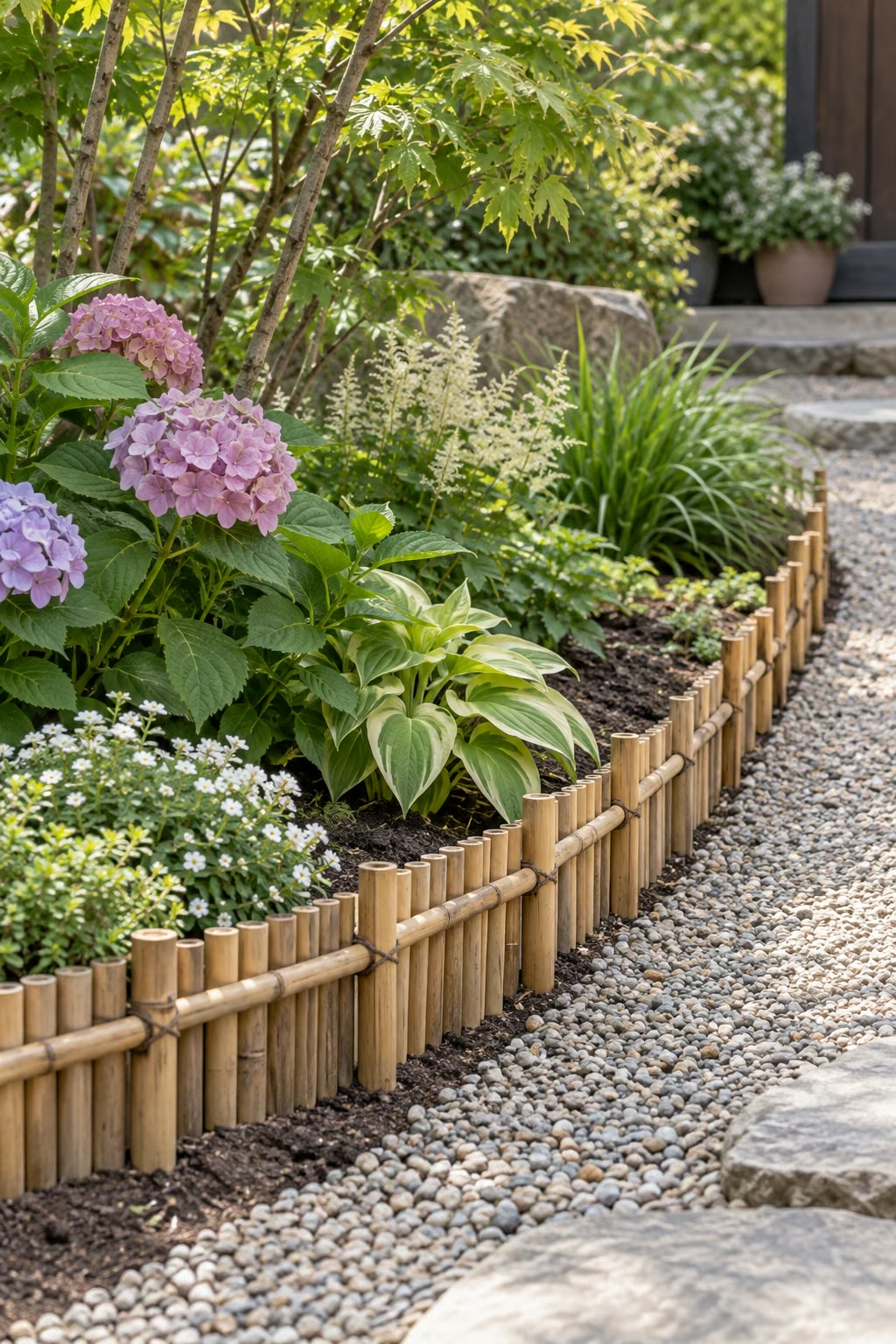
Use short bamboo edging to give a small planting bed a clear outline.
A flexible, ready-made border can follow a gentle curve, while a straight section can define the edge beside a path. Keep the shape simple enough that you can still reach the plants behind it.
Bamboo edging is available as a decorative border, but bamboo exposed to soil and moisture will eventually deteriorate. Plan to inspect and replace it rather than treating it as permanent construction.
Decorative edging is not a rhizome barrier. It should never be relied on to contain running bamboo.
31. Hang a Bamboo Wind Chime Near Your Favorite Seat
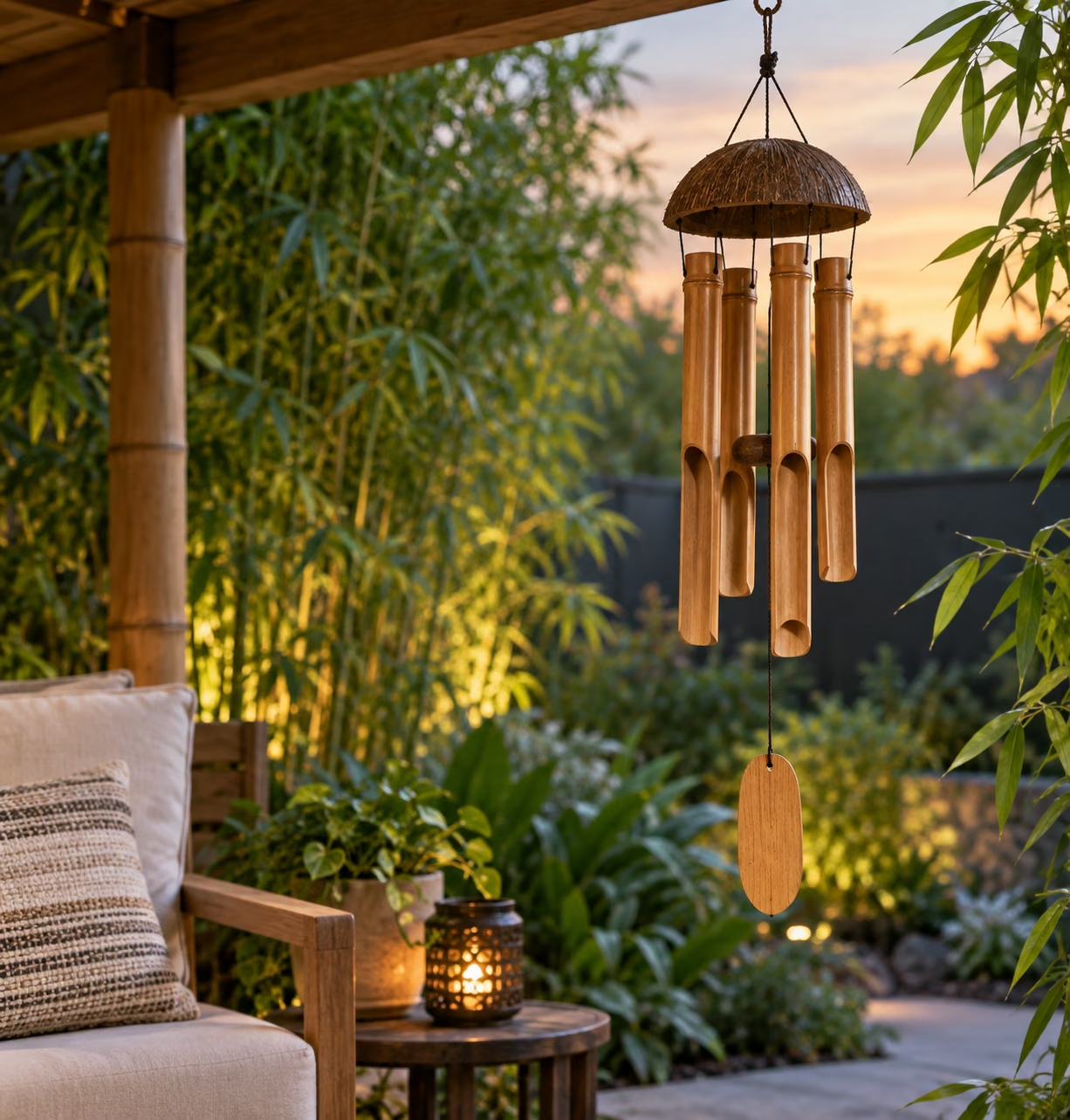
For the smallest finishing touch, add a bamboo wind chime beside a porch, pergola, or sheltered seating area.
Choose a simple design with visible bamboo tubes rather than something crowded with ornaments. Bamboo-tube chimes are an established garden accessory, including designs made with a small coconut top.
Hang it where the pieces have room to move without hitting a wall, plant, or person. Listen to the sound before choosing its final position, and keep neighboring windows in mind.
One chime is enough. Let it become a small detail you notice while enjoying the garden, rather than another feature competing for attention.
Start with the Idea Your Garden Actually Needs
You do not need to use bamboo everywhere. A single planter, a useful trellis, or one carefully positioned screen may be the right starting point.
Choose your favorite bamboo garden ideas by the job they will do: soften a view, support a crop, define an entrance, or make a seating area more inviting. Then plan the space around how you will actually use it. The best result is not simply a garden that looks good in a picture, but one you enjoy spending time in.