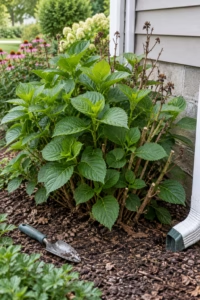
Why are my hydrangeas not flowering? Hydrangea shrubs that produce healthy leaves but no blooms usually have lost flower buds, received mistimed pruning, lacked sufficient light, or received excessive nitrogen. The correct remedy depends on whether the plant flowers on old wood or new wood, because that determines when buds form and which stems must survive winter.
Key Facts About a Nonflowering Hydrangea
- Bigleaf and oakleaf hydrangeas usually form flower buds on old wood during late summer and autumn.
- Panicle and smooth hydrangeas form flowers on new growth produced during the current season.
- A minimum of 4-6 hours of suitable light usually supports flowering, although hot afternoon sun can scorch some bigleaf cultivars.
- Fall or spring pruning can remove the next crop of flowers from old-wood types.
- Nitrogen-rich lawn fertilizer often produces large leaves and long stems while reducing reproductive growth.
- A newly planted hydrangea may need 2-3 growing seasons to establish before flowering heavily.
A hydrangea is not necessarily unhealthy when foliage is abundant and flowers are absent. Leaves indicate that the plant can photosynthesize, but flowering requires mature stems, viable buds, adequate light, sufficient water, and a seasonal signal to shift from vegetative growth to reproduction.
The most useful first diagnosis is simple: identify the hydrangea type, inspect the stems, and reconstruct the pruning and weather history. A shrub that was cut back in October has a different problem from one whose buds turned brown after a May freeze.
Why Are My Hydrangeas Not Flowering?
The four highest-probability causes are wrong pruning timing, winter or spring bud damage, insufficient light, and excessive nitrogen. Hydrangeas can also fail because of drought stress, root damage, transplant shock, immature plants, deer browsing, or a cultivar that is poorly matched to the local climate.
Flowering failure is usually a timing problem rather than a permanent decline. The plant may be growing vigorously while the structures that would have produced flowers were removed or killed months earlier.
In practice, the fastest diagnostic sequence is:
- Identify the species or cultivar from its label, flower shape, leaf shape, or previous blooms.
- Determine whether the plant flowers on old wood, new wood, or both.
- Look for living buds on last year’s stems.
- Count direct or filtered light during the growing season.
- Review pruning, fertilizer, drought, frost, and browsing events.
- Correct only the factor supported by the evidence.
Expert insight: green leaves do not prove that flower buds survived
A hydrangea can leaf out from lower buds after its terminal flower buds have died. This is common after late freezes on bigleaf hydrangeas. The resulting shrub looks vigorous, but the new leaves are growing from replacement buds that were not programmed to flower that year.
How Hydrangea Flower Buds Form
Flowering depends on the age of the wood carrying the buds. Old-wood hydrangeas initiate flower buds near the end of the current growing season, while new-wood hydrangeas initiate buds on spring and summer growth.
Old wood and new wood compared
| Hydrangea group | Common examples | Flowering wood | Main pruning window | Typical light preference |
|---|---|---|---|---|
| Bigleaf, Hydrangea macrophylla | Nikko Blue, Endless Summer | Old wood, some remontant cultivars also use new wood | Immediately after flowering, or minimal pruning | Morning sun, afternoon shade |
| Oakleaf, Hydrangea quercifolia | Alice, Ruby Slippers | Old wood | Immediately after flowering | Dappled shade to part sun |
| Panicle, Hydrangea paniculata | Limelight, PeeGee | New wood | Late winter to early spring | Full sun to partial shade |
| Smooth, Hydrangea arborescens | Annabelle, Incrediball | New wood | Late winter to early spring | Morning sun, afternoon shade |
Old-wood buds are often located near the ends of mature stems. Cutting those stems in autumn, winter, or early spring can remove the flower crop before the plant has a chance to bloom.
New-wood types are more forgiving because winter can kill the previous season’s stems without necessarily eliminating the next season’s flowers. The plant produces fresh shoots from surviving stems or the crown, then forms buds on those shoots.
Some modern bigleaf cultivars are remontant, also called reblooming. They may flower from surviving old wood and later from new growth. Reblooming does not make them immune to frost or severe pruning, because early flowers still depend on overwintered buds.
Which Hydrangea Types Are Most Likely to Lose Flowers?
Bigleaf and oakleaf hydrangeas are most vulnerable to flowering failure after untimely pruning or cold injury because both rely heavily on overwintered buds. Panicle and smooth hydrangeas generally recover more reliably after winter damage because their flower buds form on current-season shoots.
| Failure situation | Old-wood hydrangea response | New-wood hydrangea response | Likely flowering result |
|---|---|---|---|
| Cut to 15 cm in autumn | Most flower stems removed | New shoots may replace stems | No flowers or delayed flowers |
| Buds freeze in April | Replacement foliage may grow | New shoots can form later | Old-wood bloom loss, new-wood recovery possible |
| Severe winter stem dieback | Crown may survive without flower-bearing stems | Crown can produce flowering shoots | Delayed or absent bloom |
| Light reduced by mature tree | Fewer buds form | Long, weak shoots form | Sparse flowers in both groups |
| High-nitrogen lawn runoff | Leafy growth and soft stems | Leafy growth and weak flowering | Flowering reduced |
How to identify the bloom wood without a plant label
Watch where spring growth begins. Old-wood shrubs usually leaf out along existing woody stems, with buds appearing on brown, mature branches. New-wood shrubs often produce vigorous shoots from the base or from lower surviving nodes.
This test is not perfect for remontant bigleaf cultivars, which can use both wood ages. A nursery label, cultivar name, or photograph of the previous year’s flowers provides stronger identification.
How Pruning Prevents Hydrangea Flowers
Pruning prevents flowers when the cut removes stems carrying viable buds. The most damaging mistake is treating every hydrangea like a new-wood shrub and cutting it back during autumn cleanup.
Pruning rules by hydrangea group
| Group | What to remove | Safe timing | What happens after incorrect pruning |
|---|---|---|---|
| Bigleaf | Dead stems and selected old blooms | After flowering or after spring leaf-out confirms dead wood | Next season’s flowers may disappear |
| Oakleaf | Dead, damaged, or overcrowded wood | After summer flowering | Autumn pruning removes terminal buds |
| Panicle | Weak, crossing, or excessively long stems | Late winter to early spring | Usually fewer flowers, but recovery is common |
| Smooth | Weak stems and selected old growth | Late winter to early spring | New shoots usually flower later that season |
For old-wood plants, wait until late spring to remove stems that have not leafed out. Scratch a small area of bark with a fingernail. Green tissue indicates living wood; brown, dry tissue indicates dead wood. Make the cut below the dead section, stopping when healthy tissue appears.
Do not cut a hydrangea to the ground merely because the stems look untidy. The plant’s appearance in winter does not reveal whether those stems carry next year’s flowers.
What if the shrub was already pruned?
If an old-wood hydrangea was cut back before flowering, there is usually no immediate pruning correction. Allow new shoots to grow, maintain even moisture, and wait for the next bud-setting cycle. A remontant cultivar may produce late flowers on new growth, but a traditional cultivar may need until the following year.
Panicle and smooth hydrangeas tolerate more aggressive rejuvenation. Even so, removing all stems every year can delay flowering, weaken structure, and produce floppy shoots under large flower heads.
How Frost Damages Hydrangea Buds
Late frost kills exposed flower buds when temperatures fall below the buds’ tolerance after spring growth has begun. Bigleaf hydrangeas are particularly vulnerable because their overwintered buds swell early, often before the last spring freeze has passed.
Frost damage commonly appears as blackened or brown terminal buds, limp new leaves, and stems that later leaf out from lower nodes. The plant may remain green while the flower-bearing tips are dead.
| Symptom after a freeze | Probable cause | Recommended response |
|---|---|---|
| Brown terminal buds, green lower leaves | Flower-bud frost injury | Wait for lower buds to develop |
| Entire young shoot blackened | Severe freeze damage | Delay pruning until leaf-out is complete |
| Wilted leaves recover by afternoon | Cold or wind stress | Water consistently, avoid immediate cutting |
| Cracked bark near the crown | Severe cold or mechanical injury | Remove only clearly dead wood |
| No new growth by late spring | Root or crown damage | Check moisture, drainage, and plant viability |
Protect old-wood hydrangeas during forecast freezes with breathable frost cloth supported by stakes. Covering plants with plastic directly against foliage can trap cold moisture, cause abrasion, and intensify heat after sunrise.
Burlap can reduce wind exposure, but it is not a guaranteed freeze shield. The most reliable long-term solution is often site selection: place vulnerable bigleaf hydrangeas near a building, wall, hedge, or sheltered courtyard rather than in an exposed frost pocket.
How Much Sunlight Does a Hydrangea Need?
Most flowering hydrangeas need approximately 4-6 hours of useful light, but the suitable amount depends on species, climate, soil moisture, and time of day. Deep shade reduces bud formation, while intense afternoon sun can scorch bigleaf leaves and increase water stress.
Morning sunlight is generally safer for bigleaf and smooth hydrangeas in warm climates. Panicle hydrangeas tolerate and often prefer more sun, especially where the soil remains evenly moist.
Track light in summer rather than relying on winter observations. A deciduous tree can create full shade after leaf-out, and a site that appears sunny in March may receive only two hours by June.
Signs that light is the limiting factor
- Long, thin stems lean toward an opening in the canopy.
- Leaves remain large and green, but flower clusters are small or absent.
- The plant receives less than four hours of direct or bright filtered light.
- Flowering improves on the outer side of the shrub nearest a path or lawn.
- Shade increases after nearby trees leaf out.
Do not solve a shade problem by applying more fertilizer. Extra nitrogen can make low-light growth softer and leafier without creating the energy surplus required for flowers.
Can Fertilizer Stop Hydrangeas From Flowering?
Excess nitrogen can suppress flowering by directing resources toward leaves and stems, especially when hydrangeas receive lawn fertilizer or repeated high-nitrogen applications. The first number on a fertilizer label represents nitrogen, so a product marked 24-4-8 supplies substantially more nitrogen than a low-nitrogen formulation.
A fertilizer with a high middle number is not automatically a flowering cure. Phosphorus deficiency is uncommon in many garden soils, and unnecessary phosphorus can accumulate and contribute to water-quality problems. Test the soil before using a phosphorus-heavy product.
| Fertilizer or soil action | Typical cost | Best use | Main limitation |
|---|---|---|---|
| Laboratory soil test | $20-$45 | Measures pH, nutrients, and organic matter | Results take several days |
| Home soil test kit | $15-$30 | Basic pH and nutrient screening | Less precise than laboratory testing |
| Balanced slow-release fertilizer | $10-$25 per bag | Mild nutrient support when soil is deficient | Does not fix shade or pruning |
| High-nitrogen lawn fertilizer | $15-$40 per bag | Turf growth only | Runoff can increase leafy hydrangea growth |
| Phosphorus-containing amendment | $10-$30 | Confirmed phosphorus deficiency | Unnecessary application can accumulate phosphorus |
Keep lawn fertilizer away from the hydrangea root zone, particularly where irrigation or rainfall carries dissolved nutrients toward the shrub. A practical boundary is at least 3-4 feet beyond the drip line when possible.
Hydrangeas generally benefit more from consistent moisture, compost-based soil improvement, and correct light than from aggressive feeding. Fertilize only after diagnosing a nutrient need.
Other Causes of Missing Hydrangea Flowers
Water stress, root damage, browsing, disease, and transplant shock can reduce flowering even when pruning and light are appropriate. These causes usually leave additional symptoms that distinguish them from simple bud loss.
Newly planted hydrangeas
A newly planted shrub may spend its first 2-3 growing seasons developing roots and shoots rather than producing a full flower display. Container-grown plants can also suffer root circling, while bare-root or recently divided plants may need longer to reestablish.
Remove only damaged or dead growth during establishment. Heavy pruning, drought, and repeated relocation extend the recovery period.
Drought and irregular watering
Flower buds need adequate moisture during formation, particularly in late summer for old-wood types. A shrub that repeatedly wilts may abort buds, produce smaller flower heads, or enter dormancy early.
Water slowly and deeply when the upper 5-8 cm of soil dries, adjusting for rainfall and soil type. Mulch 5-8 cm deep over the root zone, but keep mulch several centimeters away from the stems.
Deer, rabbits, and stem browsing
Browsed terminal stems can remove old-wood flower buds without killing the plant. Jagged stems, missing tips, and browse lines indicate an animal rather than a fertilizer problem.
Use fencing or a locally appropriate repellant strategy. Pruning all browsed stems immediately can remove additional viable buds, so wait until you can distinguish living from dead wood.
Root and crown problems
Poor drainage, compacted soil, construction damage, and circling roots can reduce the water and oxygen available to the plant. Yellow foliage, persistent wilting despite wet soil, mushroom-like growth near the crown, or gradual decline suggests a root-zone problem.
Hydrangeas prefer moisture-retentive but well-drained soil. Moving a shrub is sometimes necessary, but transplanting during hot weather adds stress and can sacrifice the following season’s flowers.
A Seasonal Recovery Plan
The best recovery plan begins with diagnosis and avoids several simultaneous changes. Changing pruning, fertilizer, location, and watering at once makes it impossible to identify which factor mattered.
- Photograph the plant and stems. Record leaf condition, dead tips, browsing, and flower-bud location.
- Identify the hydrangea group. Check the label, cultivar name, flower shape, and previous pruning history.
- Inspect living wood. Wait until spring growth is visible, then remove only sections that remain dry and brown.
- Measure light. Check the site at midmorning, midday, and midafternoon after nearby trees have leafed out.
- Test moisture and drainage. Dig 10-15 cm into the soil; it should feel cool and moist, not saturated.
- Stop unnecessary fertilizer. Particularly avoid lawn products and high-nitrogen feeds near the shrub.
- Protect viable old wood. Use frost cloth before a predicted freeze and remove it after temperatures moderate.
- Review results next season. Compare bud survival, stem growth, and flower production before making further changes.
Expert insight: do not prune dead-looking wood too early
A frost-damaged hydrangea can look lifeless at the tips while lower nodes remain capable of growth. Waiting until late spring reveals which sections are truly dead and prevents the gardener from removing living wood that could still support flowers.
Reliable Flowering Alternatives
Gardeners in cold regions who want more dependable flowering should consider hydrangeas that bloom on new wood, especially panicle and smooth types. These groups still require appropriate light and moisture, but their flower buds are not dependent on surviving the previous winter.
| Goal | Suitable choice | Advantage | Trade-off |
|---|---|---|---|
| Reliable flowers after cold winters | Panicle hydrangea, such as Limelight | New-wood flowering | Needs more light and space |
| Large rounded flower heads | Smooth hydrangea, such as Annabelle | Flowers on current growth | Stems may flop without support |
| Blue or pink flowers | Bigleaf hydrangea | Color responds to soil chemistry and cultivar | Old-wood buds are frost-sensitive |
| Textured foliage and autumn color | Oakleaf hydrangea | Ornamental leaves and peeling bark | Old-wood pruning rules apply |
| Small garden or container | Compact reblooming bigleaf cultivar | Manageable size and possible repeat bloom | Winter protection may still be needed |
Soil pH mainly changes flower color in suitable bigleaf cultivars; it does not reliably make a deeply shaded hydrangea flower. Aluminum availability, cultivar genetics, and soil chemistry all affect whether a plant turns blue, purple, or pink.
When to Replace Rather Than Rescue a Hydrangea
Replacement makes sense when the plant repeatedly fails because the site cannot provide its basic requirements. A shade-obstructed bigleaf hydrangea, a root-damaged shrub beside a foundation, or a tender cultivar in an exposed cold site may never perform reliably without major landscape changes.
Rescue the plant when the root crown is healthy, stems are producing leaves, and the main problem is a correctable timing error. One missed flowering season after pruning or frost does not justify removal.
Before replacing a shrub, consider moving it during dormancy to a site with suitable light and drainage. The move may sacrifice one season of flowers, but matching the cultivar to the site is often more effective than increasing fertilizer or pruning frequency.
Frequently Asked Questions About Why Are My Hydrangeas Not Flowering?
Will hydrangeas flower after being cut back to the ground?
New-wood panicle and smooth hydrangeas can usually regrow and flower after severe cutting, although flowering may be delayed and stems may become weak. Old-wood bigleaf and oakleaf hydrangeas may produce foliage but no flowers because the pruning removed their overwintered buds.
Should I change soil pH to make hydrangeas bloom?
Changing soil pH is usually unnecessary for flowering. Soil pH mainly influences blue or pink color in some bigleaf cultivars. Flower production depends more directly on bloom wood, pruning timing, light, moisture, plant maturity, and survival of flower buds.
Can a hydrangea flower in full shade?
A hydrangea may survive in bright shade, but deep shade commonly reduces or eliminates flowering because the plant receives insufficient energy for bud formation. Move the shrub, selectively prune nearby branches, or choose a site with approximately 4-6 hours of suitable light.
Why does my hydrangea have leaves but no buds after winter?
Leaves without buds usually indicate that flower buds were killed by frost, removed by pruning, or damaged by browsing. This pattern is especially common on bigleaf hydrangeas, which carry flower buds through winter on last year’s stems.
Should I use coffee grounds or banana peels for more flowers?
Coffee grounds and banana peels do not provide a predictable flowering solution. They can alter soil conditions slowly or attract pests when used improperly. A soil test, consistent irrigation, suitable light, and type-appropriate pruning provide more reliable results.
How long should I wait before deciding the plant will not bloom?
Wait until the shrub has completed its normal flowering window and late-season bud formation has occurred. A newly planted hydrangea may need 2-3 seasons, while an established plant that loses buds to frost may recover during the next suitable bud-setting cycle.
Conclusion
Why are my hydrangeas not flowering? Start with bloom wood, pruning timing, frost history, light, and nitrogen exposure. Old-wood hydrangeas need their mature stems protected, while new-wood types offer more reliable recovery after winter damage. Once the cause is identified, modest changes to pruning, site exposure, watering, and fertilizer usually produce better flowers than aggressive feeding or repeated cutting.