
Picture a quiet corner of your yard where gray stones sit in a bed of raked gravel, a Japanese maple leans over a mossy path, and the only sound is water dripping into a stone basin. It feels calm the moment you step into it.
That’s the lasting appeal of a Japanese garden. It isn’t about filling every inch with flowers. Instead, it uses stone, water, carefully chosen plants, and open space to create a place that feels peaceful in every season. The good news is that you don’t need a large property or a big budget to bring that feeling home.
These 27 Japanese garden ideas include dry rock gardens, stepping stone paths, lanterns, water basins, bamboo fences, and plant combinations that work in ordinary backyards, side yards, front yards, and even balconies. Start with one idea or combine several to create your own Zen-inspired retreat.
1. Create a Dry Rock Garden With Raked Gravel
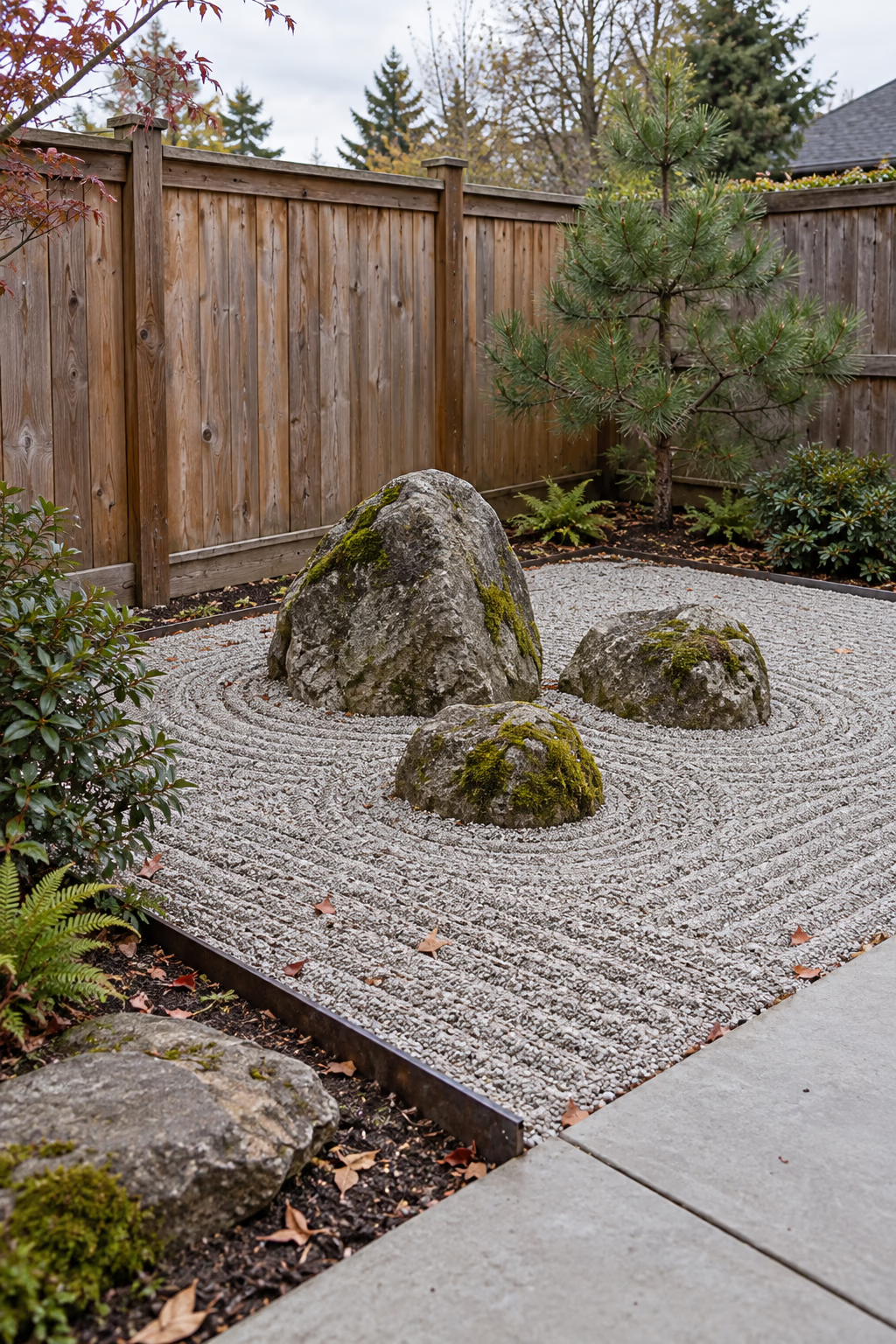
The classic Zen look in a small, flat space
A dry garden, known in Japan as karesansui, uses gravel to suggest water and stones to suggest mountains or islands. Even a level patch about 6 by 8 feet beside a patio is enough to create one.
Remove the turf, level the soil, lay a permeable landscape fabric, and spread 2 to 3 inches of fine, light-colored gravel or crushed granite. Then set a few weathered stones so they look as if they rise naturally from the ground rather than sitting on top of it.
Keep a wide-tooth rake nearby. Raking fresh lines around the stones is part of the enjoyment, and you’ll want to tidy the surface after heavy rain or leaf fall.
2. Anchor the Garden With Grouped Boulders
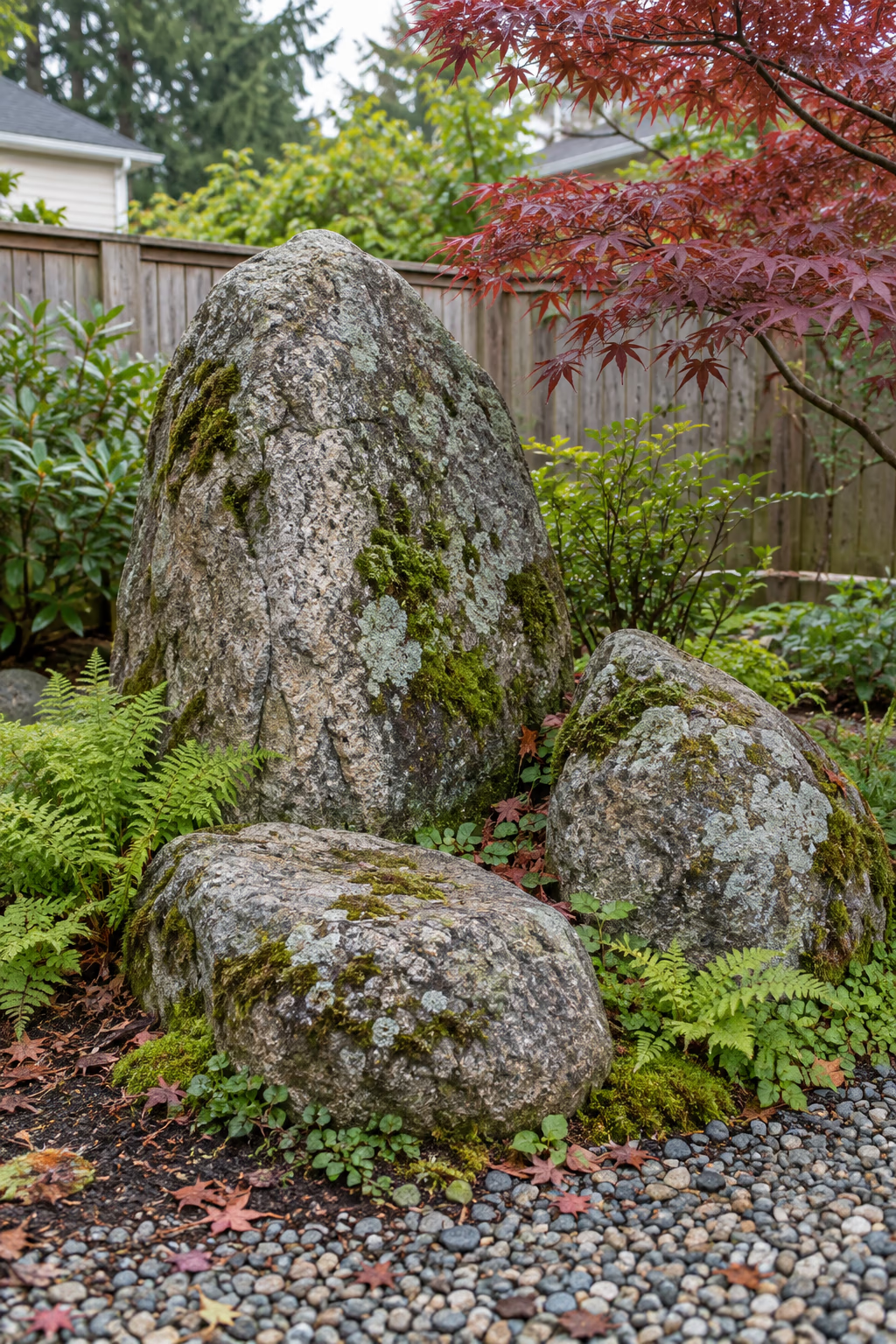
Let a few strong stones set the mood
Stones are the backbone of Japanese garden design. Instead of lining rocks up in a row, place them in small, asymmetrical groups of three or five, with one dominant stone and smaller companions nearby.
Bury each boulder by a third or more so it looks rooted in place. Weathered stone with natural texture, lichen, or rounded edges usually looks more convincing than freshly quarried rock.
Large boulders are extremely heavy. Many stone yards will deliver and position them with equipment, which is much safer than trying to roll them into place by hand.
3. Lay a Stepping Stone Path Through Moss
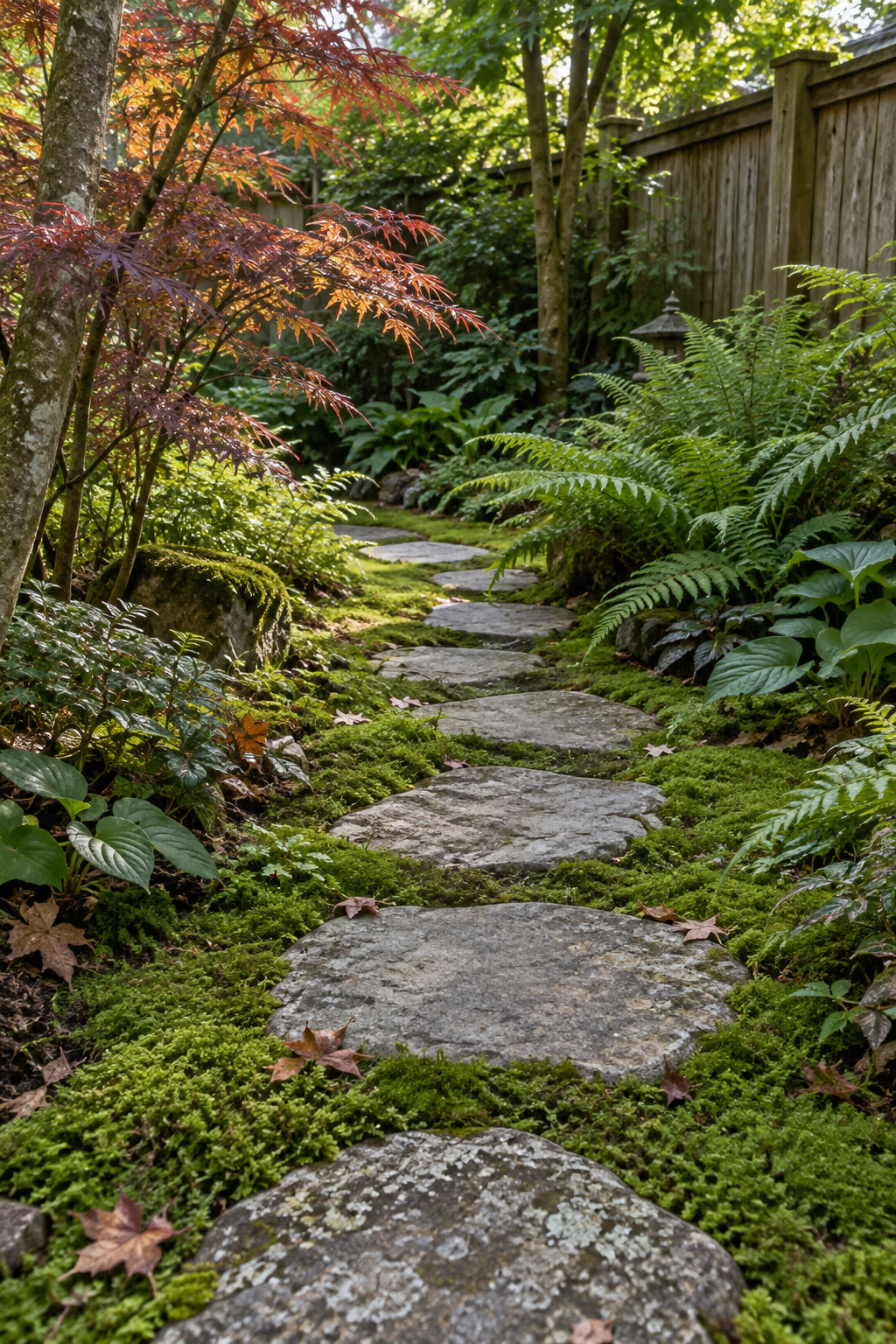
A path that invites you to slow down
Traditional stepping stones, called tobi-ishi, are spaced so that you look down and move at a slower pace. A curving line of flat stones through moss, ground cover, or fine gravel instantly gives a yard a Japanese feel.
Choose flat, stable stones at least 12 inches across with a non-slip surface. Set them on a compacted base of sand or gravel so they don’t rock, and keep the tops slightly above the surrounding ground.
Walk the route before setting the stones to find a comfortable stride. Stones in deep shade can become slippery when moss creeps over them, so scrub them occasionally if the path gets regular use.
4. Stagger Stepping Stones in a Narrow Side Yard
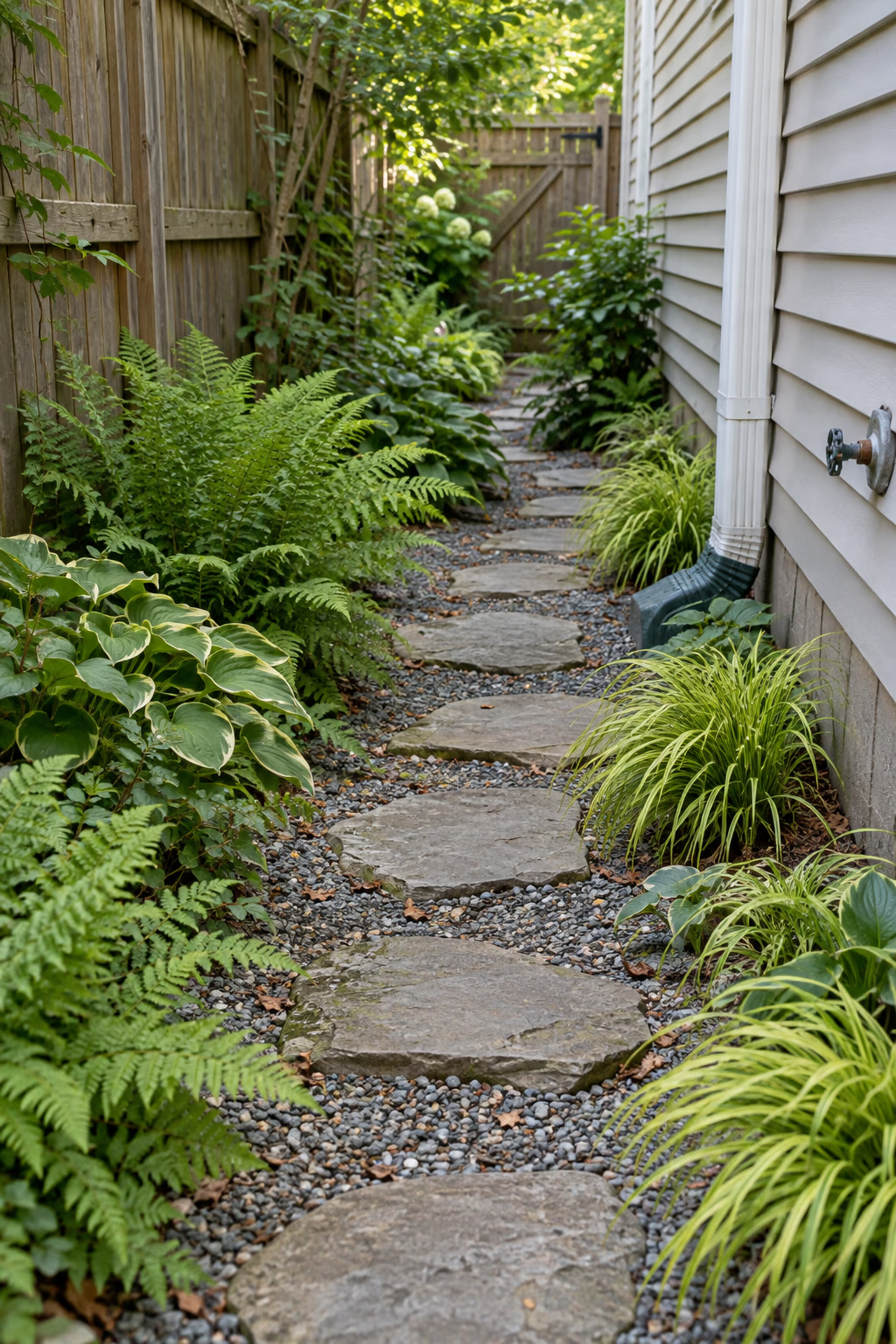
Turn a forgotten passage into a garden walk
Side yards are often long, narrow, and shady, which makes them perfect for a simple Japanese-style path. Instead of running stones straight down the middle, stagger them slightly left and right in a gentle zigzag.
The offset pattern makes a short distance feel longer and more interesting. Fill the spaces between the stones with fine gravel and edge the path with shade-tolerant plants such as ferns, hostas, or Japanese forest grass.
Keep enough clear width for wheelbarrows, trash bins, or access to utility meters. A beautiful side yard still needs to work as a practical passage.
5. Add a Stone Lantern as a Focal Point
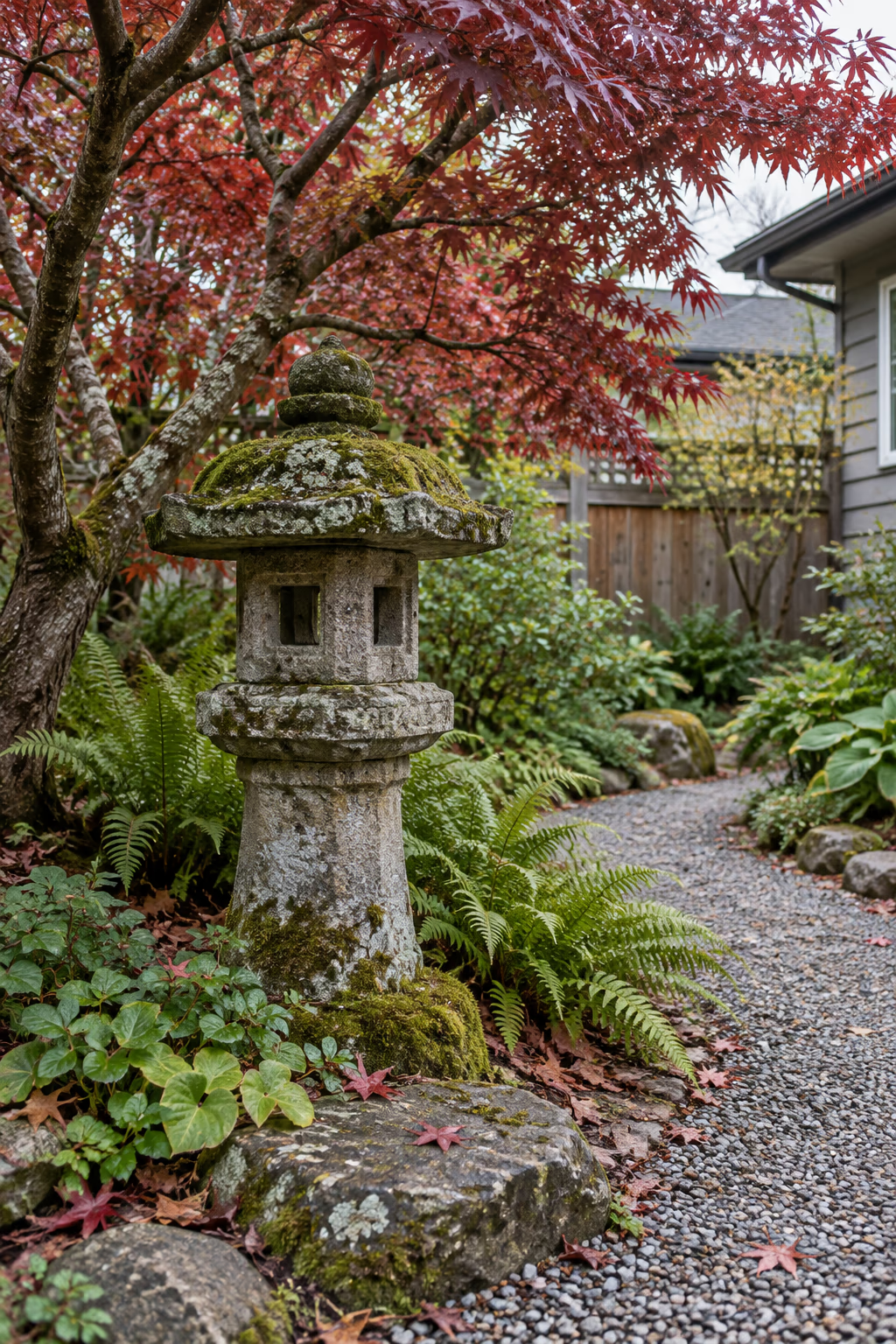
One quiet accent can define the whole garden
Stone lanterns, called toro, are among the most recognizable features of Japanese gardens. Placed at a bend in a path, near water, or beneath a tree, a single lantern draws the eye without overwhelming the space.
For a small yard, a lantern about 2 to 3 feet tall usually looks well proportioned. Cast-concrete versions are more affordable and easier to handle than carved granite, and they weather nicely as moss and lichen develop.
Set the lantern on a level, compacted base so it can’t tip. Avoid placing it in the exact center of the garden; a slightly off-center position feels more natural.
6. Install a Stone Water Basin With a Bamboo Spout
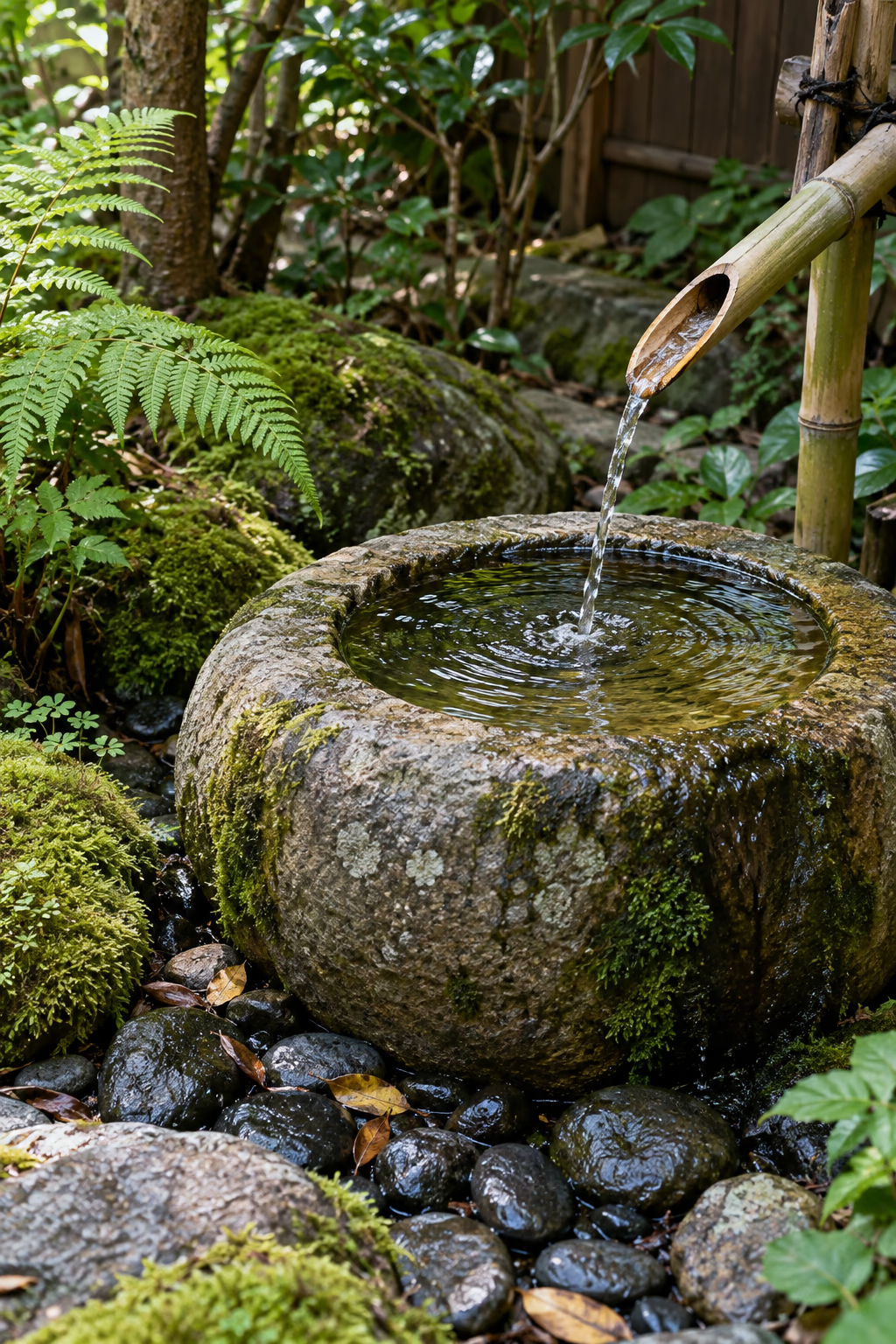
The gentle sound of water in a compact footprint
A tsukubai is a low stone basin traditionally used for washing hands before a tea ceremony. In a home garden, a hollowed stone or stone-look basin with a slow trickle from a bamboo spout brings the same soothing sound to a small corner.
Most backyard versions use a small recirculating pump hidden in a buried reservoir covered with grating and river stones. Surround the basin with a few flat stones, a fern, or a clump of moss to make it feel settled.
Use an outdoor GFCI-protected outlet for the pump and keep the reservoir topped up during hot weather. In freezing climates, drain the basin and bring the pump indoors for winter.
7. Build a Bamboo Shishi-Odoshi Fountain
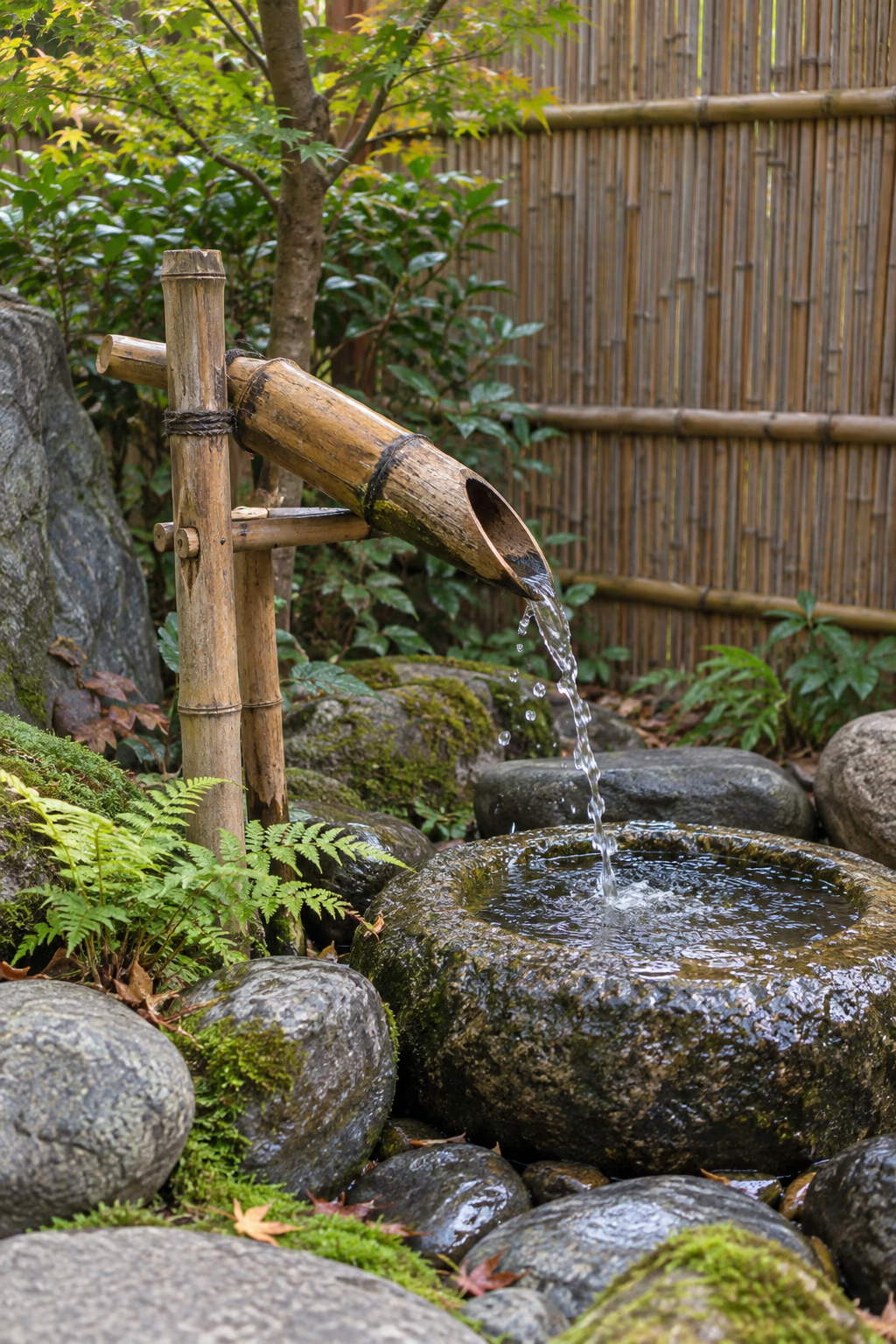
A water feature with rhythm and sound
A shishi-odoshi is a pivoting bamboo tube that slowly fills with water, tips, empties, and swings back to tap a stone with a hollow knock. It was originally used to scare animals away from crops, and it now adds movement and rhythm to many Japanese-style gardens.
Ready-made kits with a pump and basin are widely available, or you can build your own with a small reservoir, a pump, and lengths of sealed bamboo. Arrange rocks and moss around the base so the equipment disappears.
Listen to the knock before you commit to a spot. On a small lot close to neighbors, a quieter tap or a felt pad on the striking stone may be the friendlier choice.
8. Dig a Small Koi Pond
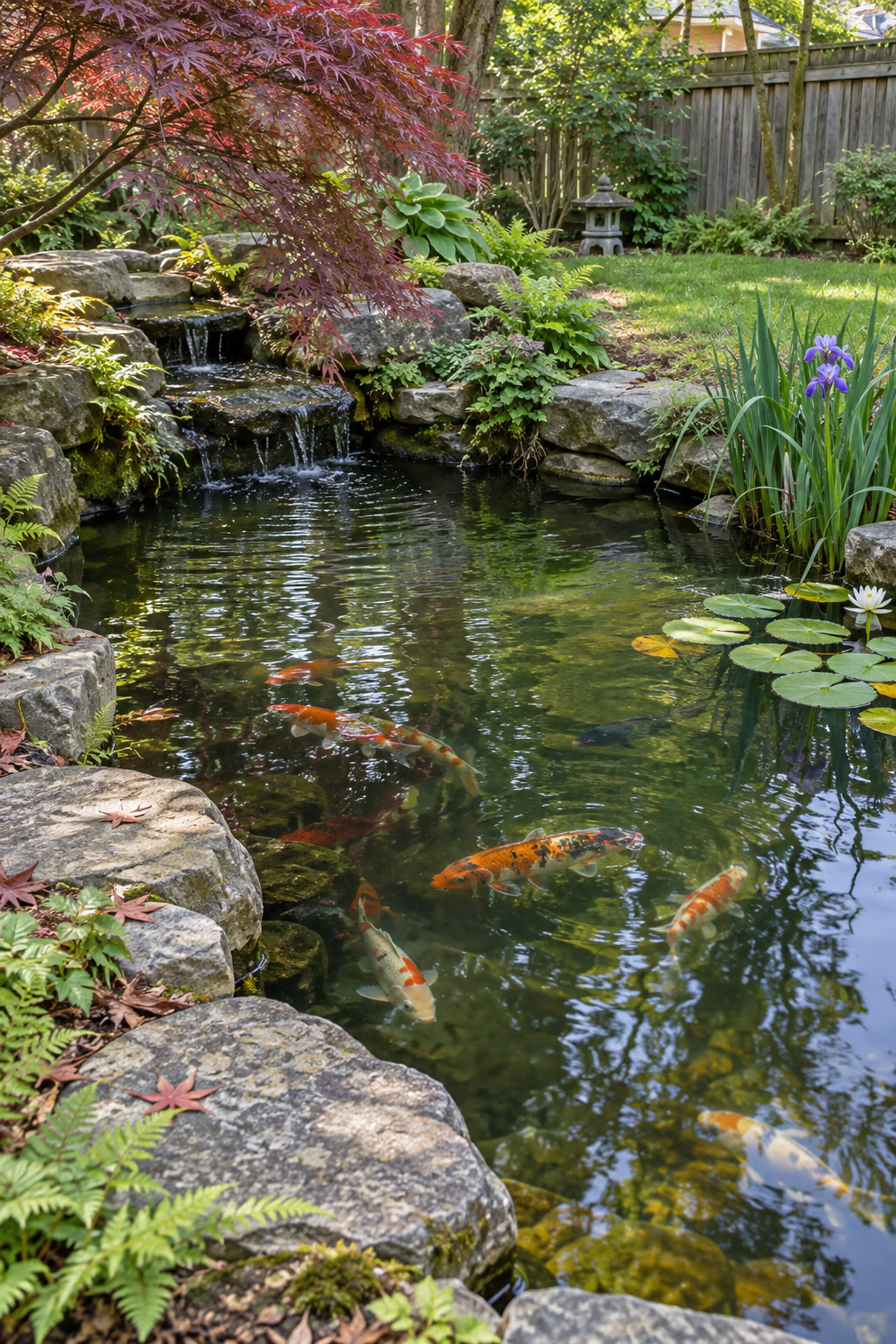
Living color moving through still water
A koi pond is a bigger commitment, but few garden features are as memorable. Natural-looking edges, overhanging plants, and a few large stones help the pond blend into the landscape.
Koi grow large and need plenty of room, depth, and good filtration. Many pond specialists suggest at least 3 feet of depth and roughly 1,000 gallons as a starting point, with deeper water in colder regions so fish can overwinter safely.
Check local rules before digging, since some areas require barriers around deeper water. Plan for herons and raccoons with rock overhangs or netting, and call 811 before excavating in the United States.
9. Choose a Shallow Reflecting Pool Instead
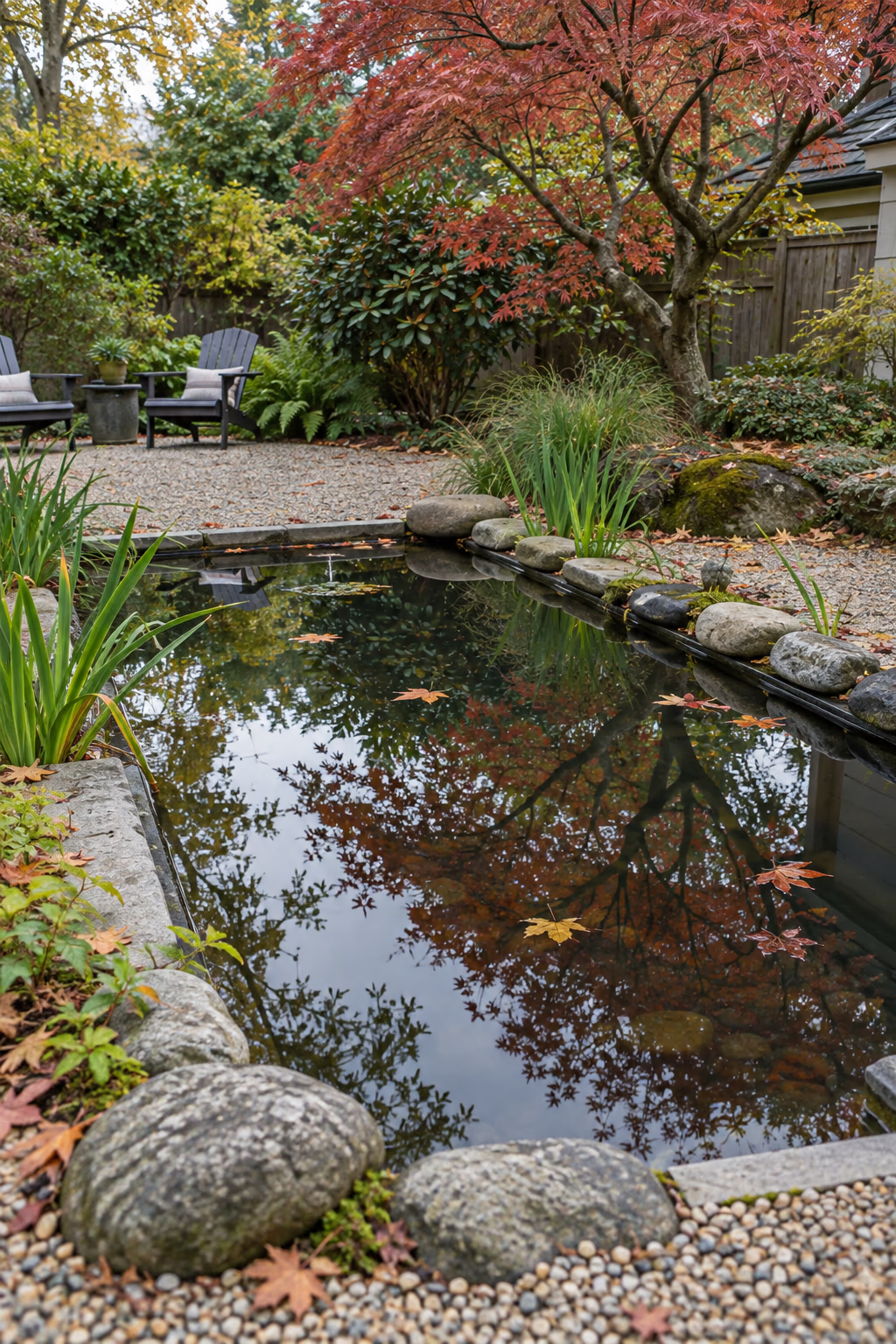
Calm water without fish or heavy filtration
If a koi pond feels like too much, a shallow reflecting pool still brings the beauty of water into the garden. A dark liner or dark basin turns the surface into a mirror for the sky, a maple, or a nearby lantern.
Keep it simple: a pool around 6 to 12 inches deep, edged with smooth river rocks and a few moisture-loving plants such as Japanese iris. Without fish, you won’t need a large filter.
Prevent mosquitoes with a small pump that keeps the water moving or with Bti mosquito dunks. Shallow water is also a safer choice for families with young children, though it should still be supervised.
10. Make a Dry Stream With a Simple Stone Bridge
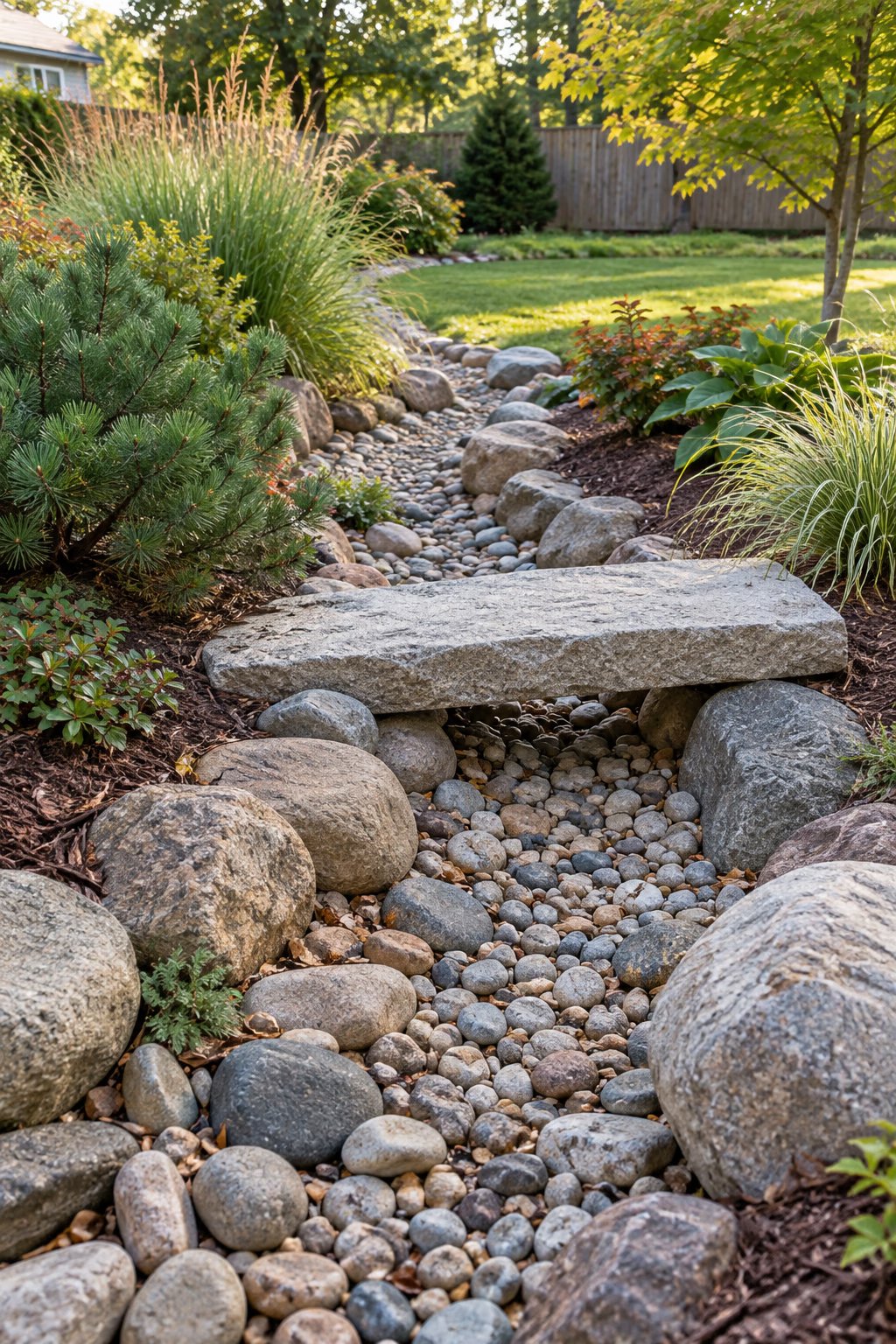
The idea of water, with no pumps at all
A dry streambed suggests a creek using nothing but stone. Lay river rocks of mixed sizes in a meandering channel, with larger stones along the banks and smaller pebbles in the center, as if water had shaped them over time.
Add a single flat slab or a short wooden bridge across the narrowest point. That one crossing turns a decorative feature into a destination and gives the path a reason to exist.
A dry stream can do real work, too. In yards with runoff problems, a gently sloped channel can help move rainwater away from the house and toward a planted area.
11. Carpet Shady Areas With Moss
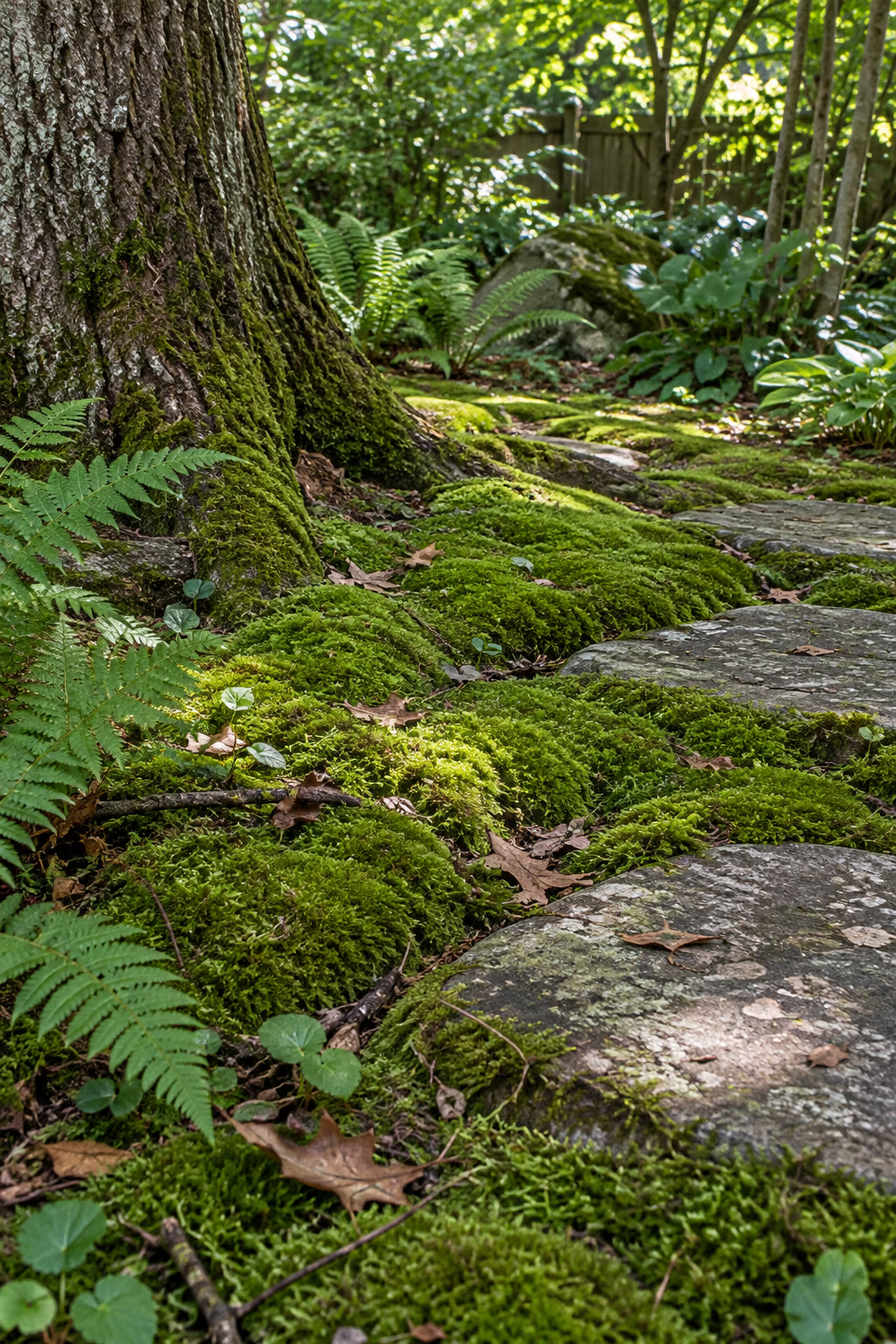
Soft green texture where grass struggles
Moss is a natural choice for the shady, damp corners where lawn grass thins out. Around stepping stones and the base of trees, it creates the soft green carpet found in many famous Japanese gardens.
Moss generally does best in shade, consistent moisture, and firm soil. Clear weeds and fallen leaves, press nursery-grown moss pieces firmly into place, and keep them evenly moist while they establish.
Moss doesn’t handle hot, dry sun or regular foot traffic, so treat it as a ground cover to look at rather than walk on. Buy it from a grower rather than collecting it from the wild.
12. Make a Japanese Maple the Star of the Garden
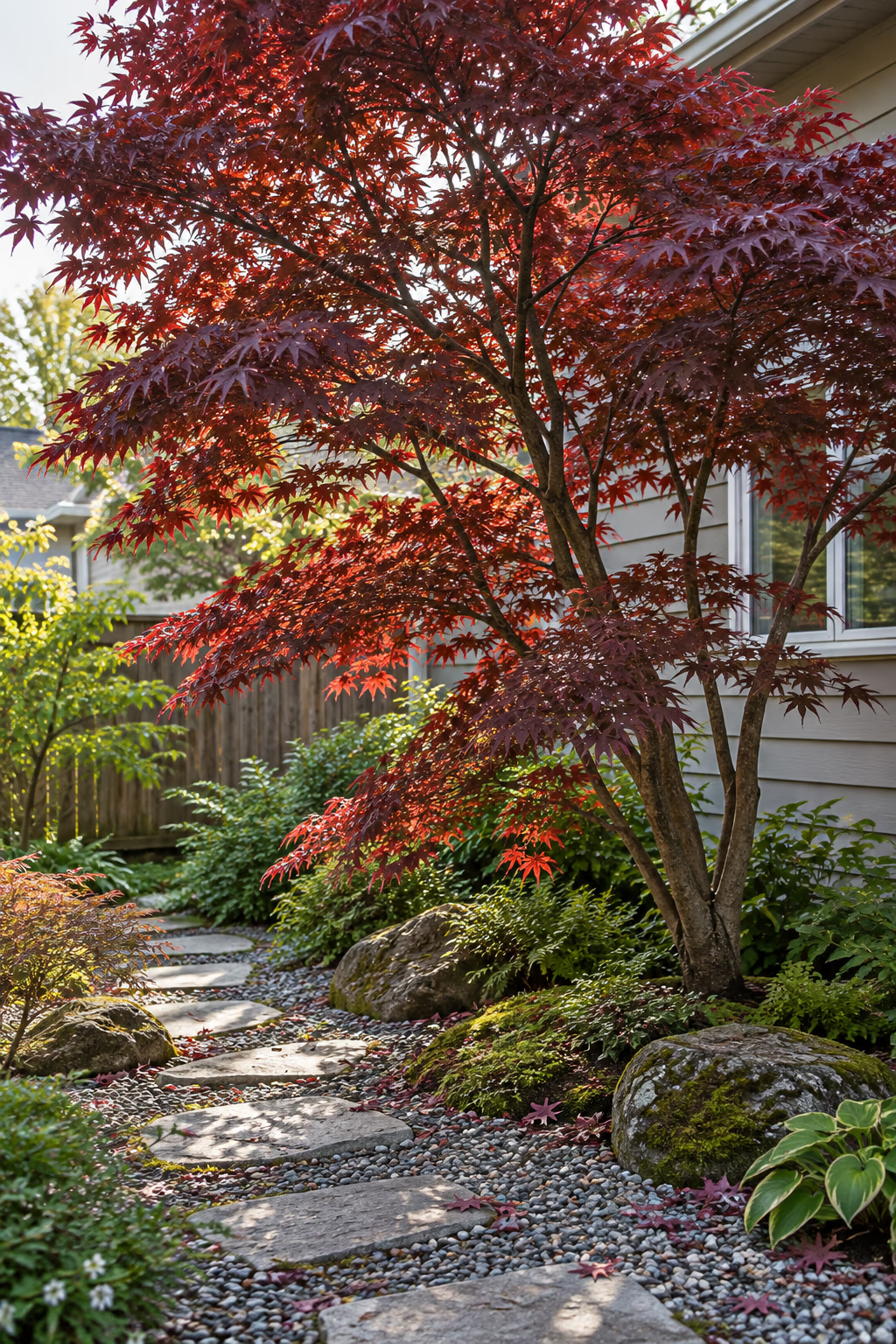
Graceful branches and color through the seasons
Few trees say “Japanese garden” quite like a Japanese maple (Acer palmatum). Its delicate leaves, layered branches, and spring and fall color give a small yard a living centerpiece.
Japanese maples are commonly grown in USDA zones 5 to 8, though hardiness varies by cultivar. In hot regions, give them morning sun and afternoon shade, shelter from drying winds, and a layer of mulch to keep the roots cool.
Check the mature size before planting. Weeping forms like ‘Crimson Queen’ stay relatively small, while upright types such as ‘Bloodgood’ can eventually reach 15 to 20 feet.
13. Grow a Dwarf Maple in a Container
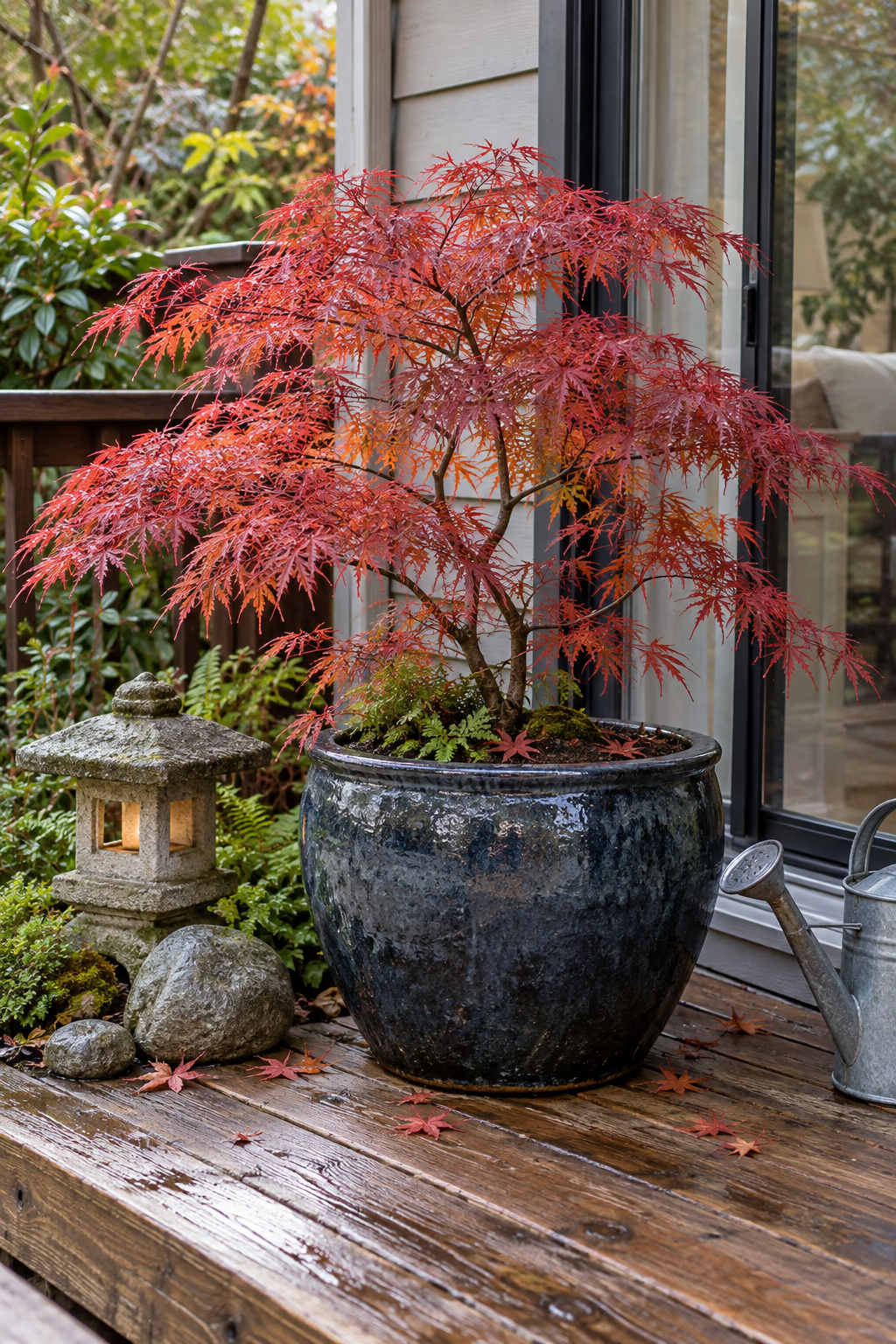
A Japanese garden accent for patios and decks
If you don’t have room for a tree in the ground, a dwarf Japanese maple in a large pot brings the same elegance to a patio, porch, or deck. Slow-growing cultivars stay compact for years.
Choose a wide container with drainage holes and a quality potting mix. A glazed ceramic or simple stone-look pot suits the style, especially when placed beside a few rounded stones or a small lantern.
Container roots are more exposed to cold than roots in the ground. In colder climates, move the pot to a sheltered spot or wrap it for winter, and water deeply during hot spells.
14. Shape a Pine Into Cloud-Pruned Layers
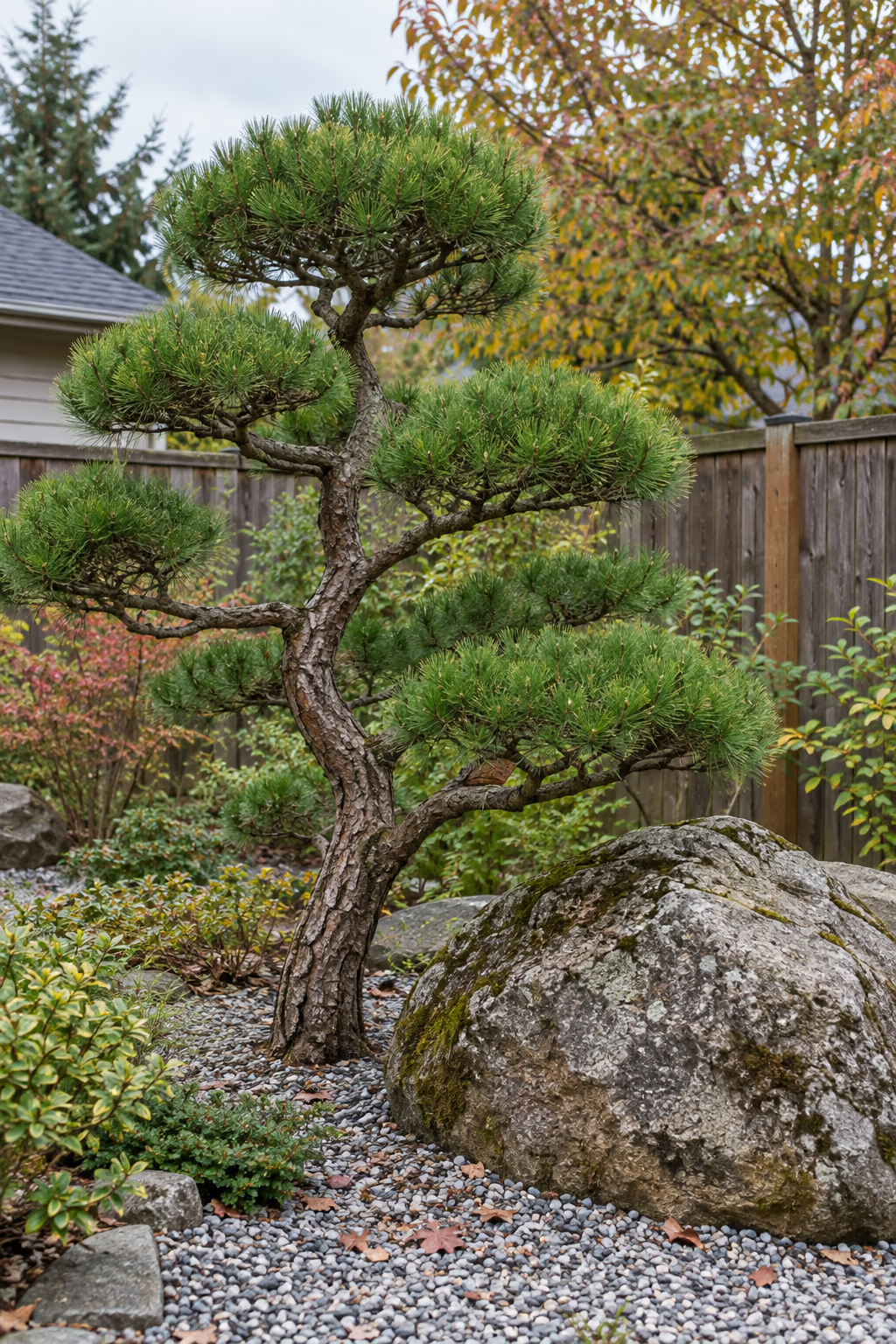
Living sculpture that adds structure all year
Cloud pruning, part of the Japanese art of niwaki, shapes trees and shrubs into rounded pads of foliage on open branches. A single cloud-pruned pine beside a boulder can become the defining feature of a small garden.
Mugo pine, Japanese black pine, and Japanese holly (Ilex crenata) are common choices for this style. Shaping happens gradually through selective pruning, thinning, and pinching new growth over several seasons.
If you’d rather not wait years, some nurseries sell pre-shaped specimens. They cost more, but they give the garden instant maturity.
15. Clip Azaleas Into Rounded Mounds
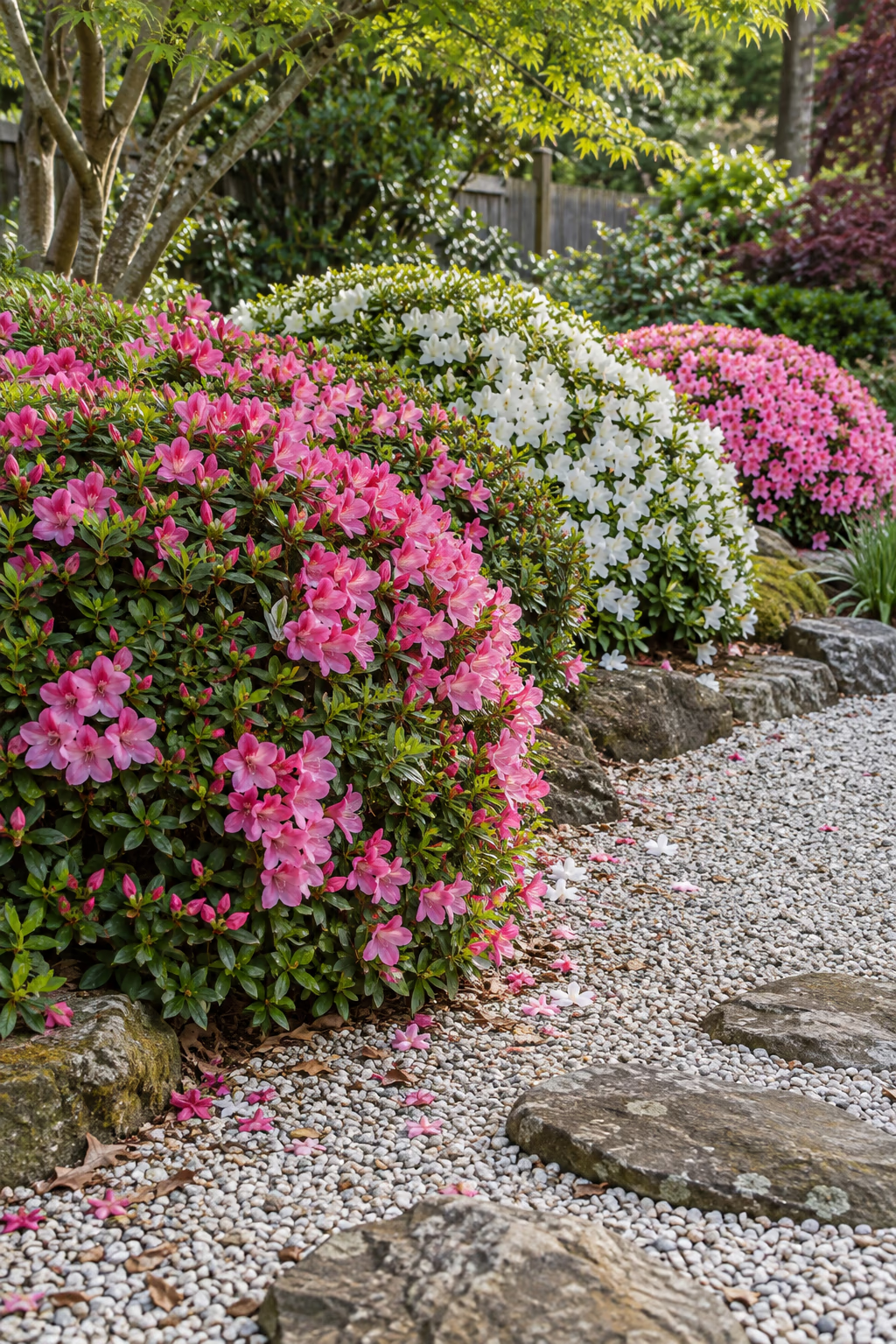
Soft shapes that echo hills and waves
In many Japanese gardens, shrubs are clipped into smooth, rounded forms that suggest rolling hills or waves. Evergreen azaleas are a favorite for this technique, called karikomi, and add a burst of spring color.
Plant several azaleas close together and shape them into flowing mounds of different sizes. Prune right after flowering so you don’t remove the buds for next year’s blooms.
Azaleas prefer acidic, well-drained soil and partial shade. Pair the mounds with gravel or a stone edge to make their shapes stand out.
16. Screen the Yard With Bamboo Fencing
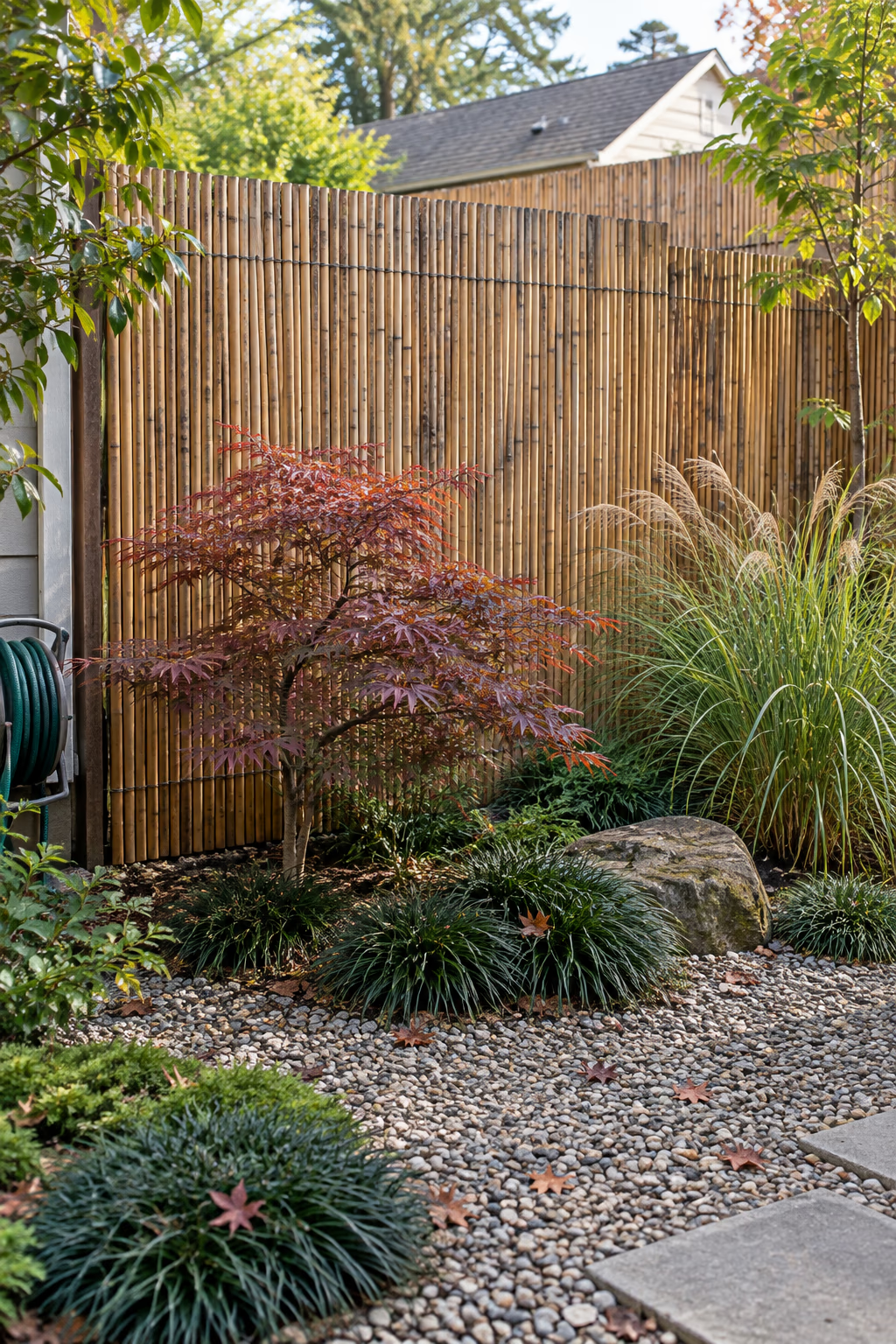
Instant privacy with a natural texture
A bamboo fence creates a quiet, enclosed feeling and gives the garden a clean backdrop. Rolled bamboo screening can be attached to an existing wood or chain-link fence, which makes it one of the fastest ways to change the look of a yard.
Natural bamboo will weather to a soft gray over time. A clear outdoor sealer can slow that process, but expect to replace screening after several years, depending on your climate.
Check local fence height rules and HOA guidelines before adding taller screening, especially along front-yard boundaries.
17. Add a Low Bamboo Lattice Fence
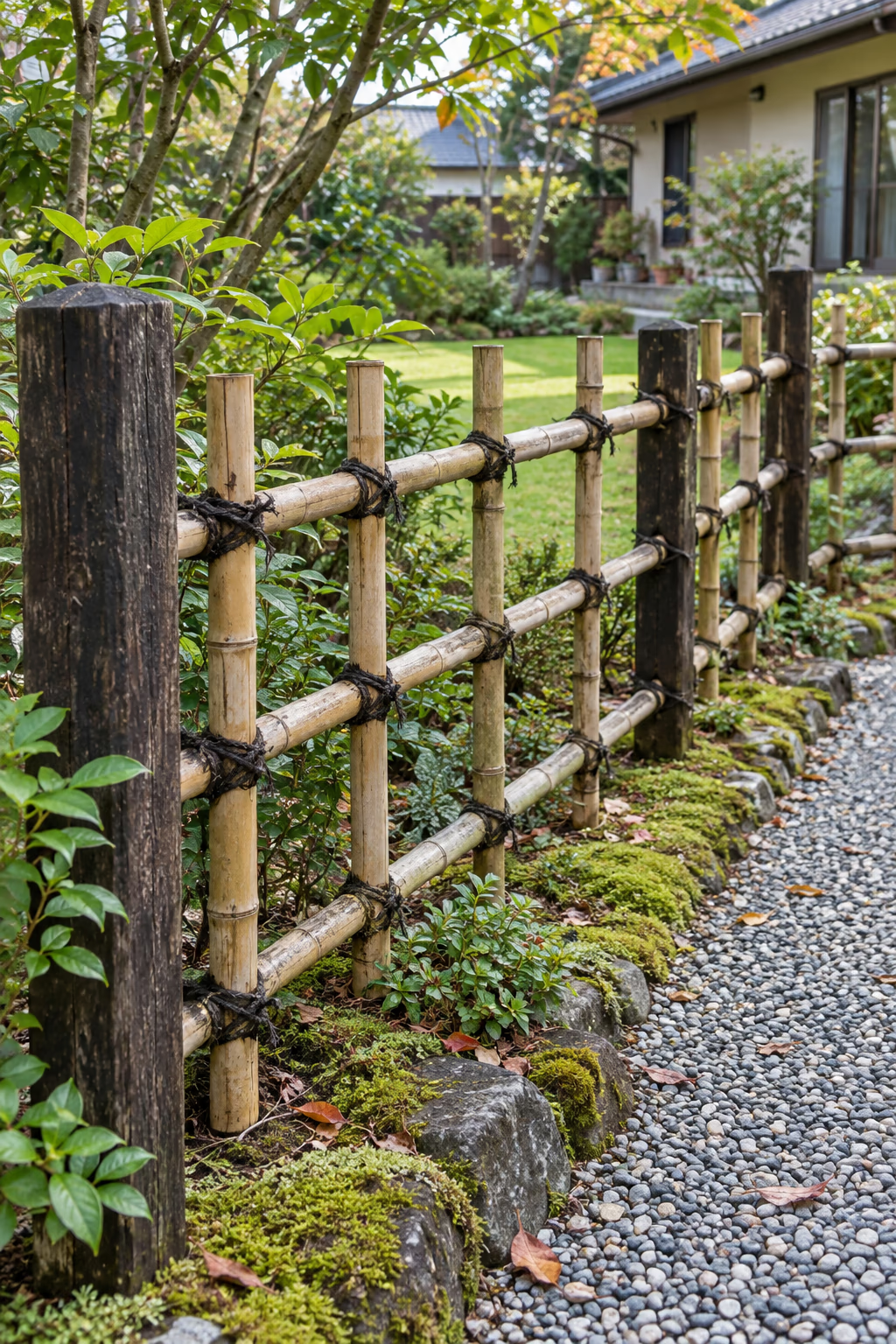
A traditional border that frames without hiding
Not every fence needs to block the view. A low, open lattice fence, inspired by the traditional yotsume-gaki style, uses horizontal and vertical bamboo poles tied together with dark rope to create a simple grid.
This type of fence works well along a path, around a gravel garden, or as a soft divider between two parts of the yard. The hand-tied knots are a beautiful detail and an enjoyable weekend project.
Use treated or naturally durable posts in the ground for stability, then attach the bamboo above. Retie or replace any pieces that loosen over time.
18. Plant Clumping Bamboo, Not Running Bamboo
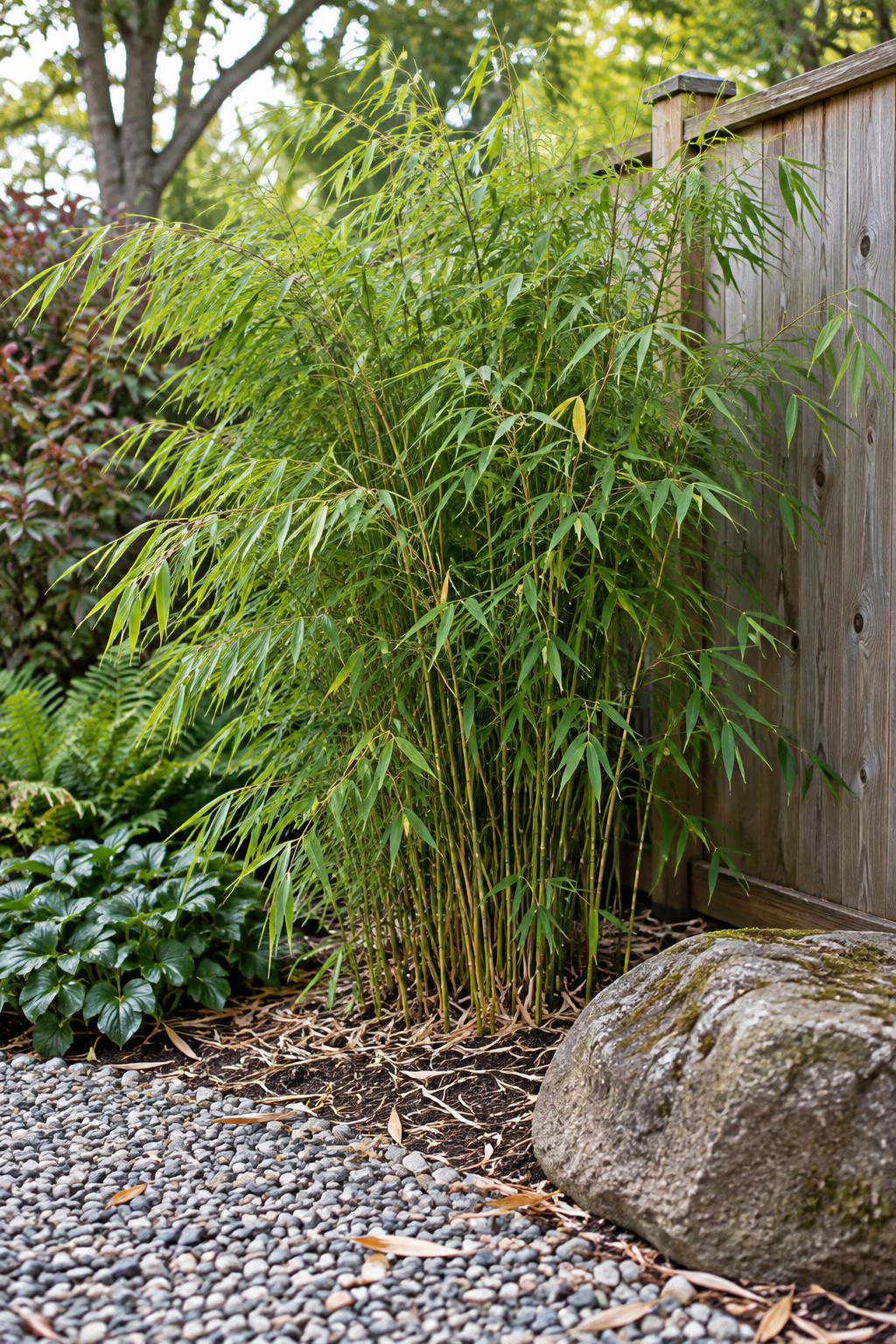
Get the look without the spread
Bamboo rustling in the breeze is a beautiful addition to a Japanese-inspired garden, but the type you choose matters. Running bamboos can spread aggressively through underground rhizomes, and some are regulated as invasive in parts of the United States.
Clumping bamboo, such as Fargesia, grows in tighter clumps and is a much safer choice for most home gardens. Plant a small grove near a fence or behind a stone feature for height and movement.
If you already have running bamboo, a deep rhizome barrier or a large above-ground container is essential, and both need regular checking.
19. Build a Low Engawa-Style Deck
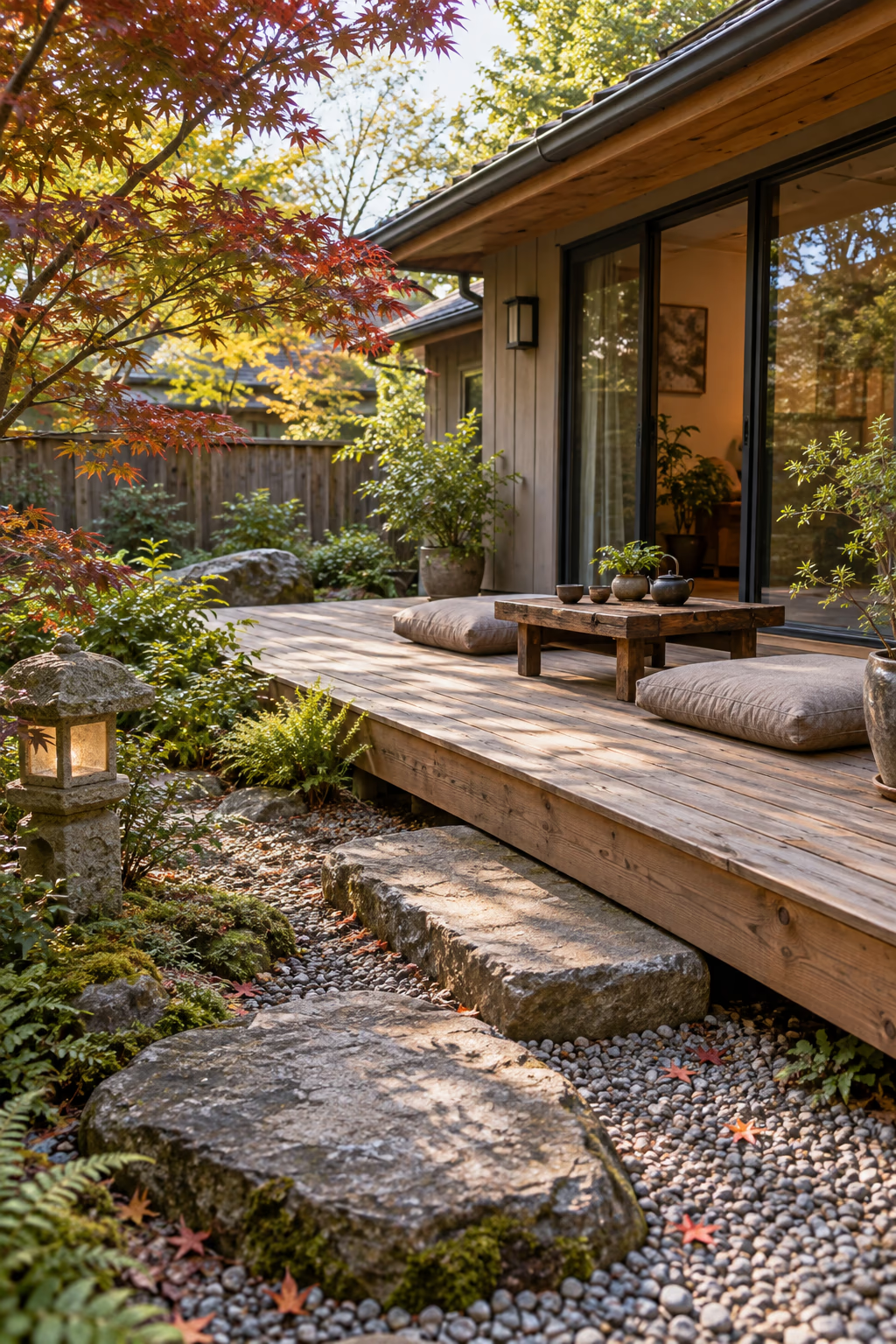
A place to sit at the edge of the garden
The engawa is a traditional veranda that connects the inside of a Japanese home to its garden. A low wooden platform along the back of the house creates a similar spot to sit, drink tea, and look out over the yard.
Keep the deck close to the ground with simple, straight boards in cedar or a natural-looking composite. Step down onto a flat stone or gravel, then let the garden begin right at the edge.
Simple cushions and a low table are all the furniture you need. Check whether your local building department requires a permit, especially if the deck attaches to the house.
20. Frame the Entry With a Roofed Garden Gate
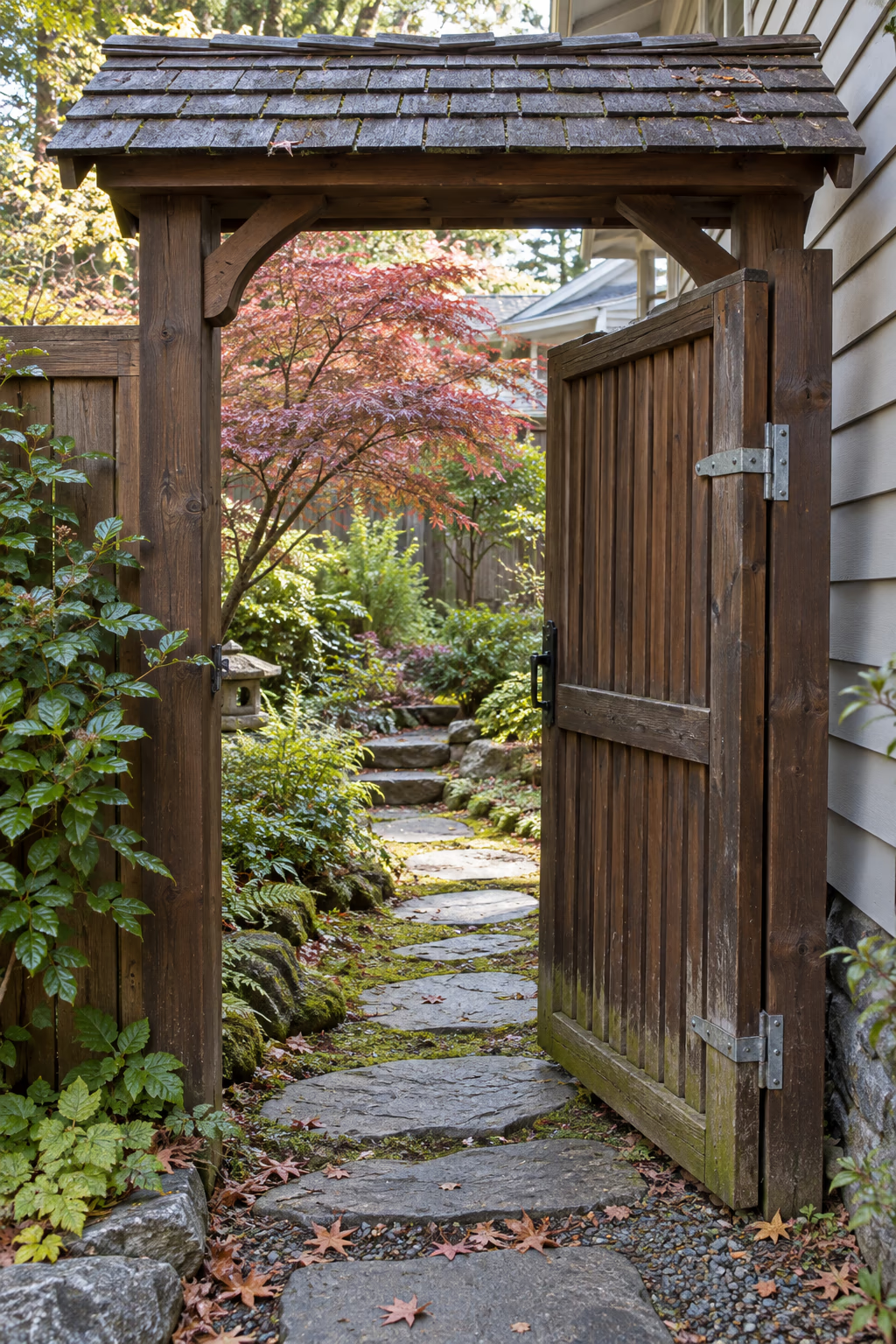
Make the garden feel like a destination
A gate signals a transition from the everyday world into a quieter space. A simple wooden gate with a small roof, built from cedar posts and slats, adds a strong Japanese-inspired detail to a backyard entrance or side yard.
Leave the wood natural or apply a dark stain for a traditional look. Use galvanized or stainless hardware so it won’t streak or rust.
Set the posts deep enough for your local frost line so the gate stays square over time. Even a gate that is usually left open helps frame the view beyond.
21. Design a Winding Tea Garden Path
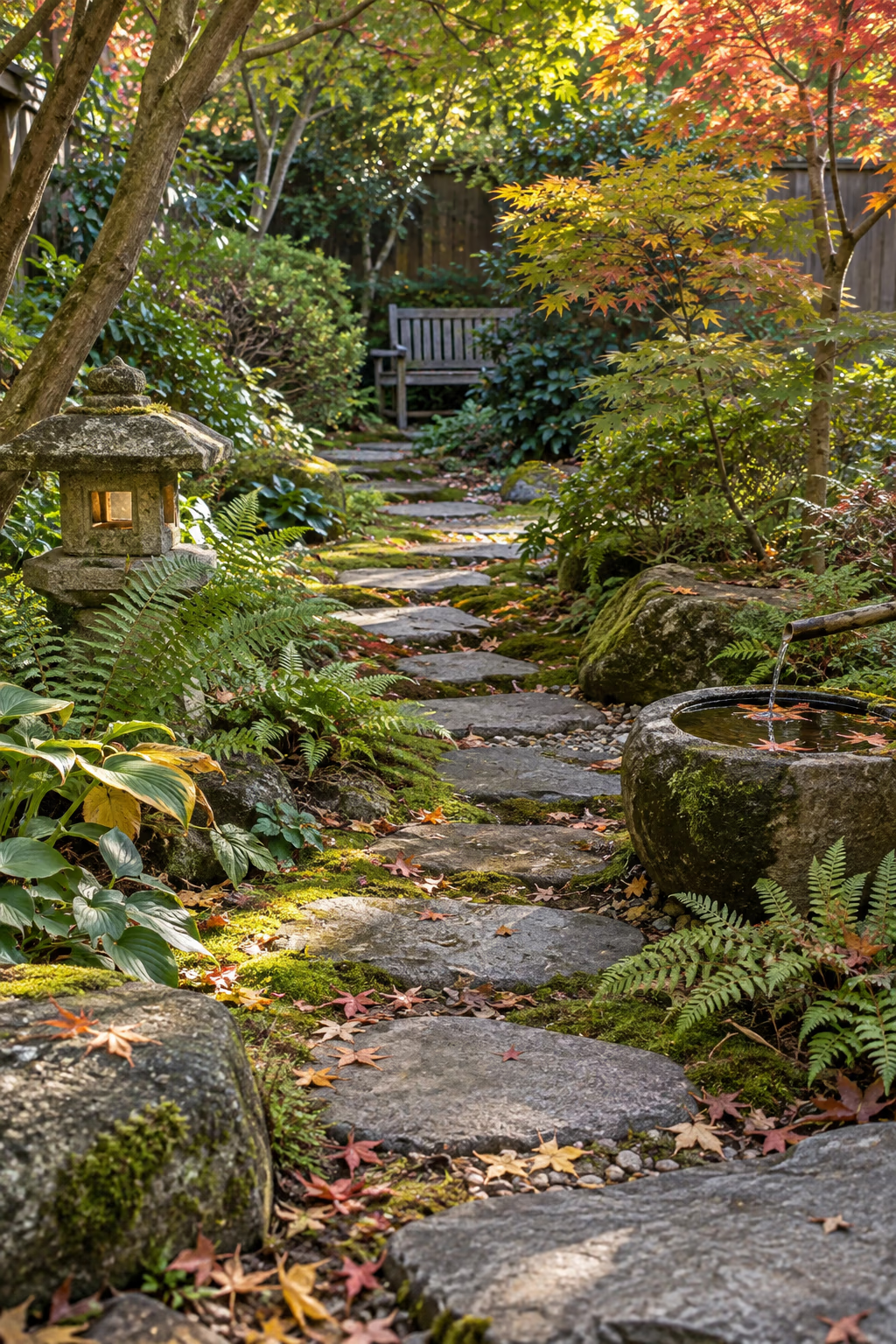
A gentle journey from one part of the yard to another
The roji is the garden path leading to a traditional teahouse, designed to help visitors leave daily distractions behind. You can borrow the idea in any yard by creating a curving path that leads to a bench, a seating area, or a small shed.
Use stepping stones, a low lantern, and a water basin along the way. Plant ferns, mosses, and shrubs so the destination is partly hidden until you approach it.
A gentle curve works better than a sharp turn, and it makes a small yard feel larger because you can’t see everything at once.
22. Create a Tiny Courtyard Garden
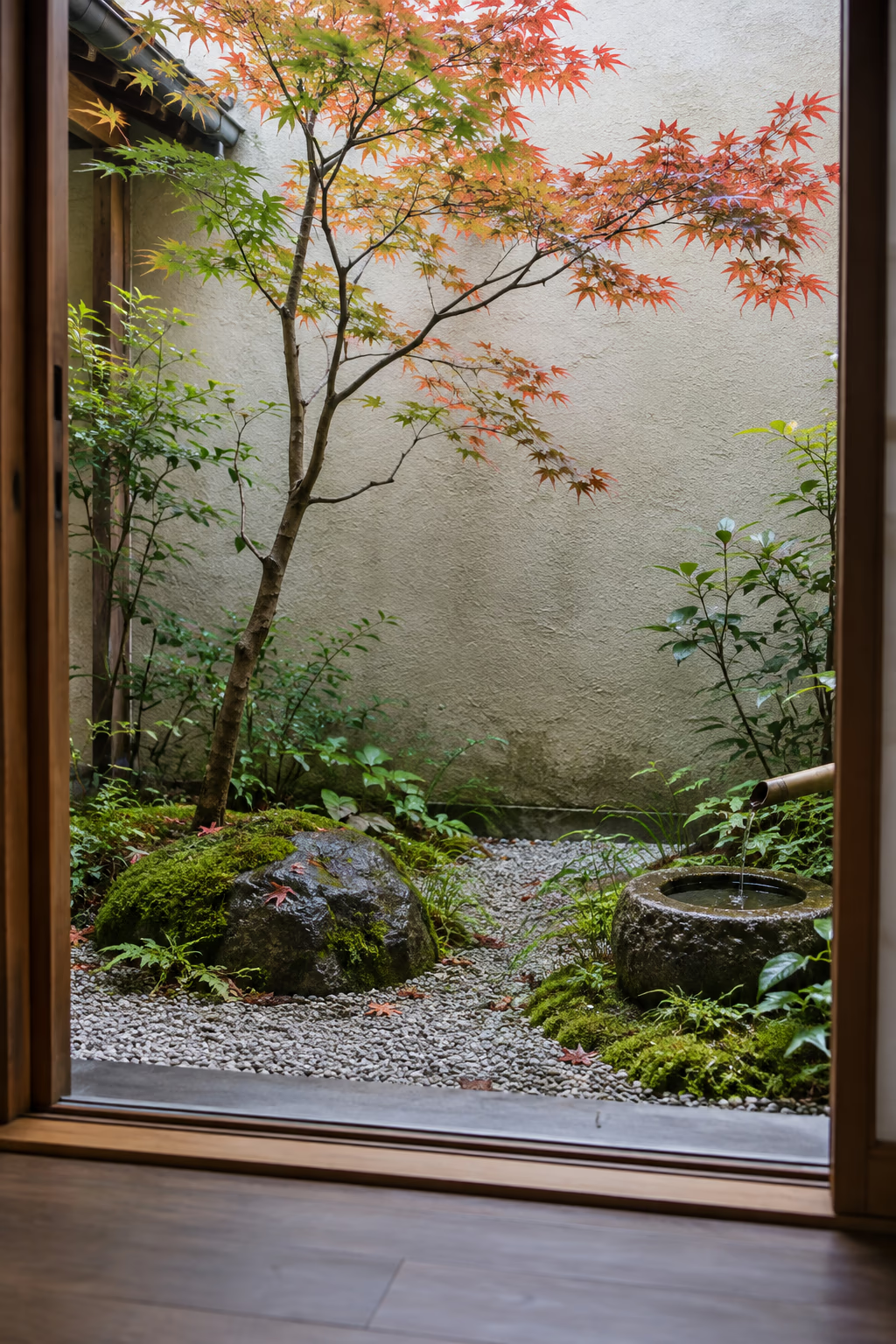
A complete garden in just a few square feet
The tsubo-niwa is a tiny Japanese courtyard garden, often built into narrow spaces between buildings. It proves that a Japanese garden can work in almost any corner.
Pick a few elements and give each one room: a small tree, a single stone, a lantern or basin, and a ground cover of moss or gravel. A fence or wall behind it forms a natural frame.
Courtyards, enclosed patios, and spaces outside a window are ideal. Because they’re often viewed from indoors, plan the design so it looks best from the house.
23. Turn a Balcony Into a Zen Corner
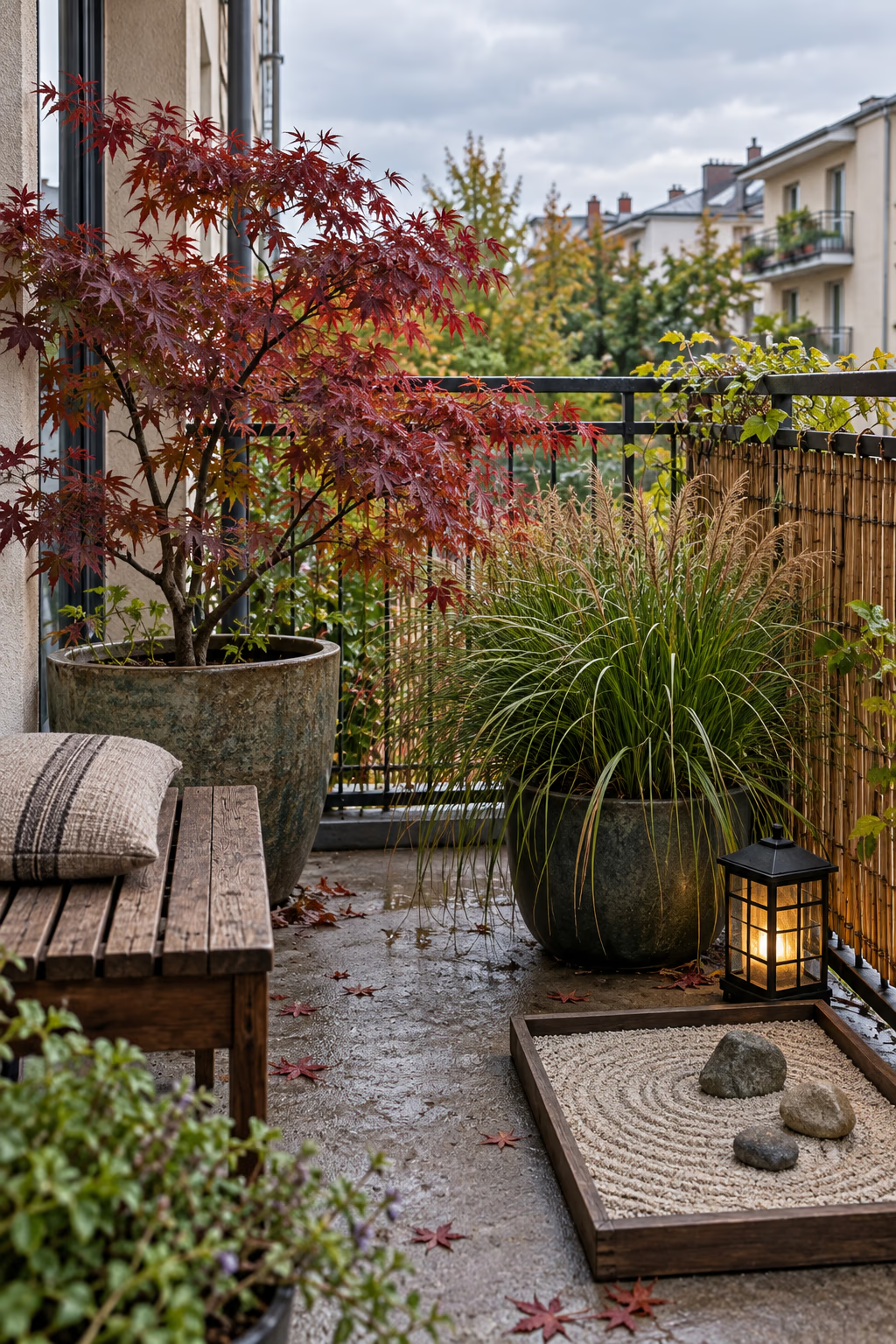
Japanese garden style for apartment living
You don’t need a yard to enjoy a Japanese garden. A balcony can host a potted dwarf maple, a few containers of ornamental grass, bamboo screening for privacy, and a shallow tray of gravel and stones.
Choose lightweight containers and potting mix, and keep heavy stones to a minimum. Wet soil and stone add up quickly, so check your building’s weight guidelines before adding large planters.
A small solar lantern or a tabletop fountain completes the look without wiring. Check building rules before adding water features.
24. Layer Ferns, Hostas, and Japanese Forest Grass
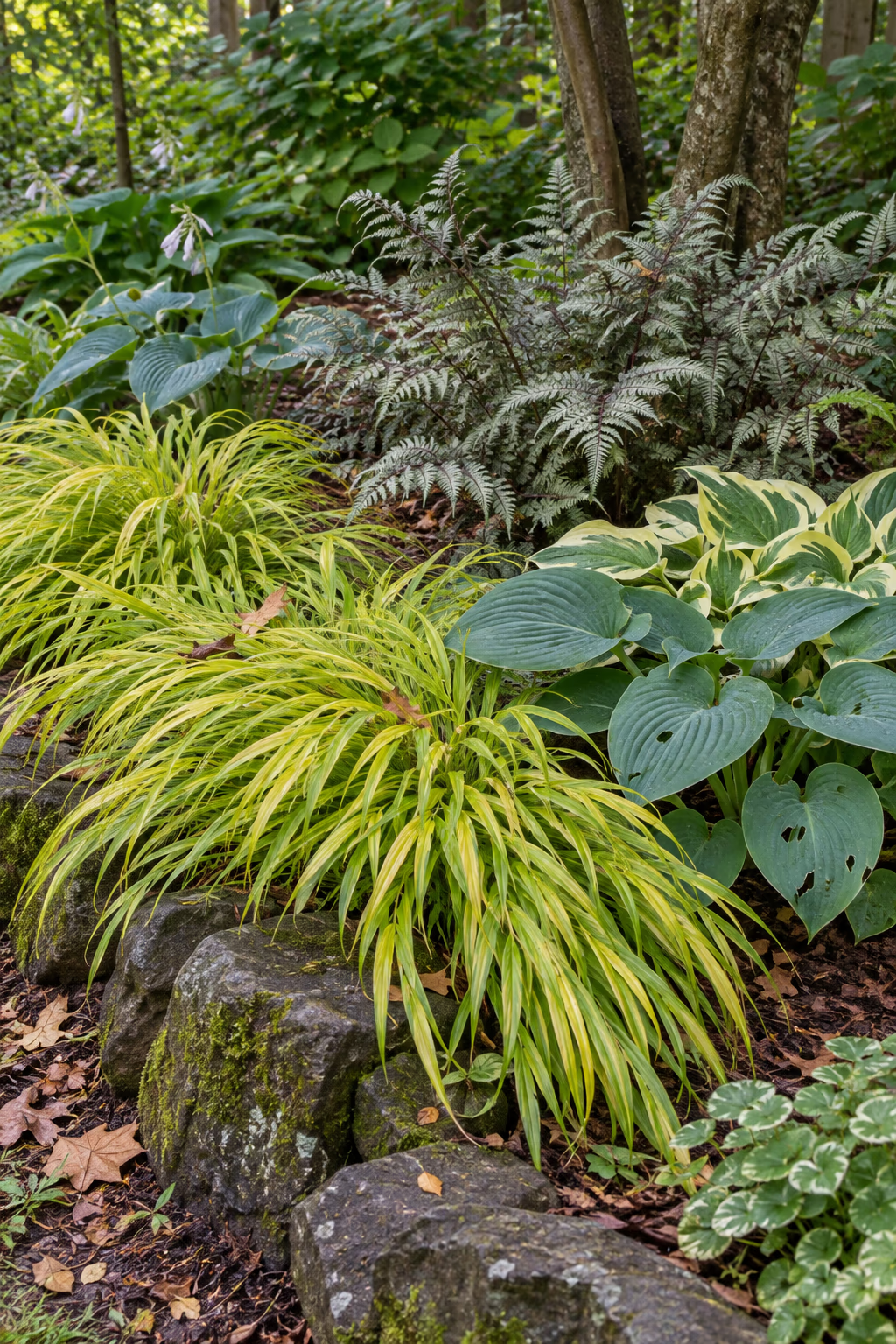
Rich texture for shady corners
Japanese gardens rely more on leaf shape and texture than on bright flowers. In shade, a layered planting of ferns, hostas, and Japanese forest grass (Hakonechloa macra) creates depth and movement.
Japanese forest grass forms soft, cascading mounds and is commonly rated for USDA zones 5 to 9. Golden ‘Aureola’ glows in shady spots, especially beside dark stone. Japanese painted fern adds silver tones.
Keep the soil evenly moist and mulched. Watch hostas for slug damage, and protect them in areas with heavy deer pressure.
25. Bring Spring Color With a Flowering Cherry
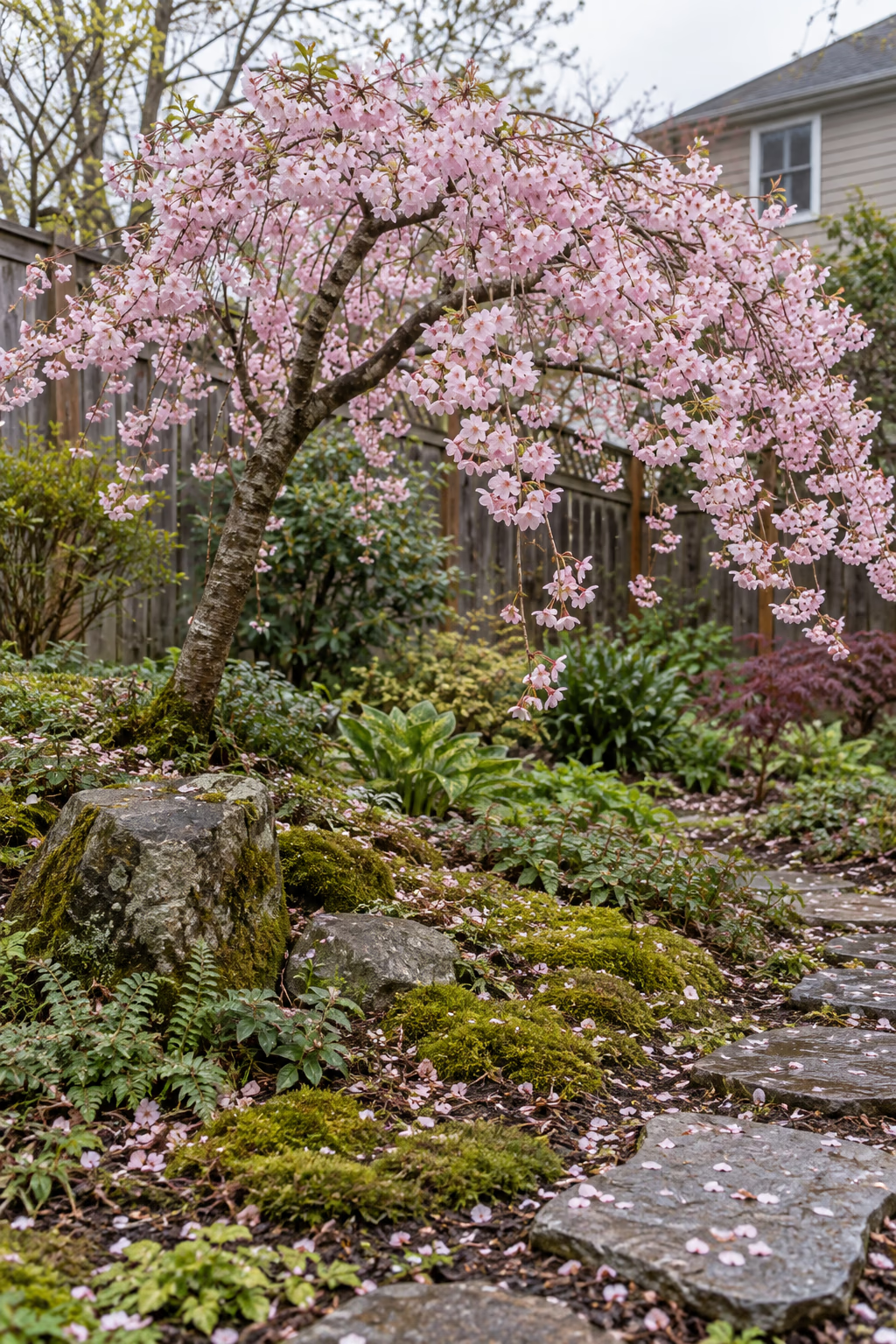
A short, unforgettable seasonal display
Flowering cherry trees are closely associated with Japan and its springtime celebrations. A single weeping or upright ornamental cherry can bring a cloud of pink or white blossoms to the garden each spring.
Most ornamental cherries prefer full sun and well-drained soil. Smaller weeping forms suit compact yards better than large upright trees.
The blooms are brief, so plan for the rest of the year as well. Underplant the tree with moss, ferns, or groundcovers so the area still looks attractive after the petals fall.
26. Give the Front Yard a Japanese-Inspired Entry
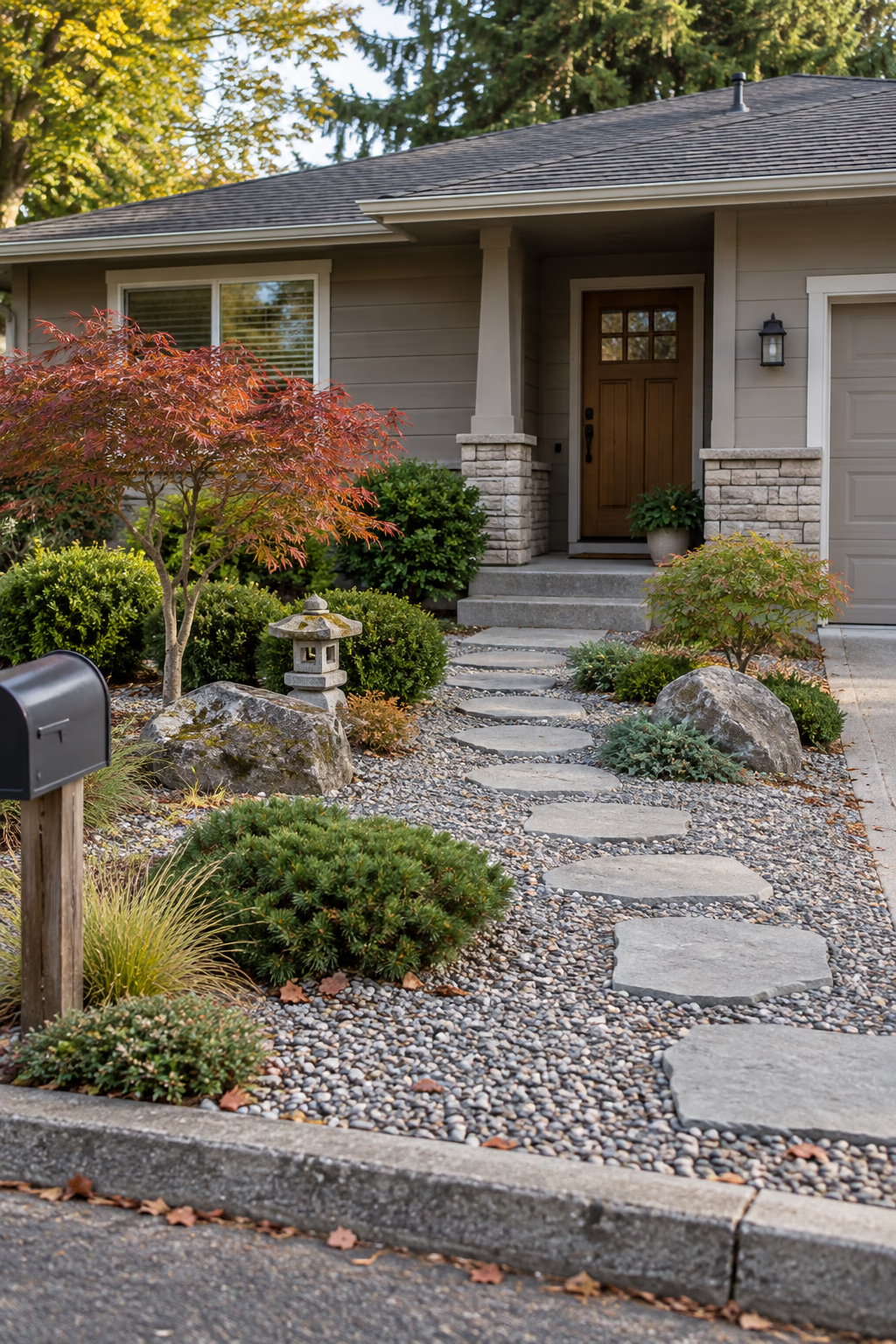
A calm, welcoming first impression
Japanese garden elements can make a front yard feel serene and polished. Replace a section of lawn with gravel, add a stepping stone path to the door, and plant a maple or pine as a focal point.
Keep the design restrained so it complements the house. Low, rounded shrubs, a few boulders, and a small lantern near the walkway are often enough.
Keep plants below window height and away from the driveway sightline. If you have an HOA, check front-yard landscaping rules before you start.
27. Light the Garden Softly at Dusk
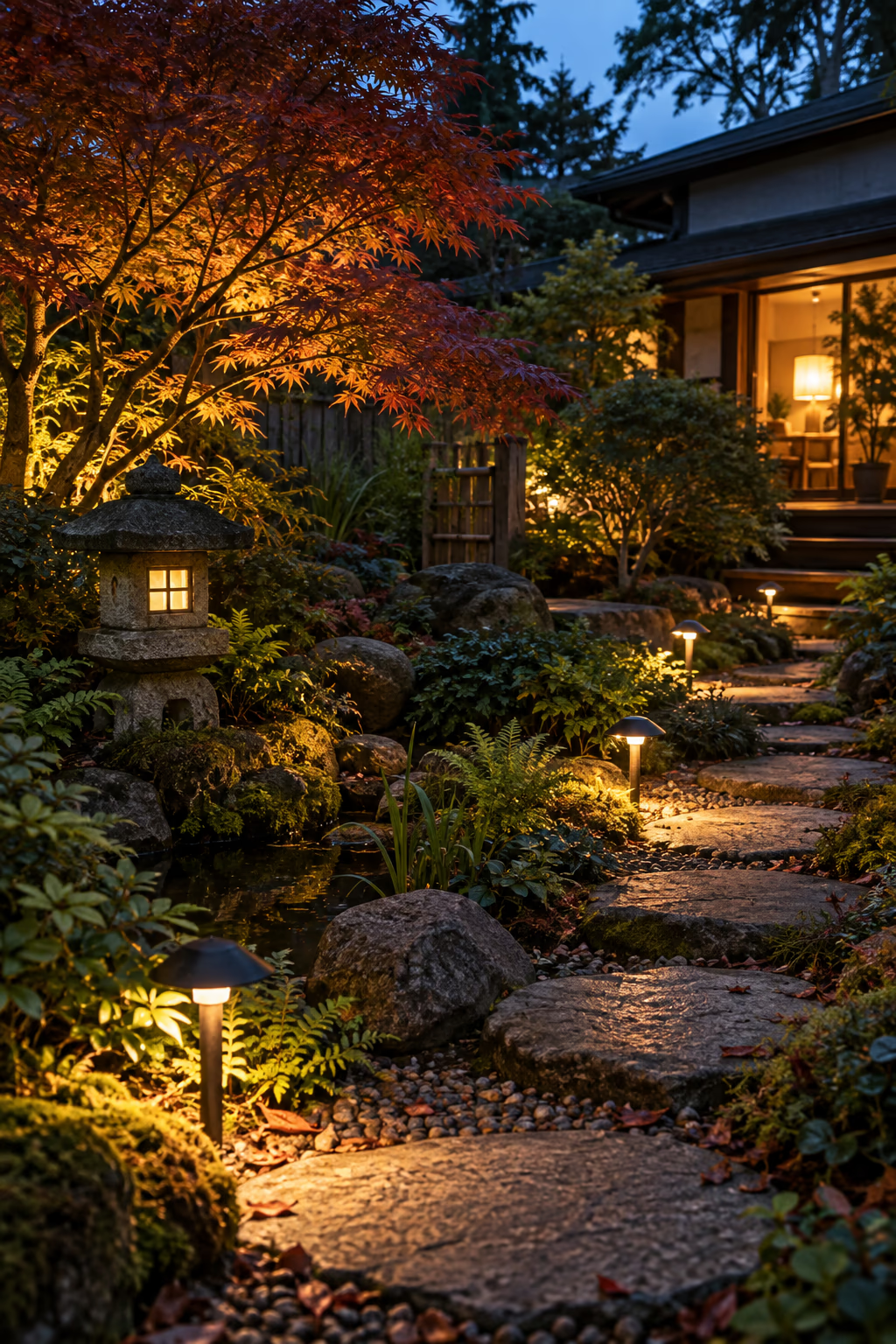
Extend the calm into the evening
Soft lighting makes a Japanese garden feel magical after sunset. Warm, low lights along a stepping stone path, a gentle glow inside a stone lantern, or an uplight beneath a maple can highlight texture without flooding the garden.
Low-voltage LED lights with a warm color temperature create a cozy look. Solar fixtures are an easy option where running wires is difficult.
Use fewer lights than you think you need. In a Japanese-inspired garden, the shadows are part of the beauty.
How to Plan a Japanese Garden
A successful Japanese garden is less about collecting features and more about creating a calm, balanced space. A little planning makes a big difference.
- Choose one main focal point. A boulder, maple, lantern, or water basin should set the tone, with everything else supporting it.
- Embrace asymmetry and open space. Group stones and plants in odd numbers and leave areas of gravel, moss, or open ground so the garden can breathe.
- Match plants to your climate. Check USDA hardiness zones and sun exposure before buying trees, shrubs, and perennials, and choose cold-hardy alternatives where needed.
- Avoid invasive plants. Choose clumping bamboo rather than running types, and check local invasive plant lists before planting.
- Plan for drainage. Gravel beds and paths need a well-prepared base, and water should flow away from your home’s foundation.
- Build in phases. Start with paths, stones, and structural plants, then add lanterns, water features, and lighting over time. In the United States, call 811 before any digging.
Frequently Asked Questions
What is the difference between a Zen garden and a Japanese garden?
A Zen garden usually refers to a dry rock garden made mainly with raked gravel and stones. Japanese garden is a broader term that can include ponds, streams, bridges, lanterns, moss, trees, and tea garden paths.
What plants are used in a Japanese garden?
Common choices include Japanese maple, pine, azalea, moss, clumping bamboo, ferns, hostas, Japanese forest grass, iris, and flowering cherry. Choose plants that suit your climate, soil, and light conditions.
Can I create a Japanese garden in a small yard?
Yes. A small dry garden, a courtyard garden, a side-yard path, or even a balcony with a potted maple can capture the style. Using just a few carefully chosen elements is part of the look.
How much does a Japanese garden cost?
Costs vary widely. A small DIY gravel and stone garden can cost a few hundred dollars, while ponds, decks, large boulders, and mature specimen trees can add thousands. Building in stages makes the project easier to budget.
Is a Japanese garden low maintenance?
It can be lower maintenance than a lawn, but it still needs regular care. Expect to rake gravel, clear fallen leaves, prune trees and shrubs, and maintain any water features.
Final Thoughts
The best Japanese garden ideas create a feeling of calm with just a few thoughtful elements. A raked gravel bed, a curving stone path, or a single maple beside a lantern can completely change how your yard feels.
Start small, choose materials and plants that suit your climate, and let the garden grow and soften over time. Before long, you’ll have a peaceful outdoor space that invites you to slow down and enjoy every season.


