
Most yards have one: a handsome shade tree standing in a circle of patchy grass, bare dirt, and roots that catch the mower blade every week. It’s the spot everyone walks past without a second look, even though the tree itself may be the best thing on the property.
A flower bed at the base changes that. It frames the trunk, hides thin turf, saves you from trimming around bark, and turns a problem patch into a planted feature. The catch is that the tree comes first. Roots near the surface, shade, and competition for water all shape what will grow there and how you should build the bed.
These 21 flower bed ideas around trees cover shade-loving plant combinations, edging that won’t harm roots, spring bulbs, benches, lighting, native wildflowers, and options for dry shade, curbside strips, and winter interest. Each one respects the tree’s health while giving you color and texture where you need it most.
1. Circle the Trunk With a Hosta and Fern Shade Ring
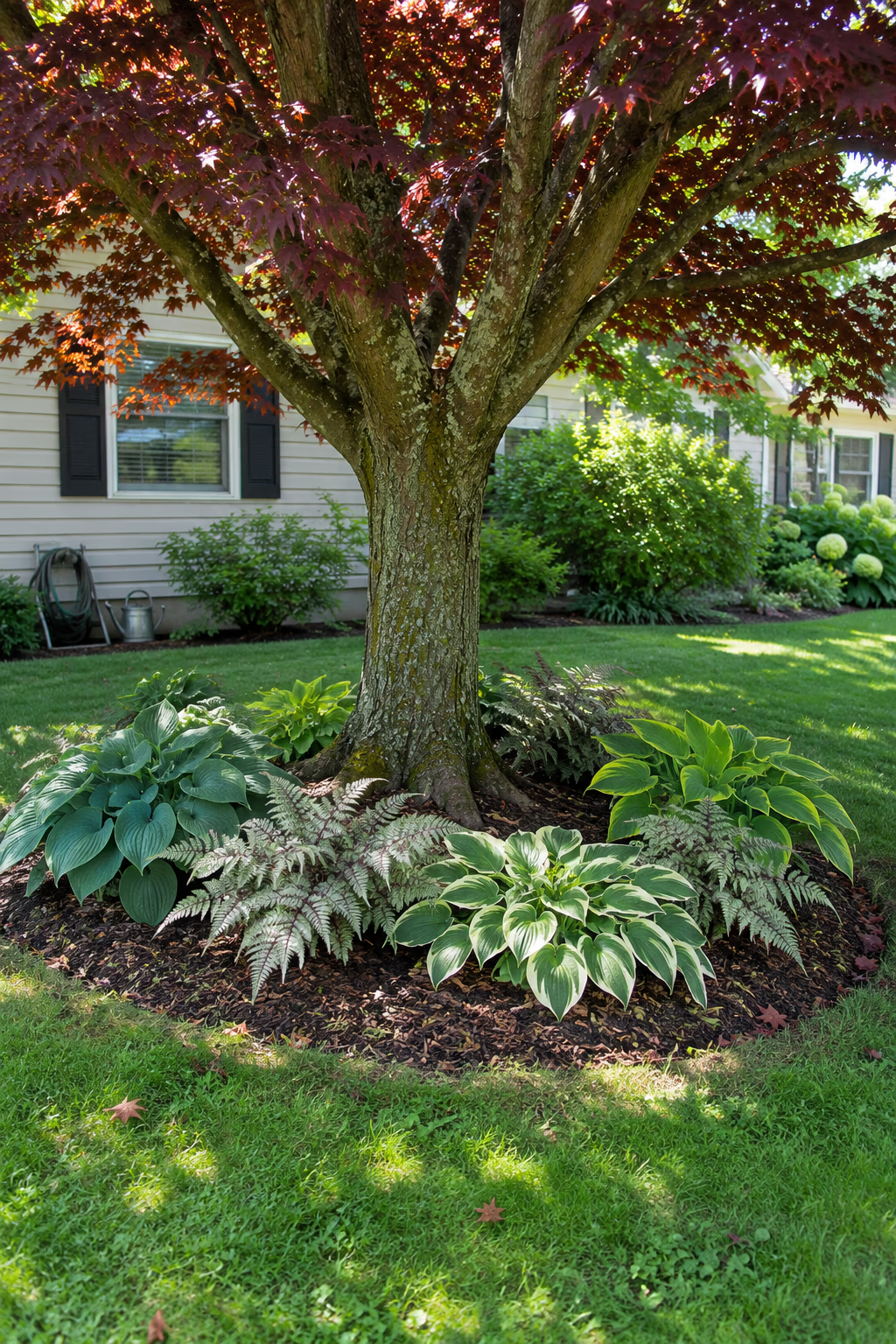
The classic tree bed that thrives in shade
A ring of hostas and ferns is the look most people picture when they think of planting under a tree, and it earns its popularity. Mark a circle 3 to 5 feet out from the trunk, skim off the grass with a flat spade, and set hostas about 18 inches apart with ferns such as lady fern or Japanese painted fern tucked between them.
Mix leaf colors for interest: blue-green, gold-edged, and white-variegated hostas look lively against the lacy, silvery fronds of painted fern. Finish with 2 inches of shredded bark mulch, pulled back a few inches from the bark so the root flare stays visible.
Hostas are a favorite food for deer and slugs. If deer visit your yard, lean more heavily on ferns, which they usually ignore, and check hosta leaves for slug holes after rainy spells.
2. Edge the Tree Ring With Brick Laid at Ground Level
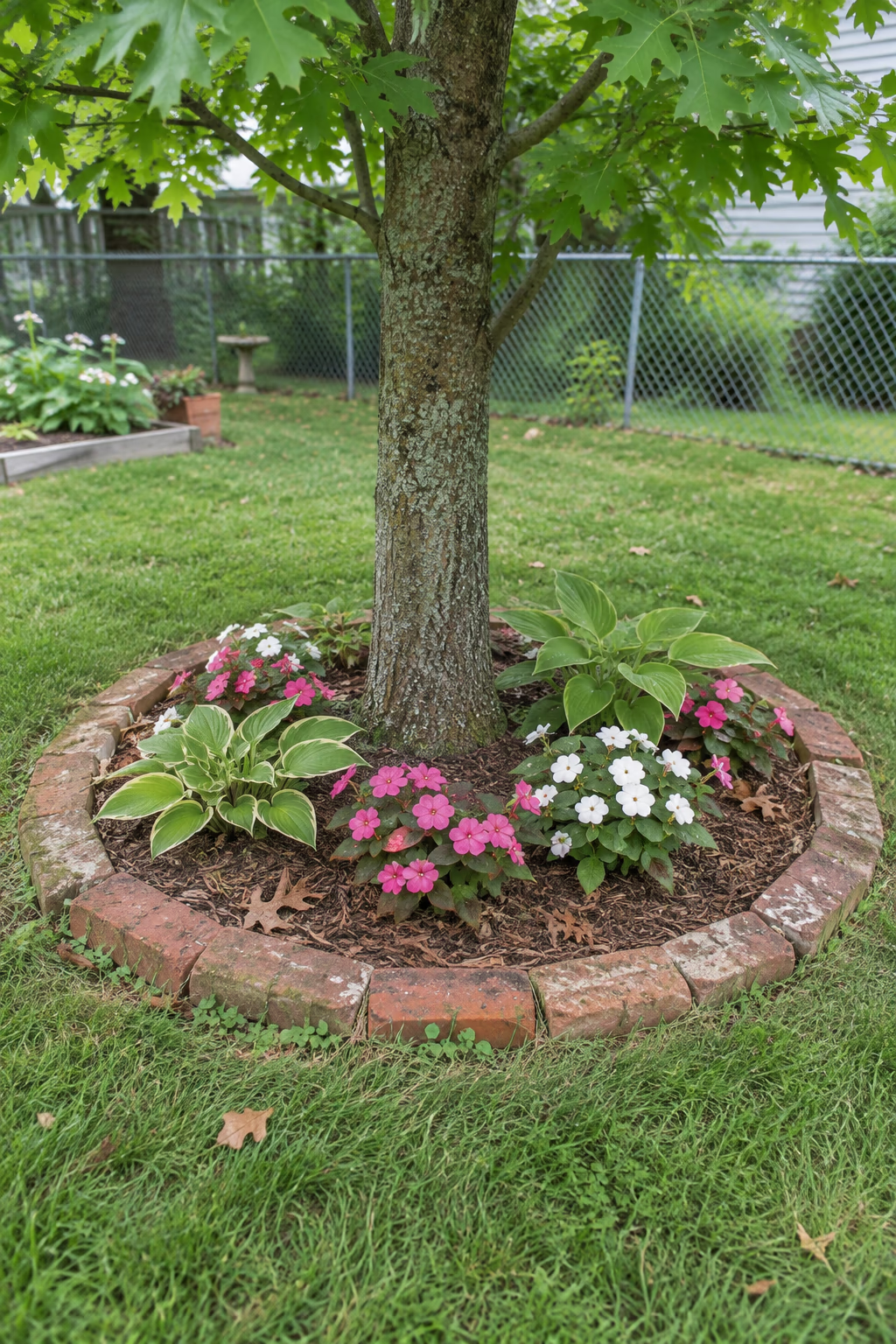
A crisp outline that makes mowing easier
Clean edging is what turns a planted circle into a finished feature. Reclaimed red brick set on end or laid flat in a soldier course looks traditional, while tumbled concrete pavers in gray or tan suit newer homes. Set the edging flush with the lawn so a mower wheel can ride right over it.
Dig only a shallow trench, about 2 to 4 inches deep, and work by hand rather than with a power edger. If you hit a root thicker than about an inch, shift the edging line outward rather than cutting it.
Avoid stacking bricks or blocks into a tall wall filled with soil. Raised soil against a trunk can rot the bark and suffocate roots, which is one of the most common ways homeowners accidentally kill a healthy tree.
3. Naturalize Small Spring Bulbs Under Bare Branches
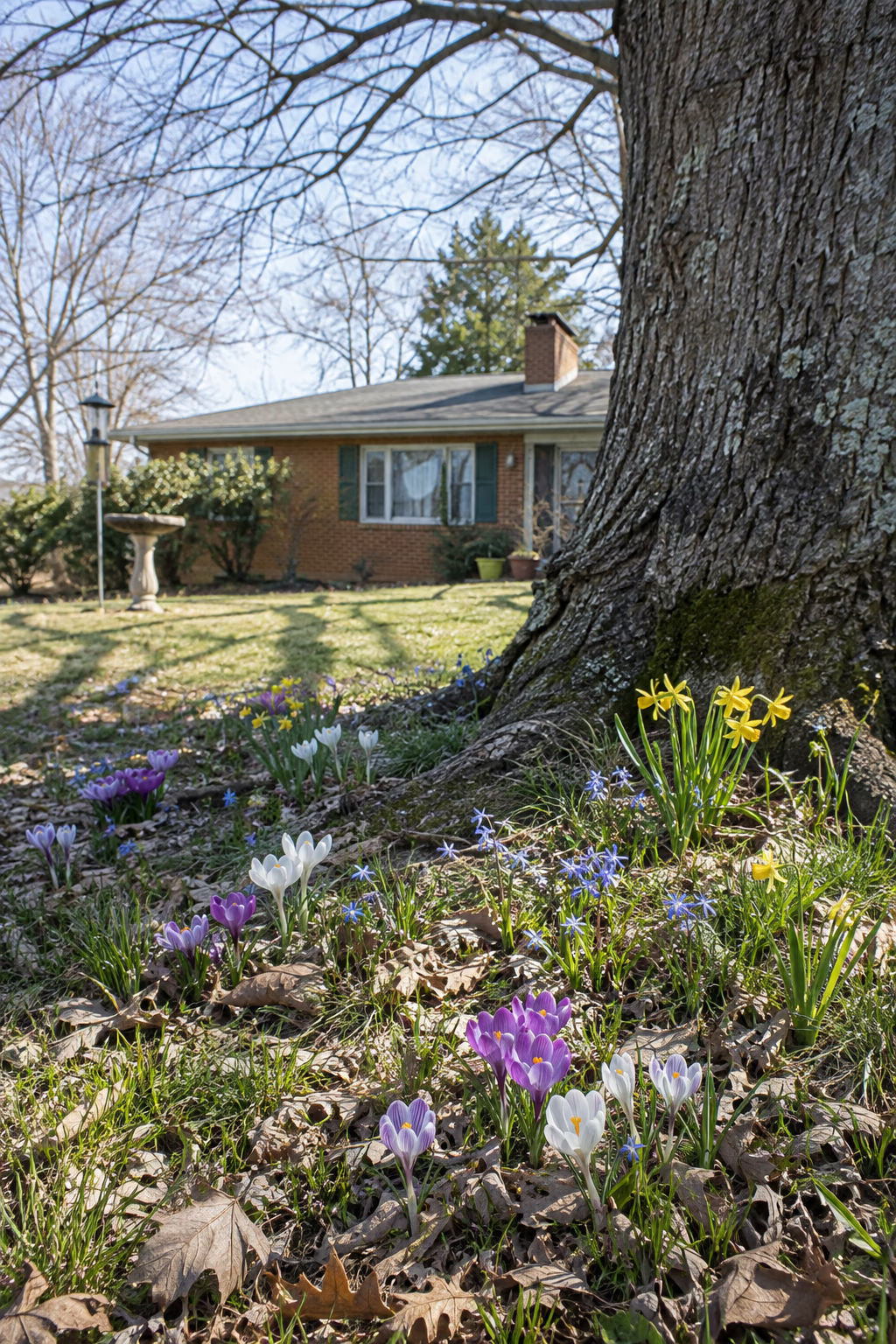
Early color before the leaves close in
Under deciduous trees, the brightest weeks of the year come in early spring, before the canopy leafs out. Small bulbs such as crocus, snowdrops, glory-of-the-snow, Siberian squill, and miniature daffodils bloom and finish in that sunny window.
Because the bulbs are small, you can plant them with a narrow trowel or bulb auger in pockets between roots instead of digging a whole bed. Plant in fall, scattering handfuls and planting them where they land for a natural drift, and let the foliage yellow on its own so the bulbs come back and spread.
Squirrels love to dig up crocus and tulips. Daffodils, snowdrops, and squill are far less tempting, so they make a safer backbone if rodents are active in your yard.
4. Mix Astilbe and Coral Bells for Shade-Proof Color
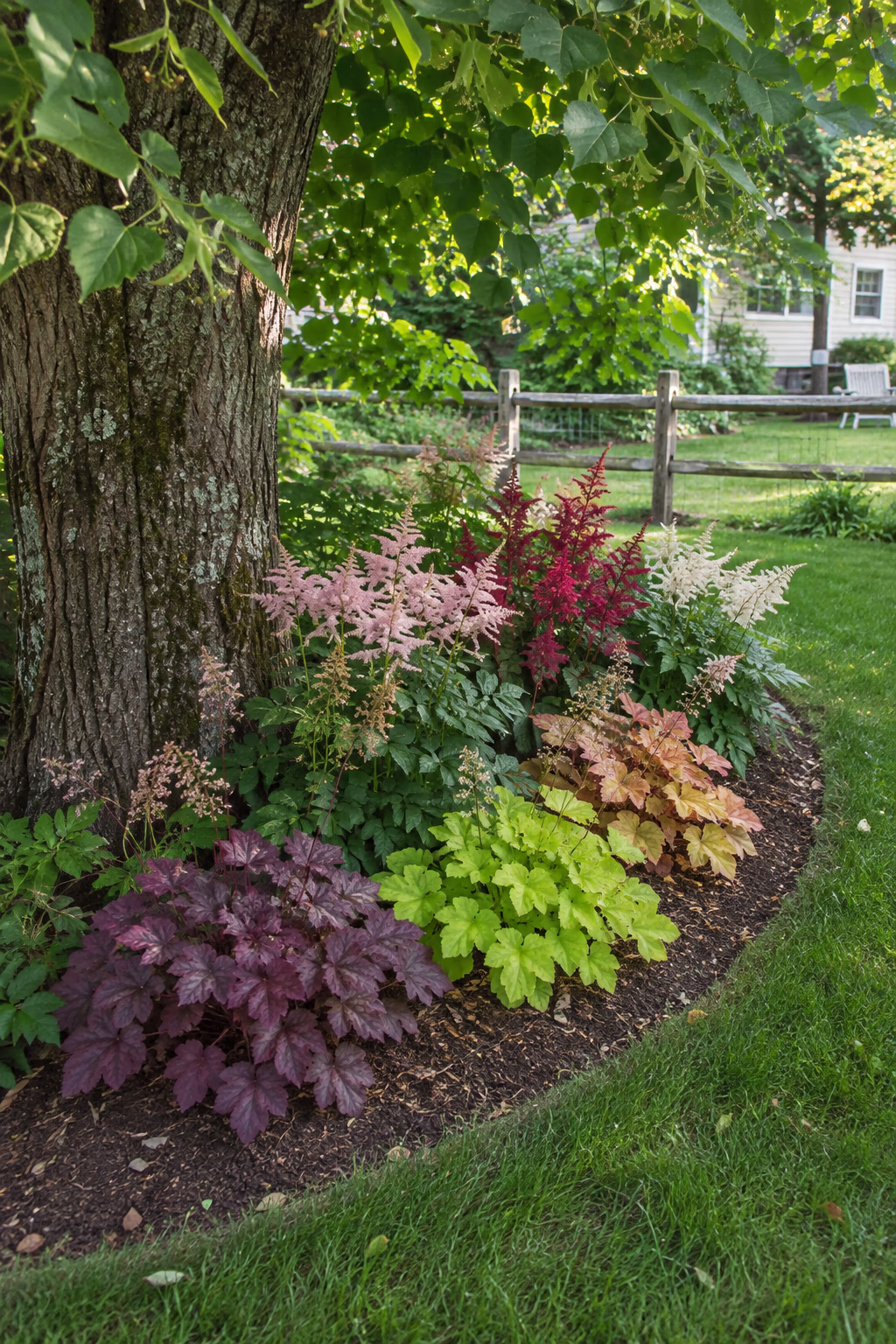
Feathery plumes over colorful foliage
Astilbe sends up feathery plumes in pink, red, lavender, or white in early to midsummer, and coral bells (heuchera) contribute leaves in shades of plum, lime, amber, and silver all season. Together they bring real color to a spot where most flowers struggle.
Plant astilbe in groups of three toward the back of the bed, closer to the trunk, and edge the front with coral bells so the low, mounded foliage faces the lawn. Both prefer part shade and soil rich in organic matter.
Astilbe dislikes drying out, and tree roots pull a lot of water. Plan on a slow, deep soak once or twice a week in hot, dry spells, and choose the more drought-tolerant coral bells for the driest pockets.
5. Wrap a Bench Around the Trunk and Plant Below It
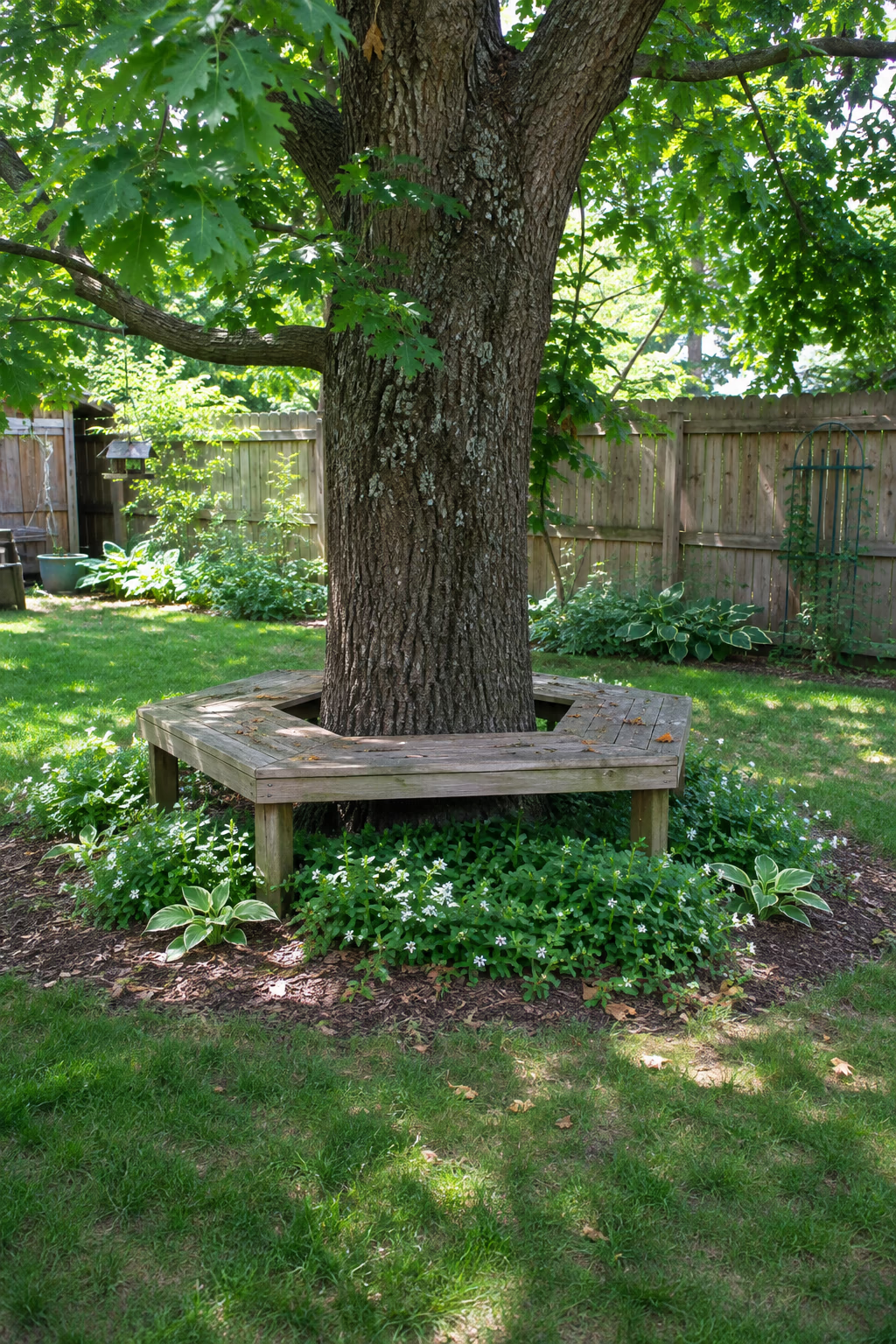
A shady seat with flowers at your feet
A wraparound tree bench turns the base of a large tree into a gathering spot. Hexagonal or octagonal cedar benches are a common DIY project, and kits are available too. Surround the bench with a ring of low plants such as sweet woodruff, ajuga, or dwarf hostas so the seat looks anchored.
Set the bench on small footings or pavers placed between roots rather than pouring a continuous slab. Leave at least 6 inches of space between the bench and the trunk on every side, and check that gap yearly so the growing tree never presses against the boards.
Use rot-resistant wood such as cedar, or a composite, and sand any rough edges. Expect to clear leaves, sap, and bird droppings from the seat more often than with a bench in the open.
6. Tuck Bowls of Impatiens Between Surface Roots
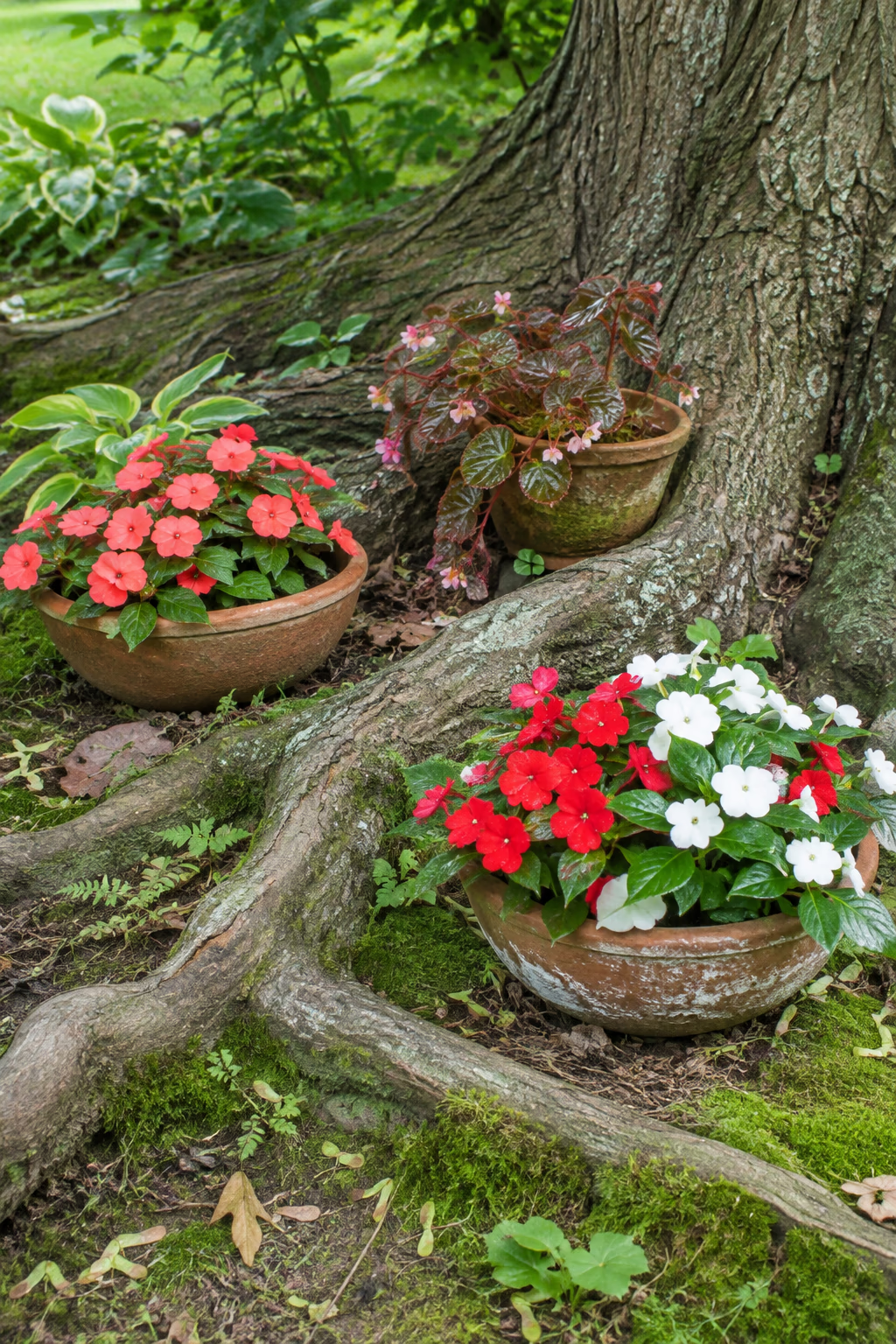
Seasonal color without digging every year
When thick roots cover the surface, planting in the ground is difficult and annual digging can damage the tree. Shallow terracotta bowls or wide, low pots nestled between roots give you bold summer color with no root disturbance at all.
Fill the bowls with impatiens, begonias, torenia, or browallia, all of which handle shade. Group three bowls of different sizes on one side of the trunk instead of spacing them evenly, which looks more natural. Mildew-resistant impatiens or New Guinea types are a smart choice if impatiens downy mildew has been a problem in your area.
Pots dry out fast under a leafy canopy because rain doesn’t reach them easily. Check them daily in summer, and raise them on small feet so they don’t sit directly on bark.
7. Plant a Native Woodland Wildflower Bed
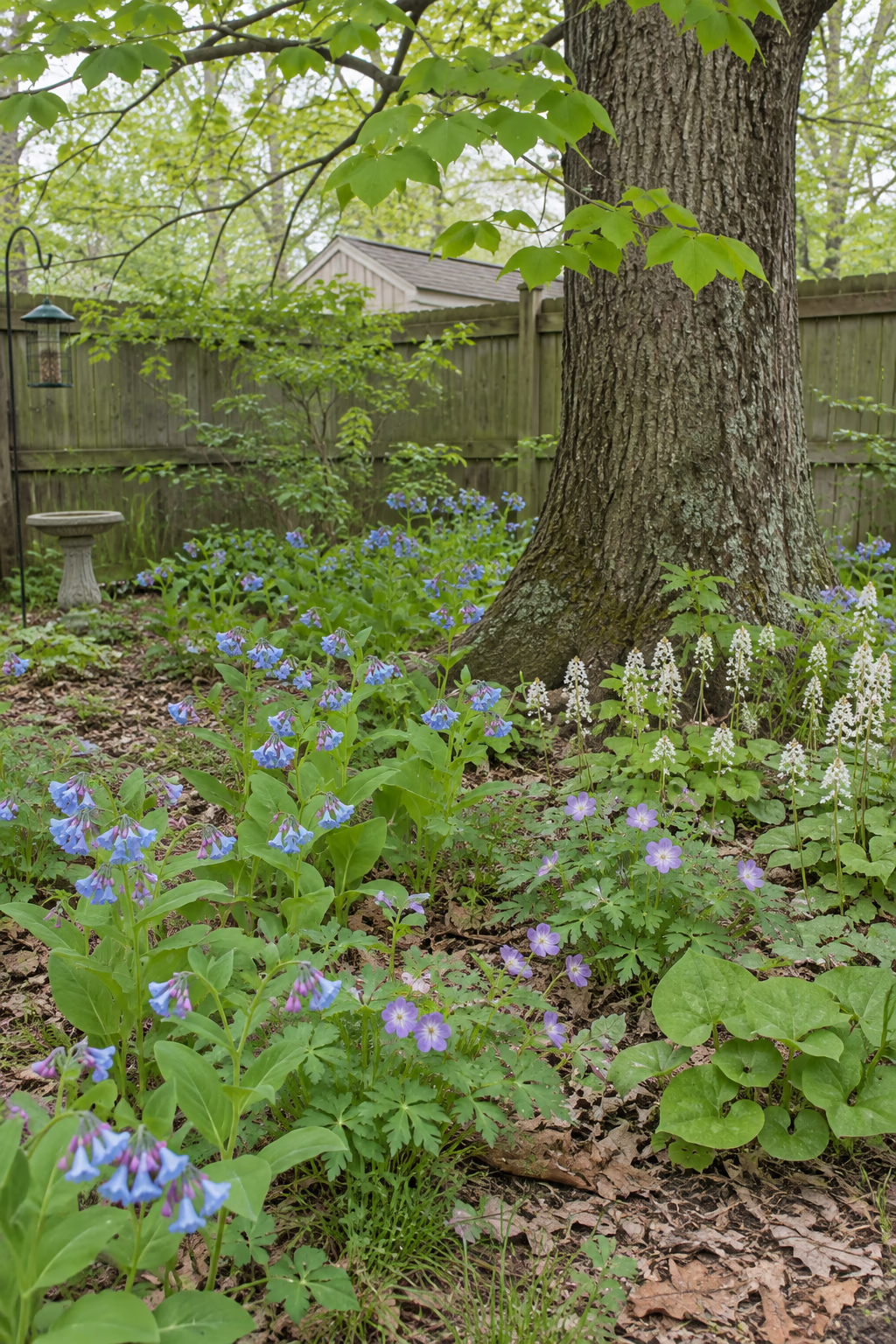
A natural look that feeds pollinators
The ground under a tree is already a small woodland, so native woodland plants feel right at home. In much of the eastern and central US, good choices include wild geranium, foamflower, Virginia bluebells, Jacob’s ladder, wild ginger, and woodland phlox.
Plant them in loose drifts rather than rings, and let fallen leaves stay in the bed over winter. Shredded leaves act as free mulch, feed the soil, and shelter overwintering insects that many native birds depend on.
Native ranges vary widely, so check with your local extension office or native plant society for species suited to your region. Buy nursery-grown plants rather than digging them from the wild.
8. Save Sun Lovers for the Edge of the Canopy
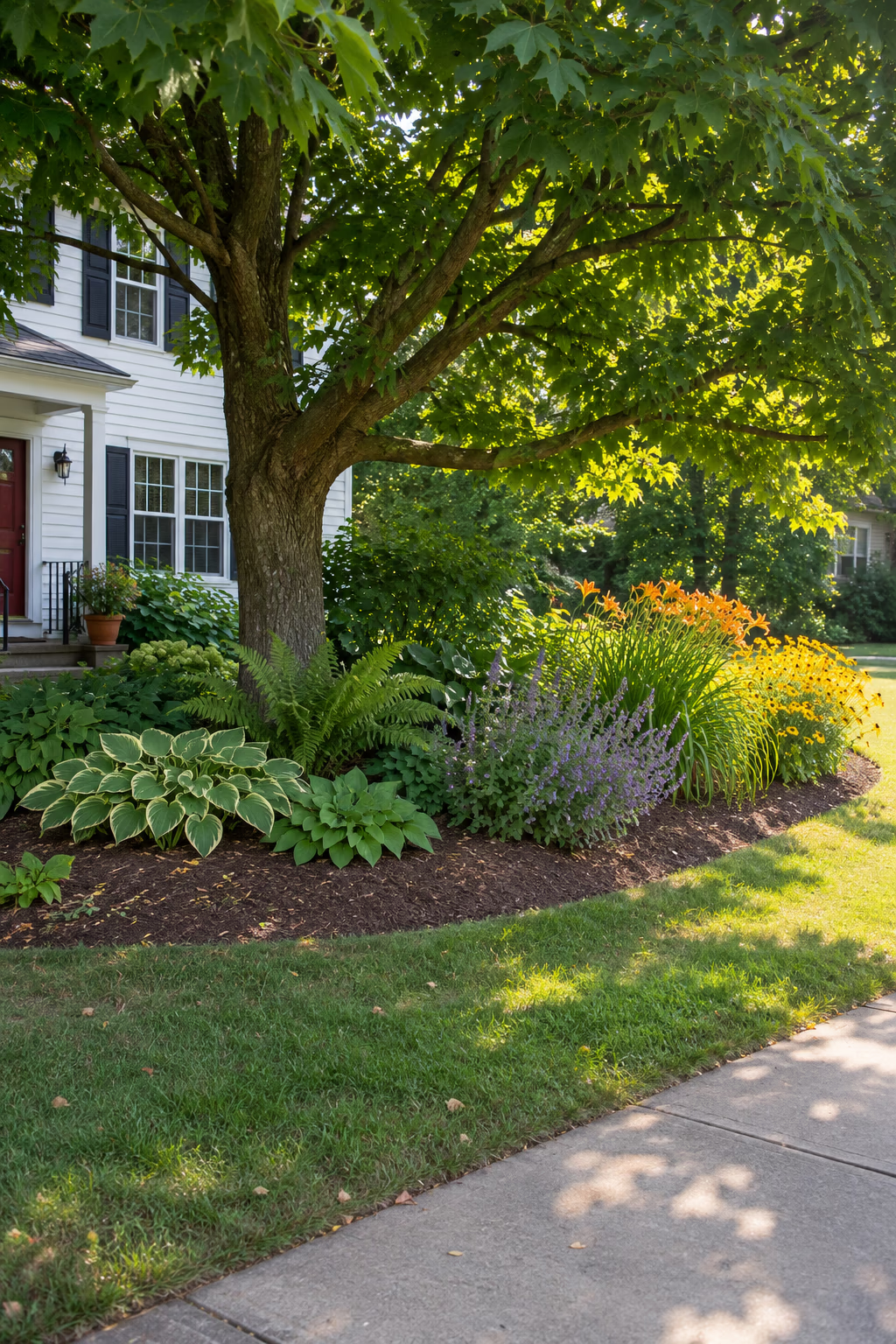
More flowers where the light reaches
Light changes dramatically from the trunk to the outer edge of the branches. Use that gradient: shade plants near the trunk, and sun-tolerant flowers such as catmint, daylilies, black-eyed Susans, and salvia in the outer band where afternoon sun reaches.
Before planting, watch the bed for a full day in summer and note where the sun falls and for how long. Areas with six or more hours of direct light can host most perennials, while spots with three to four hours suit part-shade plants like Siberian iris or columbine.
Trees grow, and shade spreads with them. Expect to swap a few sun lovers for shade plants every several years as the canopy widens.
9. Nestle Boulders and Groundcovers Around Exposed Roots
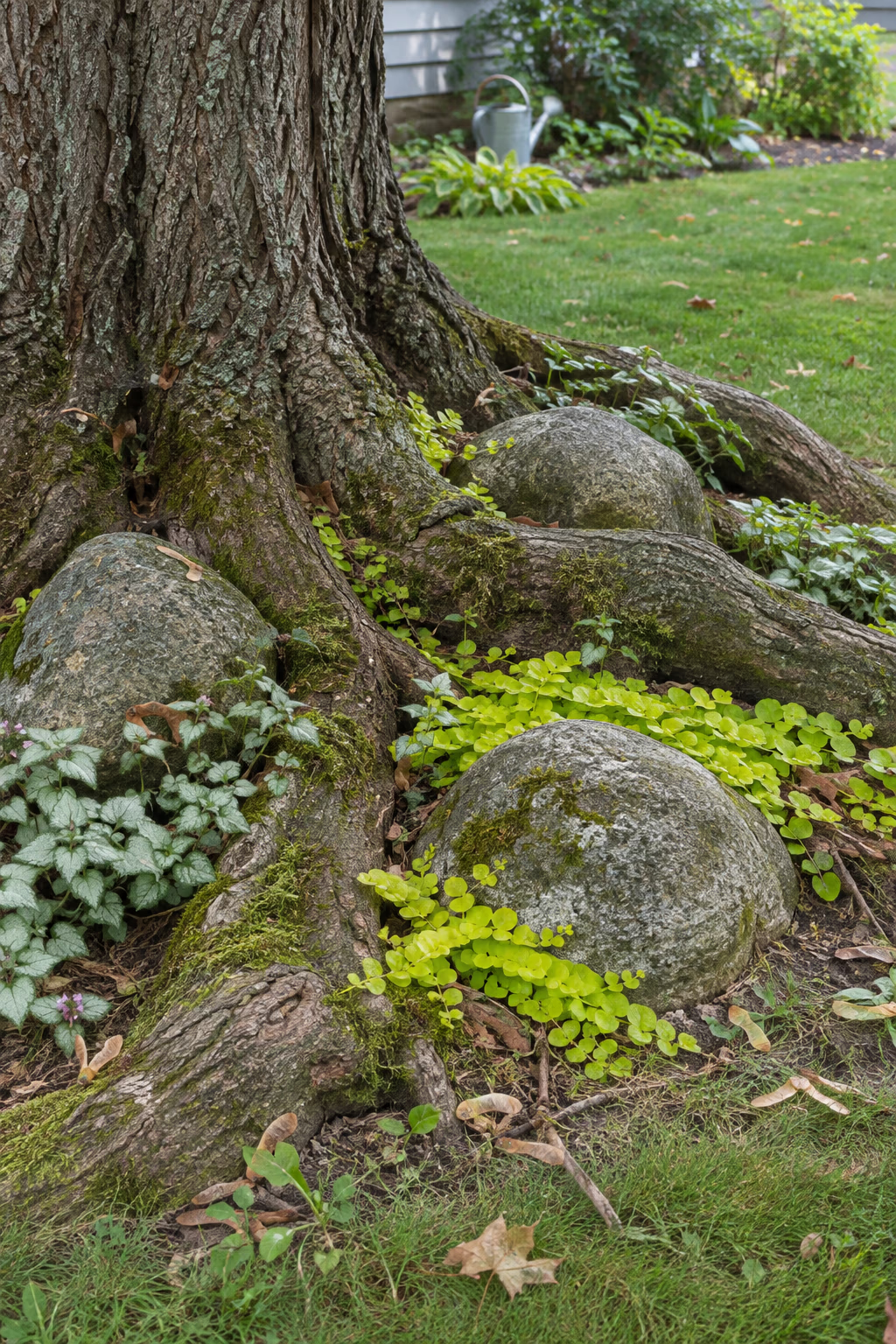
Make surface roots look intentional
Some trees, especially maples, oaks, and older silver maples, push roots above the soil. Instead of fighting them, frame them. Set two or three medium boulders between the root arms and plant low groundcovers such as creeping Jenny, lamium, or moss in the gaps.
Choose boulders you can move with a dolly, roughly 12 to 24 inches across, and nestle each one into a shallow scrape so it looks settled. Keep them off the roots themselves and away from the trunk.
Never cover exposed roots with a thick layer of new soil to smooth them out. A light dusting of compost, an inch or less, is enough to help groundcovers root in.
10. Join Two Trees With One Curving Island Bed
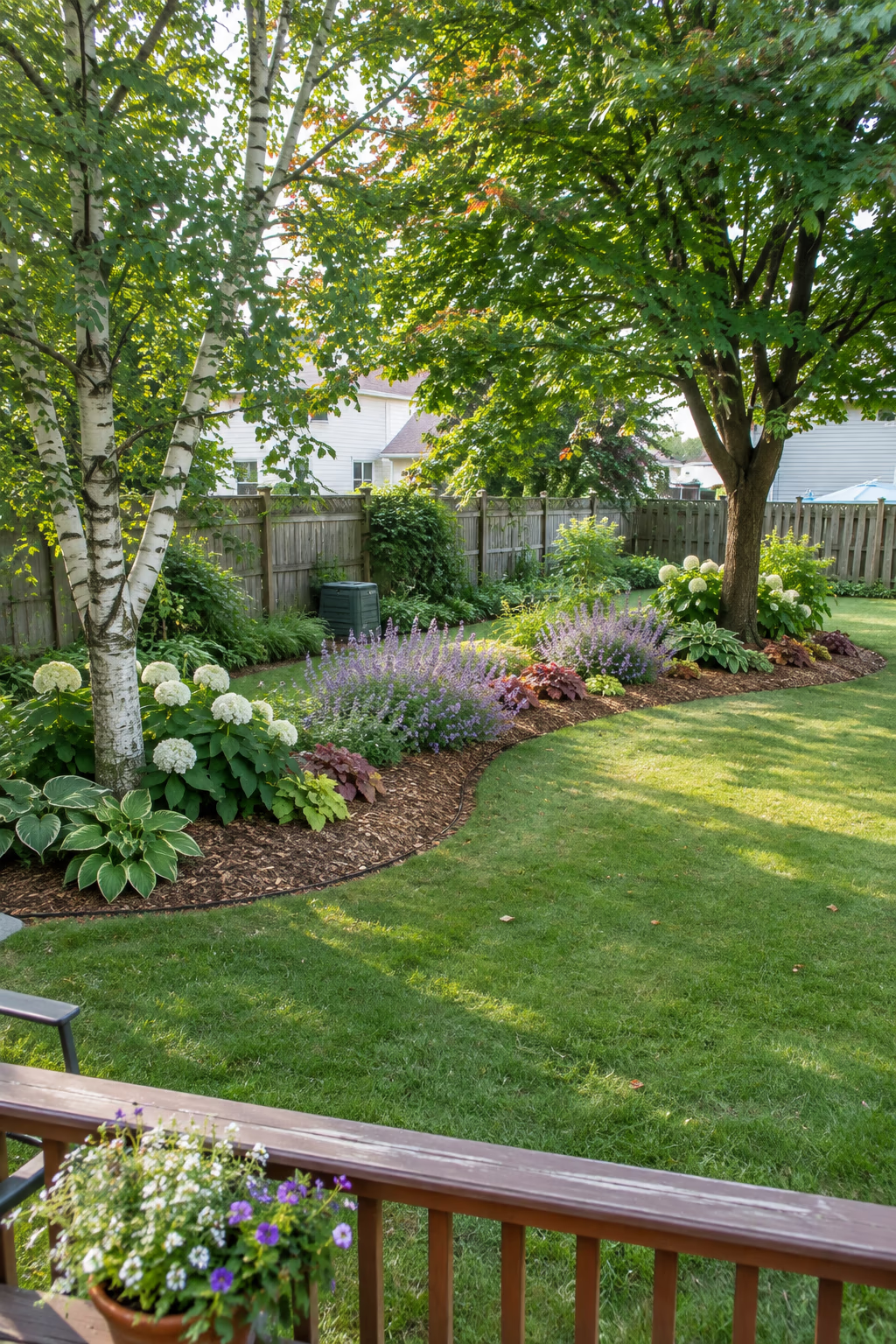
One big bed instead of two small rings
If two or three trees stand near each other in the lawn, linking them with a single kidney-shaped bed looks more polished than separate circles and cuts mowing time. Lay out a garden hose to test the curve, then live with it for a few days before cutting the outline.
Plant shrubs and taller perennials under the trees and lower flowers in the open middle where more sun reaches. Repeating the same plant, such as a drift of hostas or catmint, along the whole bed ties it together.
Smother the grass inside the new outline with cardboard and 3 inches of wood chips in fall rather than tilling. By spring the turf will be dead and you can plant in pockets without disturbing roots.
11. Plant an All-White Bed That Glows in the Shade
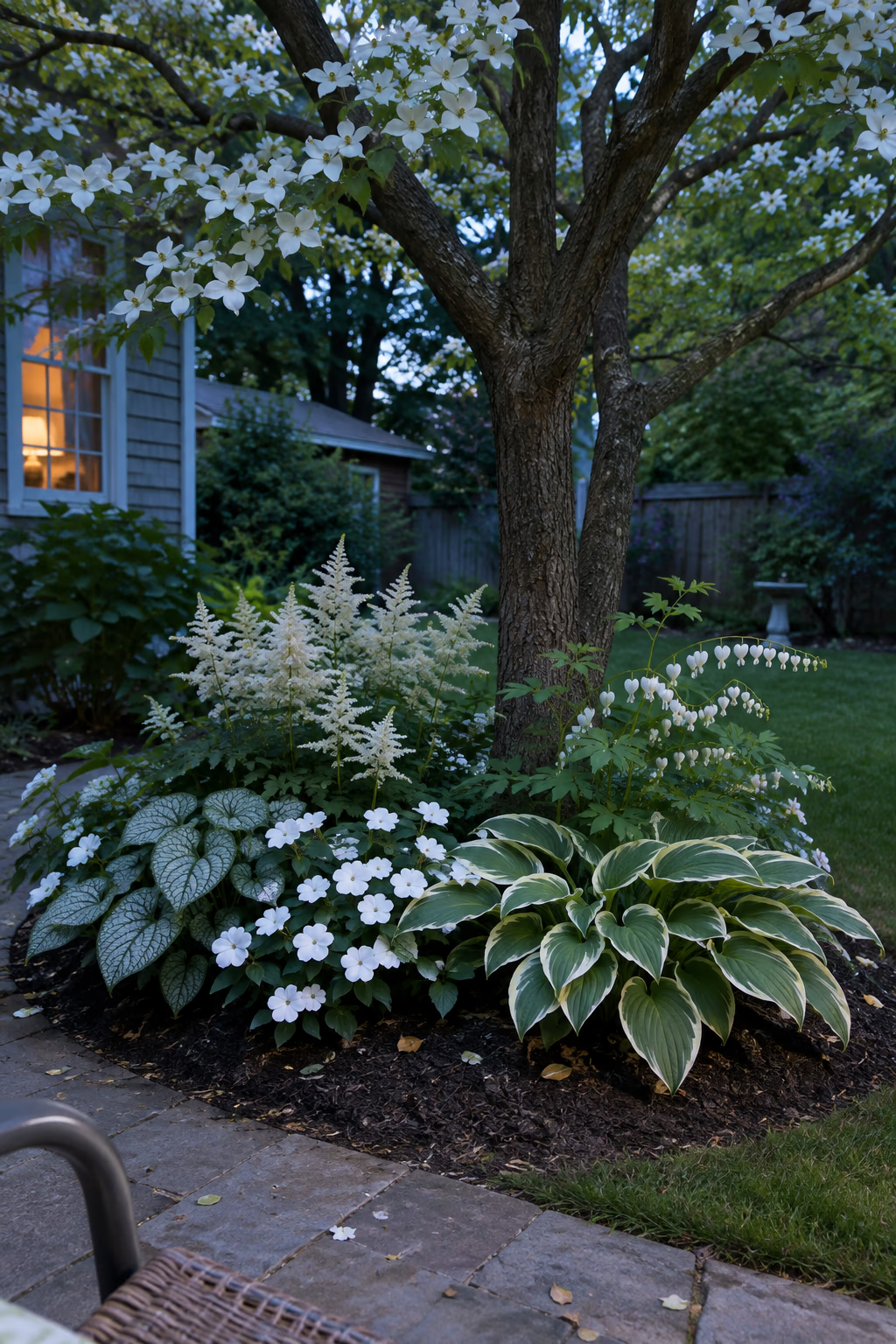
Pale blooms that light up dark corners
White and pale flowers stand out in shade far better than deep reds or purples, which tend to disappear. A one-color bed under a tree also fits the current interest in monochrome planting. Try white astilbe, white bleeding heart, sweet woodruff, white impatiens, and hostas with white-edged leaves.
Add silver foliage for depth, such as lungwort with spotted leaves or brunnera with silvery, heart-shaped leaves. The bed will look especially good at dusk, when pale flowers seem to glow.
White blooms show brown spots as they fade, so deadhead regularly. Choosing plants with white variegated foliage keeps the theme going even when nothing is in flower.
12. Layer an Oakleaf Hydrangea Beneath a Tall Canopy
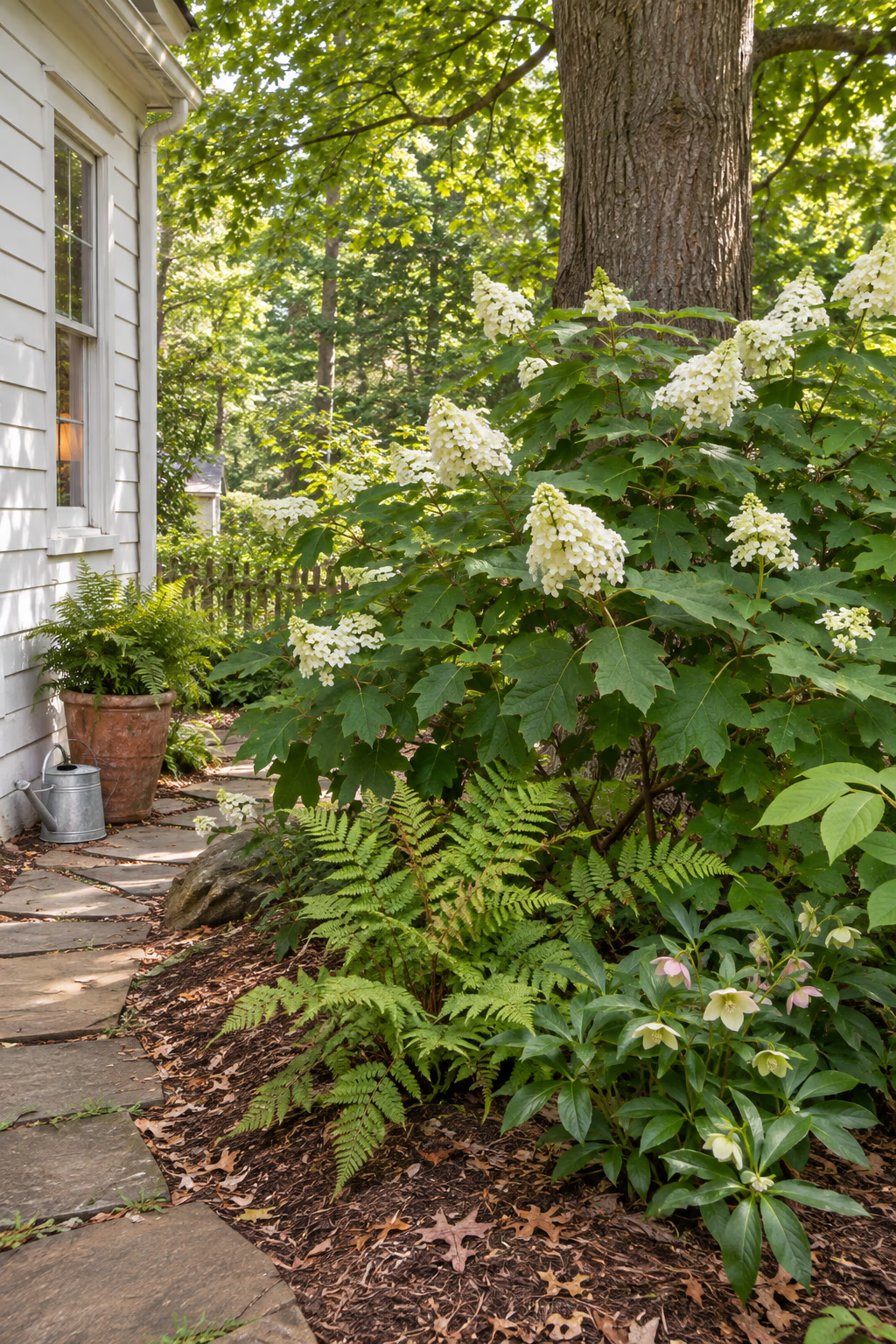
Shrub structure with four seasons of interest
Under a tall tree with high branches, a flowering shrub adds the middle layer that a bed of low plants lacks. Oakleaf hydrangea is a strong choice: native to the Southeast, hardy in roughly zones 5 to 9, with cone-shaped white flowers in summer, wine-red fall color, and peeling bark in winter.
Plant it toward the outer edge of the canopy rather than tight against the trunk, and dig the hole only as large as the root ball between major roots. Underplant with ferns or hellebores to finish the layered look.
Oakleaf hydrangea can reach 6 to 8 feet tall and wide, though compact varieties stay around 3 to 4 feet. Check the mature size before buying so the shrub won’t crowd the bed or a nearby walkway.
13. Brighten Summer Shade With Caladiums and Coleus
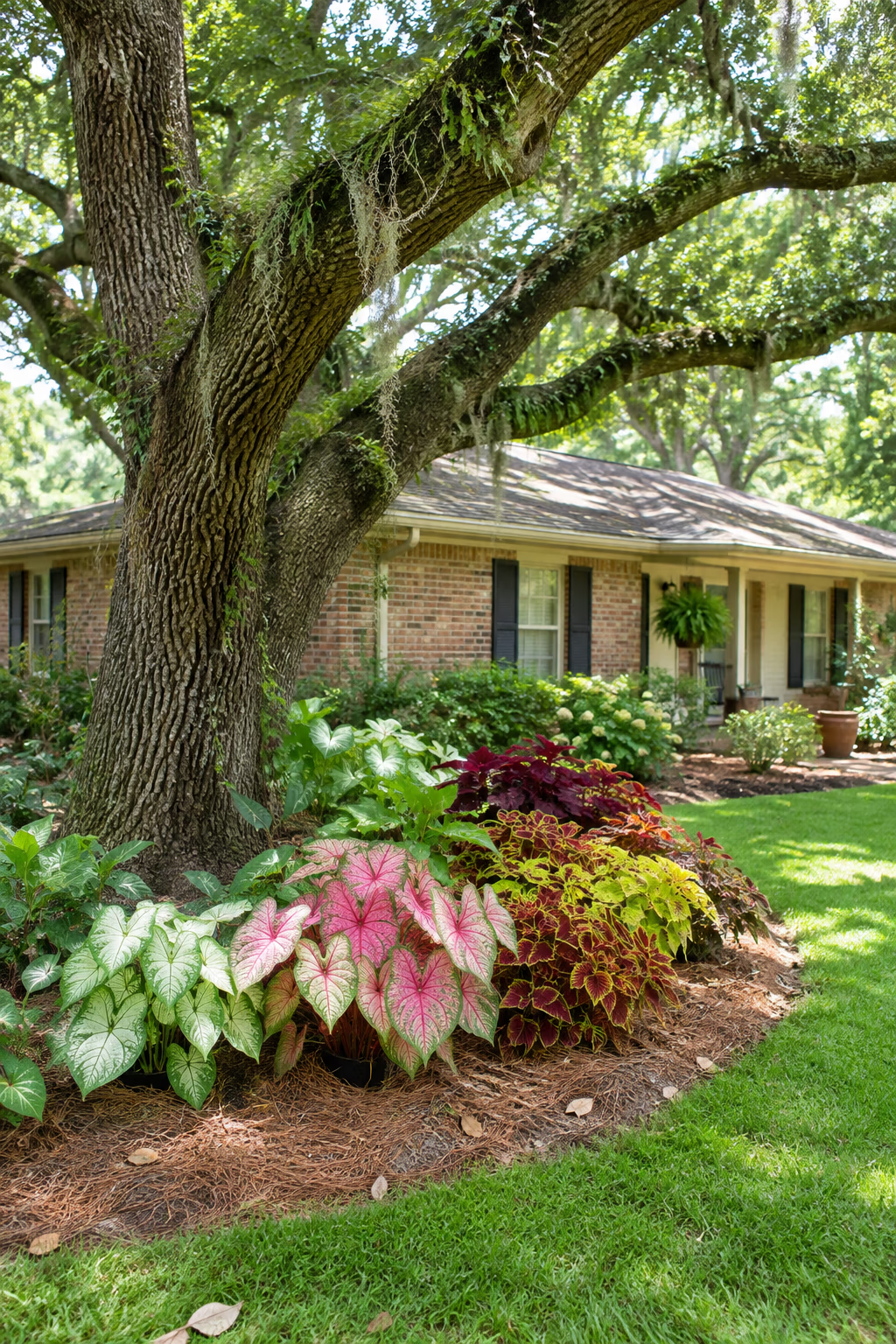
Leaves that are as bright as any flower
For pure summer drama, combine caladiums, with their huge heart-shaped leaves splashed in pink, red, and white, and coleus, available in shades from lime to burgundy. Both thrive in shade and keep their color from early summer until frost.
Plant caladium tubers or starter plants once the soil is warm, above about 65 degrees, and set coleus between them. Pinch the coleus flower spikes off as they form to keep the plants bushy and the leaves looking their best.
In most of the US, both are grown as annuals. Caladium tubers can be dug and stored indoors over winter, but many gardeners simply replant each year, so set aside a seasonal budget.
14. Carpet the Ground With a Flowering Groundcover
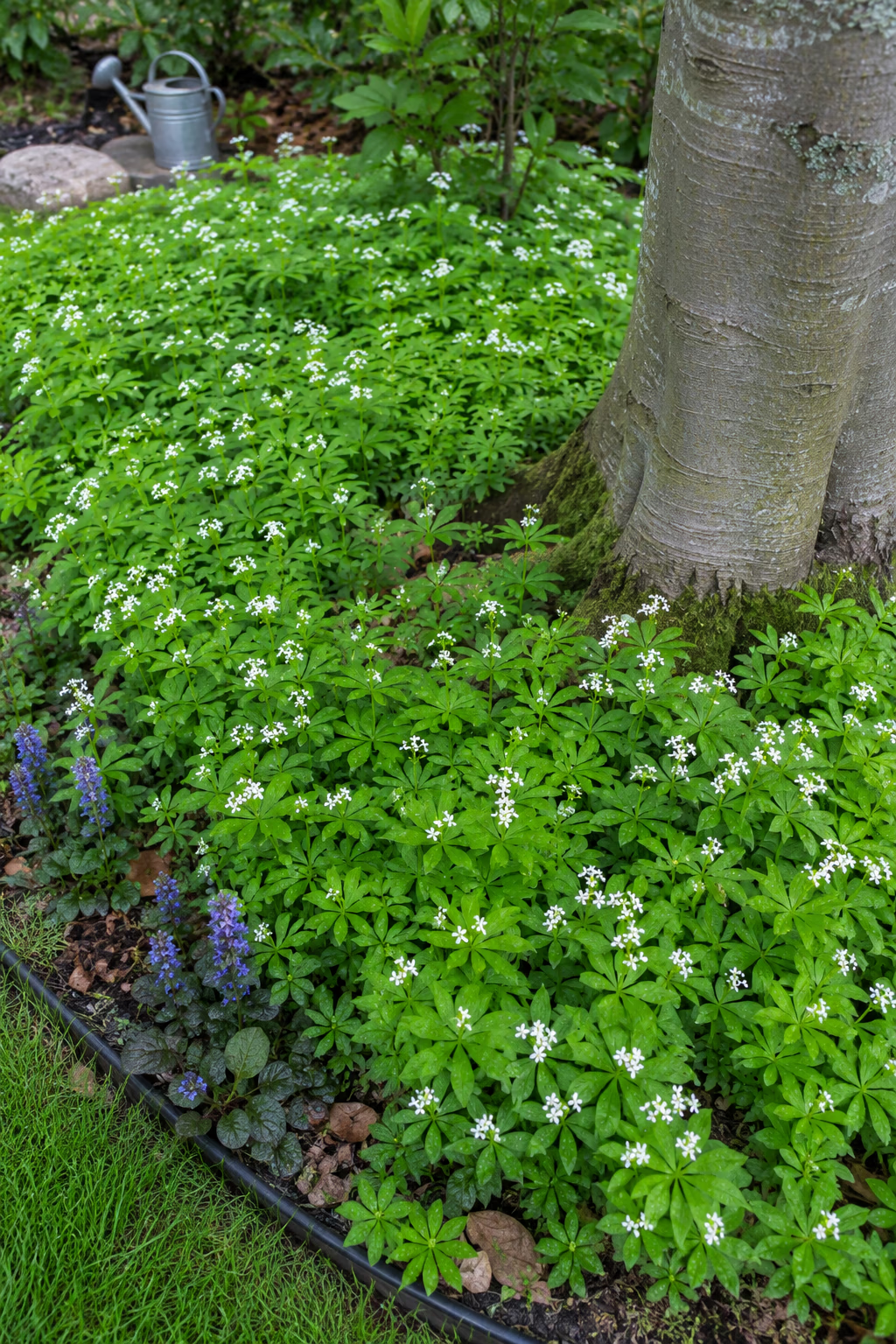
A living mulch instead of bare dirt
Where grass refuses to grow under a tree, a dense flowering groundcover can take over the whole circle. Sweet woodruff offers white spring flowers and a fresh green carpet, ajuga sends up blue spikes, and epimedium handles dry shade with dainty spring blooms.
Plant small plugs 8 to 12 inches apart in little holes dug with a hand trowel, mulch lightly between them, and water regularly through the first summer. Most groundcovers fill in completely within two seasons.
Some groundcovers spread aggressively. Keep sweet woodruff and ajuga in check with edging, and avoid English ivy and vinca, which are invasive in many regions and can climb or smother.
15. Set a Gravel Ring With Hardy Succulents Under Light Shade
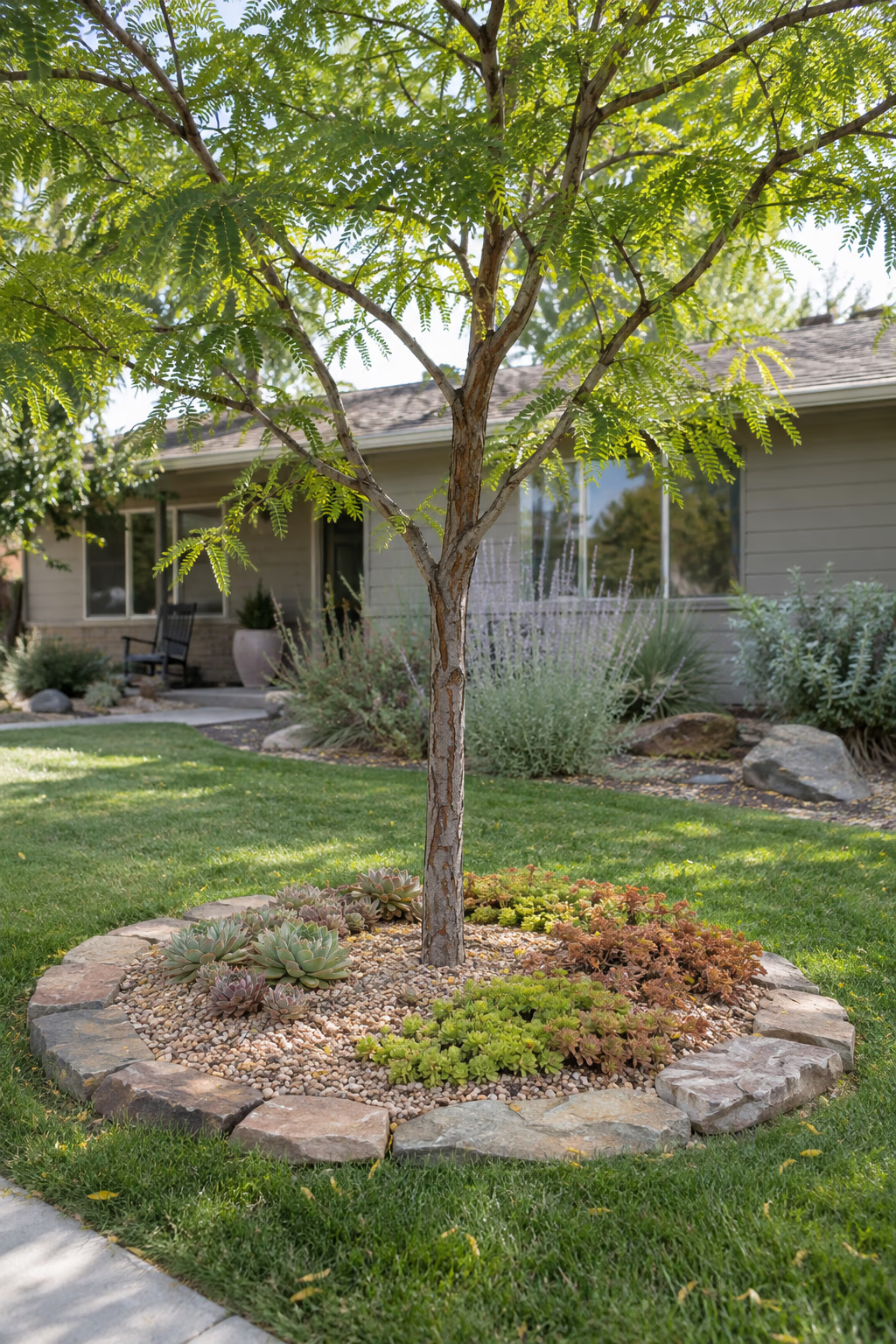
A low-water option for thin canopies
Trees with light, airy canopies, such as honeylocust, birch, or small ornamental trees, let enough sun through for tough succulents. Hens-and-chicks and low sedums tucked into a ring of pea gravel or small river rock make a tidy, drought-friendly bed.
Use gravel only 1 to 2 inches deep over the soil and keep it a few inches from the trunk. Plant the succulents in small pockets of gritty soil so their crowns sit just above the gravel.
Succulents rot if wet leaves pile on top of them. A quick pass with a leaf blower on low or a soft rake in fall keeps them healthy, and this idea won’t work under dense shade trees.
16. Light the Tree Bed With Low Path and Uplights
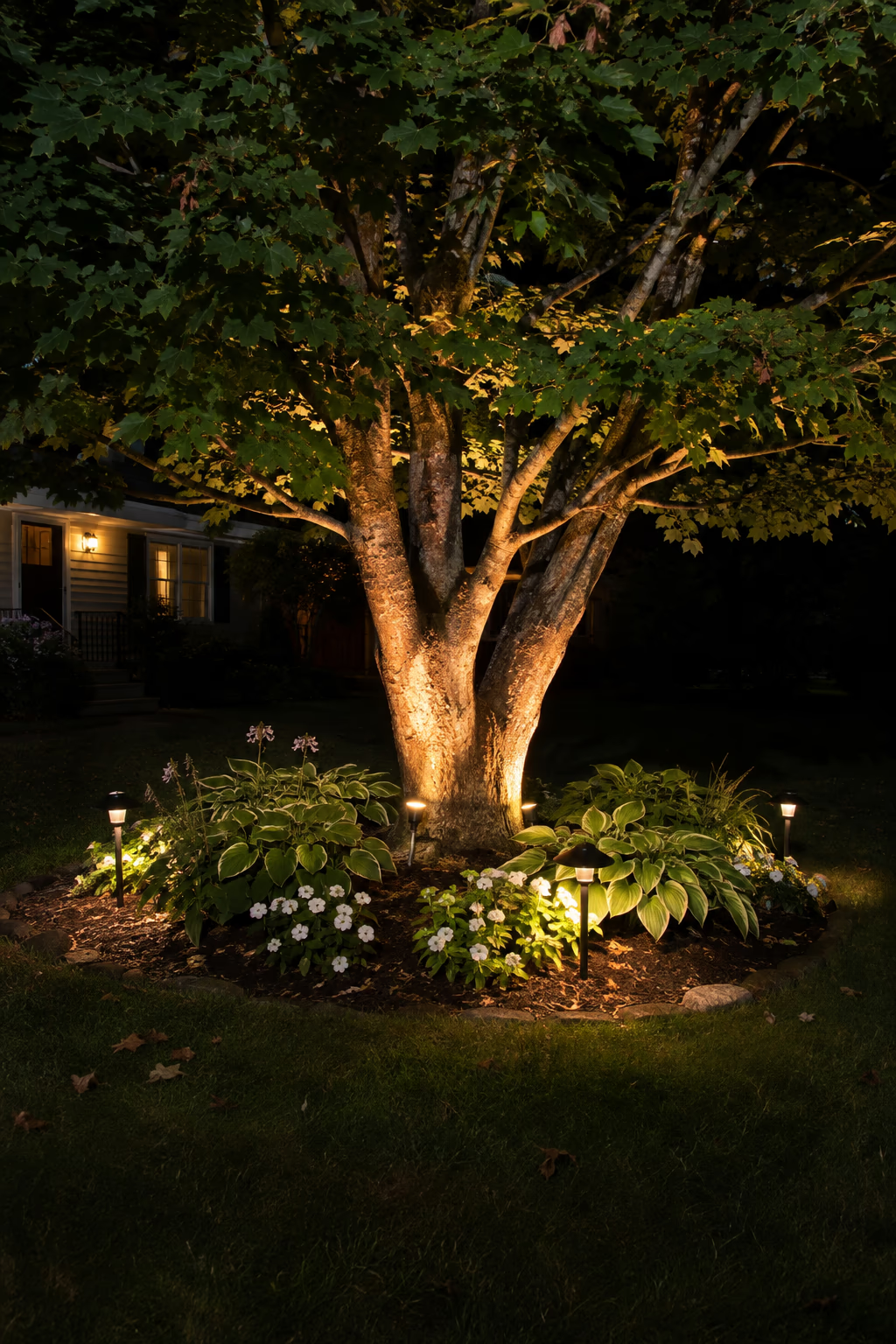
A night view of trunk and flowers
A couple of uplights aimed into the canopy show off branch structure after dark, while small path lights catch the flowers below. Warm white bulbs look the most natural and flatter both bark and blooms.
Low-voltage LED systems are a good fit because the cable runs in a shallow slit just under the mulch, which spares roots. Solar fixtures work only if their panels get direct sun, which is often lacking under a dense tree, so consider models with a separate panel you can place in the open.
Aim lights away from windows and neighboring homes. Some communities and HOAs have rules about outdoor lighting brightness, so check before you install anything powerful.
17. Lay Stepping Stones Through the Tree Bed
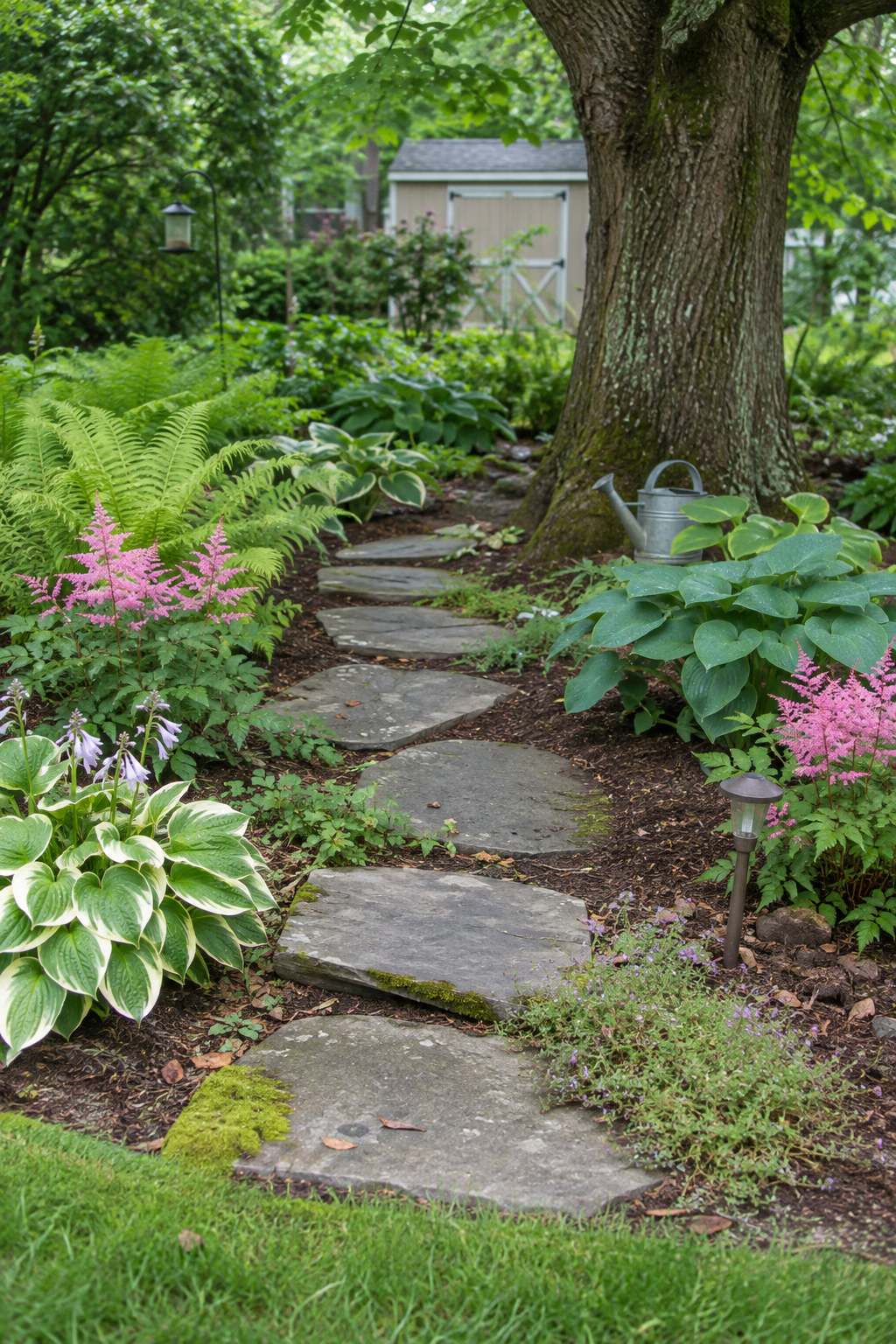
Easy access without trampled plants
A wide tree bed is easier to enjoy and maintain when you can walk into it. A short line of flat flagstone or concrete steppers lets you reach the trunk, prune, and pull weeds without compacting the soil over the roots.
Set the stones directly on the surface or in a bed of mulch rather than excavating for a gravel base. Space them about 24 inches apart, center to center, for a comfortable stride, and let low plants like creeping thyme or moss soften the edges in brighter spots.
Flat stones resting on roots can rock as the roots grow. Reset any wobbly ones each spring so they don’t become a tripping hazard.
18. Extend the Season With Toad Lilies and Japanese Anemones
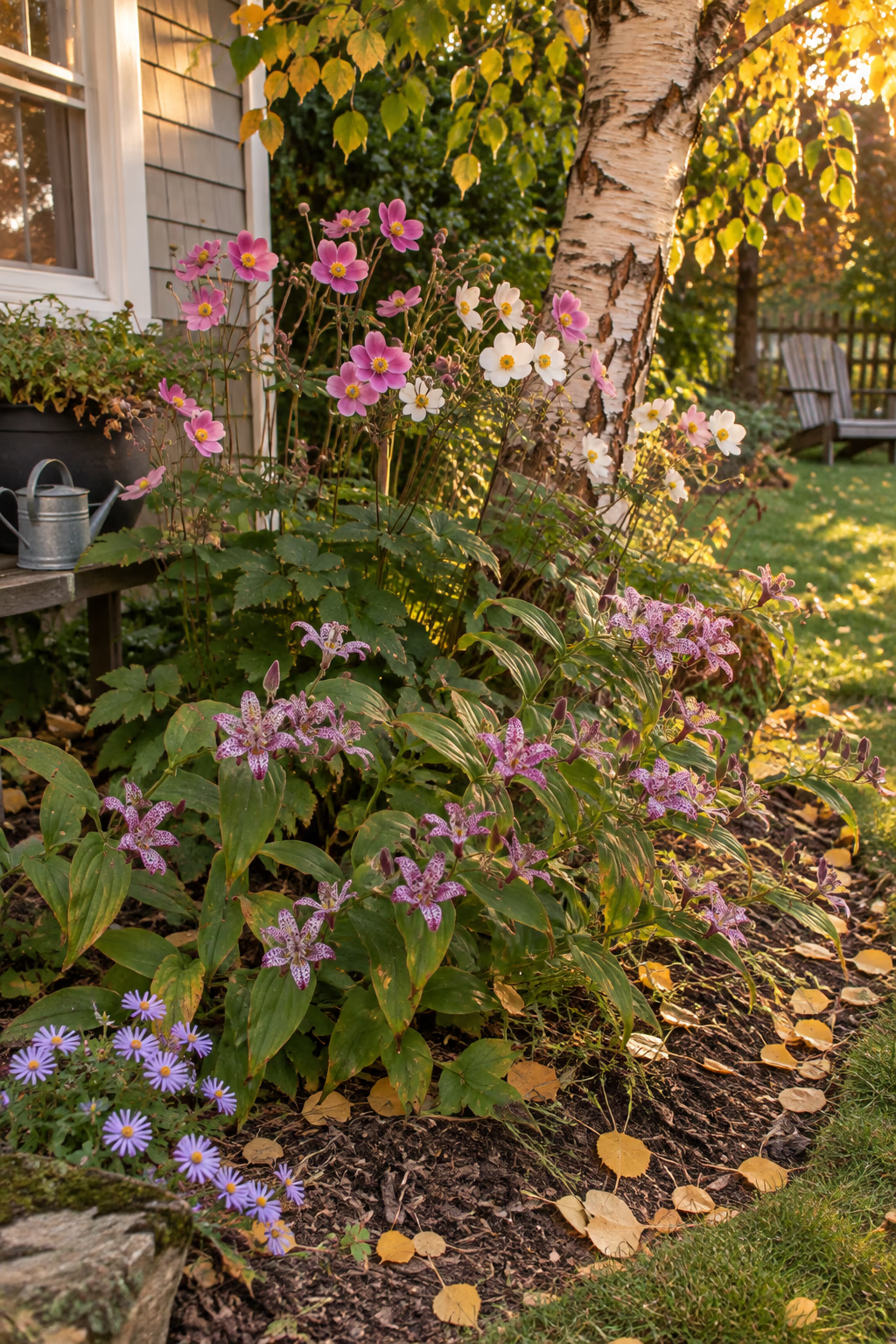
Late flowers when most shade gardens fade
Many shade plants bloom in spring and then rest. Toad lilies, with orchid-like speckled flowers, and Japanese anemones, with tall pink or white blooms on wiry stems, carry the bed into late summer and fall.
Plant toad lilies near the front where their small, intricate flowers can be seen up close, and set Japanese anemones behind them, since they can reach 3 feet or more. Add a few woodland asters at the brighter edge for extra fall color.
Japanese anemones spread steadily once established, which is great in a large tree bed but can crowd smaller neighbors. Toad lilies prefer moist soil, so mulch them well.
19. Dress Up a Curbside Tree Lawn With Tough Perennials
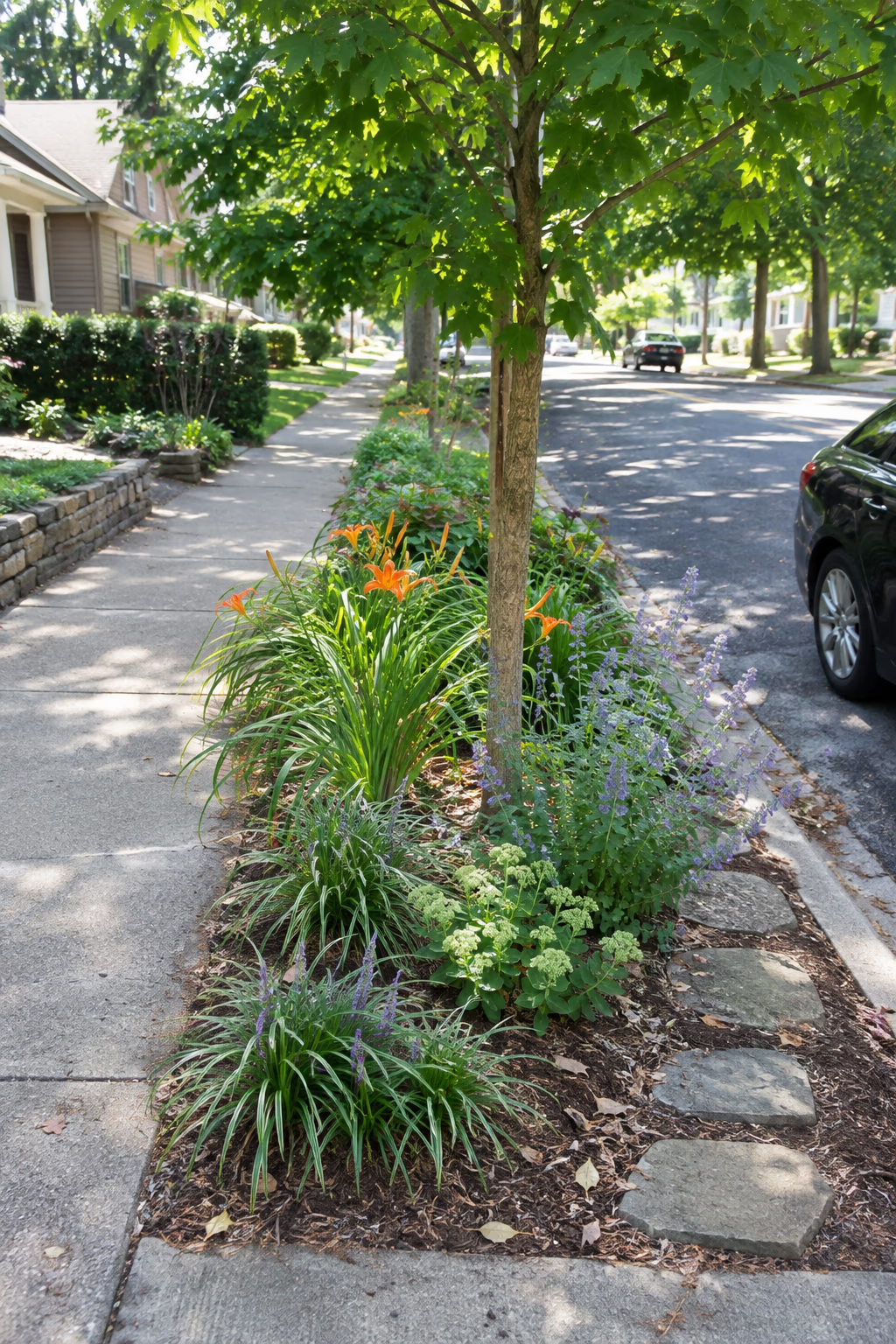
Curb appeal for the strip by the street
Street trees in the strip between the sidewalk and curb often sit in compacted, sun-baked soil that grass can’t handle. Tough, low perennials such as daylilies, catmint, liriope, and sedum can replace the thin turf and frame the trunk.
Keep plants under about 24 to 30 inches tall so drivers can see past them, and leave a mulched or stepping-stone strip where car doors open and people step out. Plant salt-tolerant species if your street gets salted in winter.
The strip is often owned by the city, and the tree may be city-owned as well. Check local rules or HOA guidelines before planting, and call 811 before digging because utility lines often run here.
20. Add a Birdbath as a Focal Point in the Tree Bed
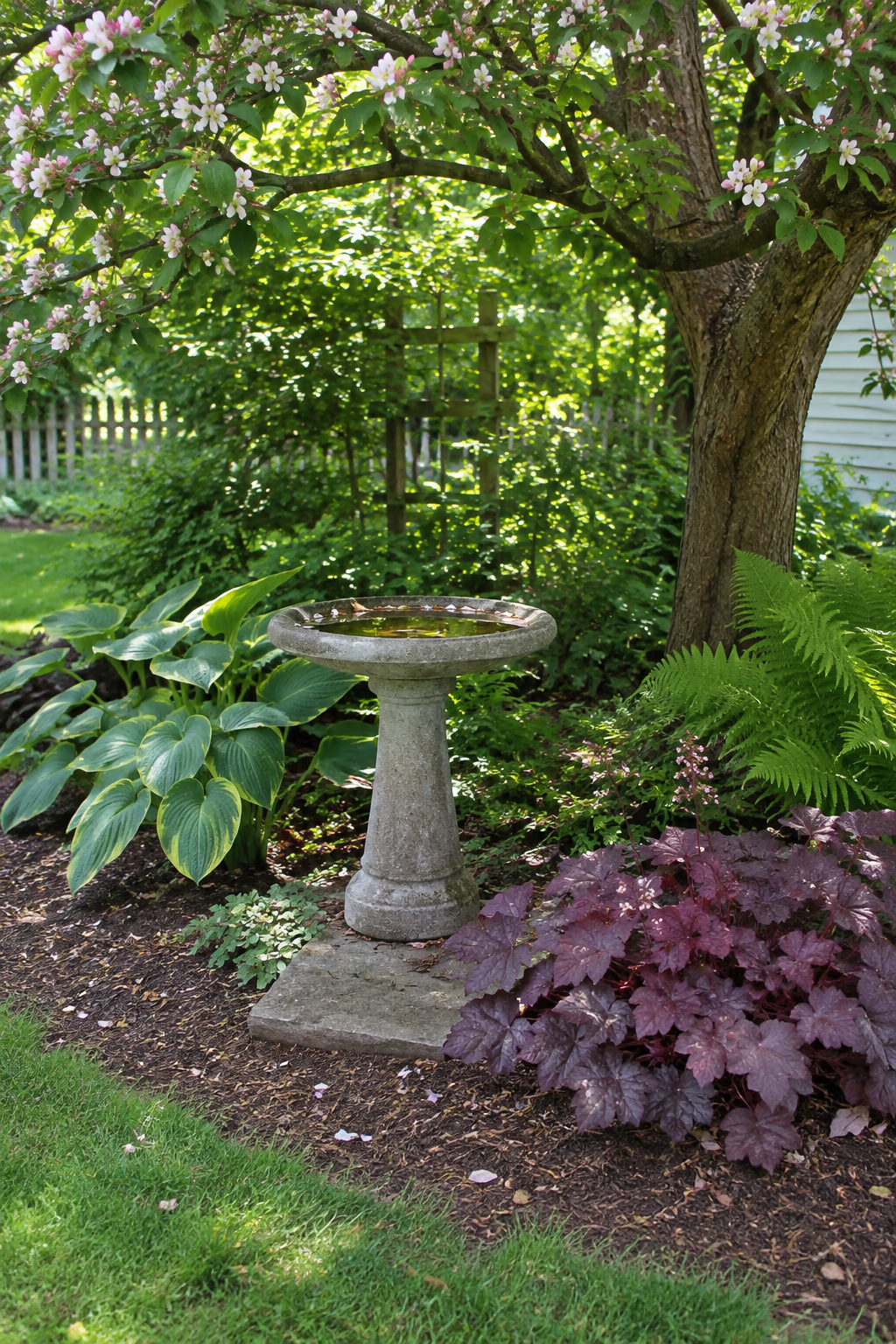
A shady stop for songbirds
Placing a pedestal birdbath at the edge of a tree bed gives the planting a focal point and puts water right where birds feel safe, near branches they can retreat to. Surround its base with low ferns, hostas, or coral bells.
Set the bath on a flat stepping stone so it stays level, a few feet out from the trunk rather than against it. A shallow basin, 1 to 2 inches deep with a gently sloping edge, suits most songbirds.
Shade keeps water cooler and slows algae, but falling leaves and seeds will dirty the basin faster. Scrub and refill it every few days, and more often in summer heat.
21. Plant Hellebores and Evergreen Ferns for Winter Interest
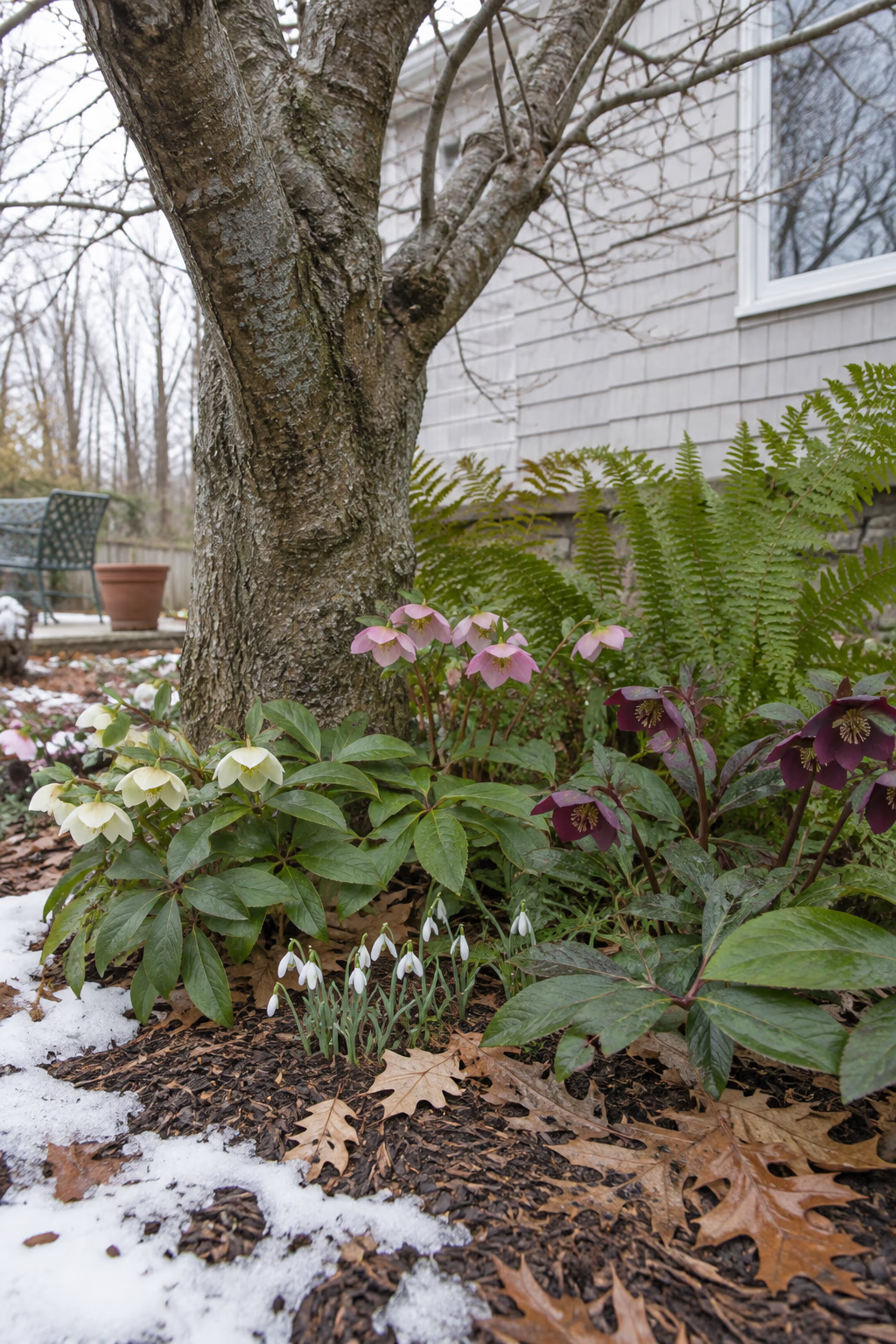
Green leaves and flowers in the cold months
A tree bed doesn’t have to look bare from November to March. Hellebores keep leathery evergreen leaves through most winters and bloom in late winter or very early spring in shades of white, pink, plum, and green. Christmas fern stays green all year in much of the eastern US.
Plant hellebores where you’ll see them from a window or walkway, since they flower when you’re spending little time outdoors. Pair them with the snowdrops or squill from earlier in this list for a bed that wakes up weeks ahead of the rest of the yard.
Hellebores are toxic if eaten, so keep that in mind around curious pets and children. Cut away tattered old leaves in late winter so the new flowers stand out clearly.
How to Plan a Flower Bed Around a Tree
The best tree beds are built with the tree’s roots in mind first and the flowers second. A little planning keeps both healthy for years.
- Find the root flare. Make sure the spot where the trunk widens into roots is visible above the soil, and never bury it with new soil or mulch.
- Skip raised beds and soil piles. Add no more than an inch or two of compost over the root zone, and keep mulch 2 to 3 inches deep in a flat ring that stays a few inches from the bark.
- Dig small pockets, not trenches. Use a hand trowel to plant between roots, avoid tilling, and never cut roots thicker than about an inch.
- Start with small plants. Plugs and quart-size pots need smaller holes than gallon containers, so they disturb fewer roots and often establish faster.
- Know your tree. Black walnut releases a compound that stunts many plants, and shallow-rooted maples and beeches make dense, dry shade, so choose tolerant plants for those trees.
- Water deeply and check for utilities. Give the bed slow, deep soakings during its first two summers rather than daily sprinkles, and call 811 before any digging in the United States.
Frequently Asked Questions
Will a flower bed hurt my tree?
Not if you build it carefully. Problems come from cutting large roots, tilling the soil, piling soil or mulch against the trunk, and compacting the ground with heavy equipment. A shallow bed of small plants set in individual holes is generally safe for established trees.
Can I build a raised bed around a tree?
It’s best to avoid it. Adding several inches of soil over roots limits the oxygen they receive, and soil against the bark encourages rot and disease. If you want a defined edge, set brick or stone at ground level and keep the bed close to the original grade.
What flowers grow best under trees?
Shade-tolerant plants do best, including hostas, ferns, astilbe, coral bells, hellebores, impatiens, begonias, brunnera, foamflower, and early spring bulbs. Toward the outer edge of the canopy, where more sun reaches, catmint, daylilies, and black-eyed Susans are good options.
How far from the trunk should I plant?
Leave a clear ring of at least 6 to 12 inches around the trunk with just a thin layer of mulch. Larger roots are concentrated near the trunk, so it’s easier to plant a foot or more away, where roots are smaller and spaced farther apart.
How often should I water plants under a tree?
New plants need regular watering for their first one or two summers because the tree competes for moisture and the canopy blocks some rain. A deep soak once or twice a week in dry weather is usually better than frequent light watering, and it benefits the tree too.
Final Thoughts
A flower bed around a tree can turn the most overlooked spot in your yard into one of its best features. A ring of hostas and ferns, a crisp brick edge, or a drift of spring bulbs is often all it takes to make the tree look intentional and well cared for.
Start with one idea, protect the roots, and add plants a few at a time as you learn how the light and moisture behave under your canopy. In a season or two, you’ll have a bed that looks settled and natural and a tree that stays healthy for years to come.


